










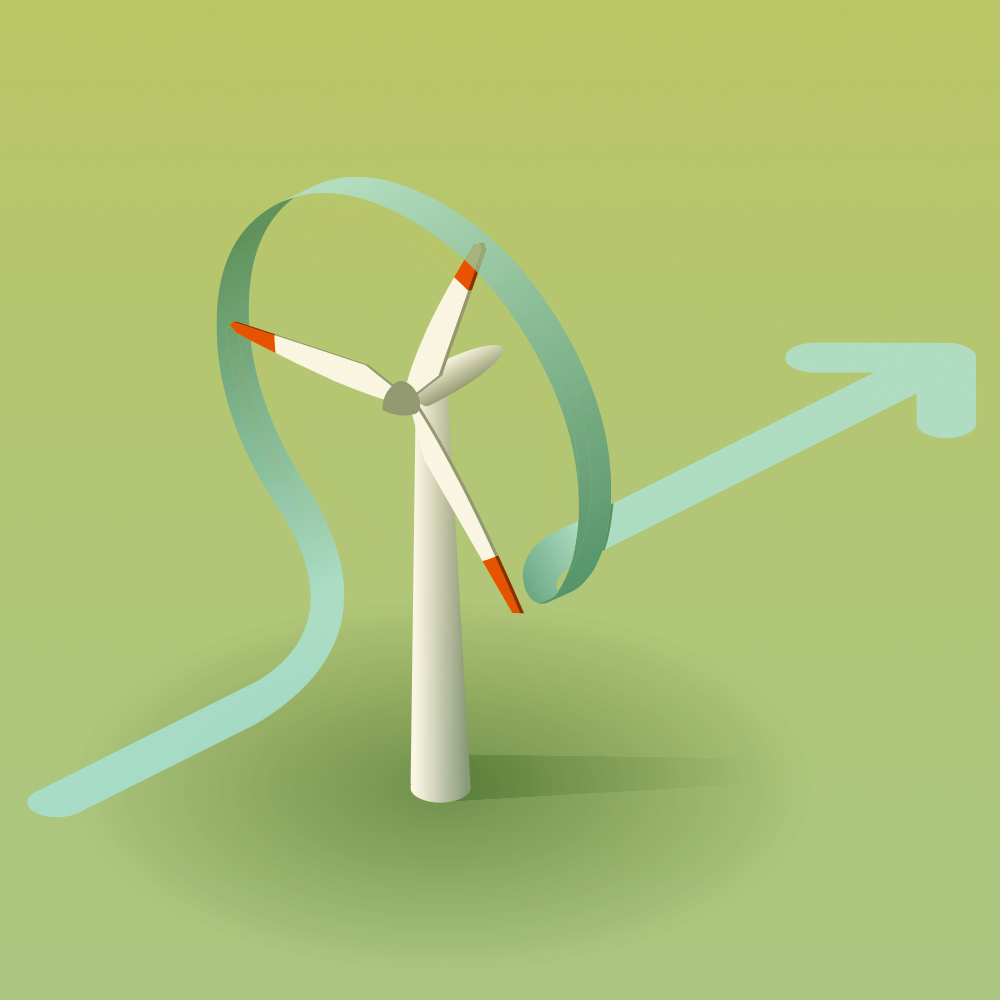
Most green power solutions seek to generate large amounts of electricity to meet demand in the fight against global warming. However, some projects aim to utilize more modest renewable energy sources to power sensors and wearables. We recently talked about nighttime solar power, but today it’s the turn of wind power with wind turbines operating in light breezes. Welcome to the world of electricity in small things, where the slightest vibration powers your device.
A wind harvester who loved the breeze
The world’s largest wind turbines can reach heights of 850 feet and their electrical output is measured in megawatts. A prototype presented by scientists at the Nanyang Technological University (NTU) in Singapore pales in comparison. It is 6 inches tall and 8 inches wide and produces 290 microwatts.But what makes it so special?
First, the Singapore prototype operates in light winds of just 2 meters per second.it is equivalent 2 on the Beaufort scale, a rating that measures wind strength based on observable effects. In plain English, it’s the bare minimum to feel a breeze in your face.
Second, just like the bladeless wind turbine we just talked about, the Singapore prototype is based on similar technology. Instead of using a turbine, it relies on material vibration.
The device consists of low-cost parts made of copper, aluminum, and Teflon, and an epoxy fiber body. The mechanism converts the vibrations into electric current, with long aluminum foil vibrating in the breeze like a trampoline. This vibration causes a charge transfer from the aluminum foil to the copper foil, creating the triboelectric effect.
The researchers found that the prototype produced enough energy to light up 40 LED bulbs in the lab with a wind of 4 meters per second. Powers the heat sensor and wirelessly transmits data to your phoneThe device has a rechargeable battery that stores energy when the air is still.
urban and rural applications
The new wind harvester is designed for the age of sensors and IoT devices, which will grow exponentially and communicate instantly thanks to 5G technology. One of the first applications devised by NTU scientists is powering sensors installed on the facade of buildings in environments such as the suburbs of Singapore, where winds often blow at speeds of less than 2.5 m/s. is to
These sensors are Measure aspects such as structure temperature and health, air quality, and wind strength, among other parameters. And not only in cities. The device does not contain heavy metals or toxic substances, making it ideal for use in sensors installed in forests to warn of hazards such as wildfires. Even if the equipment reaches the end of its service life, it will not adversely affect the forest.
Trillion Sensor Challenge
In the development of IoT, the concept of a trillion sensor system is applied to a network containing millions of interconnected devices. From an ecological and logistical point of view, it would be a nightmare if they were all powered by batteries, as they would have to be recharged or replaced regularly. The key to meeting this challenge is to employ techniques that harvest the energy of each sensor. And it’s done in a reproducible way.
In this sense, one of the fundamental breakthroughs is the triboelectric nanogenerator (TENG), which is usually made of organic materials. The first version of these electrical systems, unveiled in 2012, are devices that can generate energy by converting vibration or mechanical pressure into electricity.
One of the latest examples of this technology comes from China.A scientist from Fuzhou University announced New version of TENG Called CS-TENG, it has demonstrated the ability to harness the wind, even at velocities of 2.3 m/s, to power water quality sensors.
To discover the full potential of renewable energy like this, subscribe to our newsletter at the bottom of this page.
sauce:
