











Detonation can save a lot more fuel than combustion if the engine can withstand it. NASA believes that a rotating detonation engine could be the future of deep space travel, with excellent results in prototype tests.
Combustion engines are proven, and no matter how angry they look in the highest-fueled dragsters and space rocket boosters, the combustion process of oxidizing fuel in air is relatively slow and predictable. Explosions, on the other hand, are as chaotic and destructive as they sound. This is how most bombs work. Taking an explosive fuel and subjecting it to an energy shock breaks the chemical bonds that hold each molecule together, releasing an enormous amount of energy in a shock wave that expands at supersonic speeds.
NASA, like many other groups, wants to take advantage of these explosions for several main reasons. First, detonation engines have a much higher theoretical efficiency level than combustion engines, perhaps 25% or so. It should be able to produce more thrust using less fuel and a smaller rocket. In spaceflight engineering and economics, this means cheaper launches, more chargeable payloads, and longer ranges.
They are also relevant for hypersonic flight. Combustion engines can only operate at subsonic airspeeds. To go supersonic or hypersonic, the intake air must be rapidly decelerated to subsonic speed and burned. This creates heat and drag. The detonation occurs at supersonic speeds, which not only increases efficiency, but also reduces heat and drag in hypersonic applications, as the air hardly needs to be slowed down.
A rotating detonation engine (RDE) uses a ring-shaped chamber and precisely timed fuel injection to produce constant thrust, in contrast to oblique wave and pulse detonation engines. Each explosion creates a shock wave that creates thrust, but moves around the ring causing the next explosion.
A number of groups are currently working on test launches of rotary detonation engines, from the University of Central Florida working with the Air Force Research Laboratory, to RMIT in Australia working with DefendTex, Venus Aerospace, a Houston company, and Aerojet Rocketdyne. reporting success. .. Jaxa, the Japanese space agency, has gone as far as testing a small one in space.
NASA
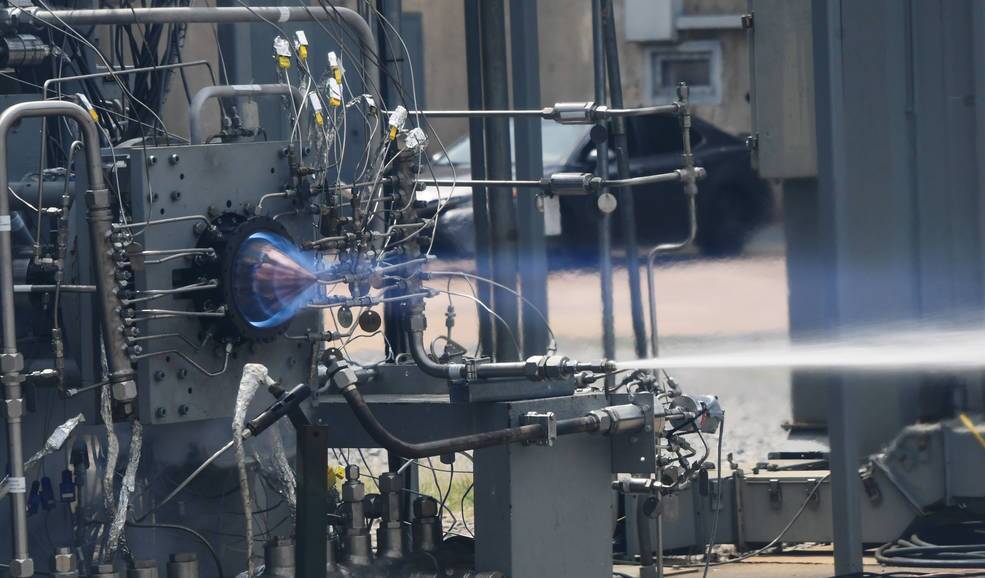
NASA has continued to test on the ground for the time being, but last year it announced that it had successfully tested a small RDE in collaboration with Indiana company In Space LLE. The engine fired “more than a dozen times for a total of nearly 10 minutes,” so it’s clear that it handled a major RDE development challenge: keeping the engine from blowing up.
The engine is built using powder bed fusion 3D printing incorporating NASA’s proprietary GRCop-42 copper alloy. This is key to its ability to withstand the extreme conditions of sustained explosions without overheating, the agency said.
At full speed, the RDE “produced over 4,000 pounds of thrust for nearly one minute at an average chamber pressure of 622 pounds per square inch, the highest ever pressure rating for this design,” according to NASA. The tests included “successful performance of both deep throttle and internal ignition.”
With promising results, NASA announced a scale-up to a fully reusable RDE in the 10,000-pound thrust class. The team hopes to be able to perform better than a normal rocket engine. You can see this object catch fire in the video below.
Rotating Detonation Rocket Engine Test at Marshall Space Flight Center
Source: NASA
