












Why is data leak detection so important?
Ransomware and data theft used to extort companies around the world is on the rise. At the same time, the industry is facing a number of critical vulnerabilities in database software and corporate websites. This evolution paints a dire picture of data leaks and leaks that every security he leader and team grapples with. This article focuses on this challenge and discusses the benefits that machine learning algorithms and network detection and response (NDR) approaches bring.
Data exfiltration often serves as the final act of a cyberattack, providing the last chance to detect a breach before the data is exposed or used for nefarious activities such as espionage. However, data breaches are not just the aftermath of cyberattacks, they can also be the result of human error. Preventing data exfiltration through security controls would be ideal, but the increased infrastructure complexity and distribution associated with the integration of legacy devices makes prevention a daunting task. In such scenarios, detection acts as the ultimate safety net. Certainly, it’s better late than never.
Addressing the Challenge of Detecting Data Leaks
Attackers can exploit numerous security gaps to collect and exfiltrate data using protocols such as DNS, HTTP(S), FTP, and SMB. The MITER ATT&CK framework describes many such exfiltration attack patterns. However, keeping up with all protocol and infrastructure changes is a daunting task and complicates integration for holistic security monitoring. What you need is device- or network-specific, volume-based analysis of relevant thresholds.
This is where Network Detection & Response (NDR) technology comes into play. ML-driven NDR enables critical network monitoring by providing two key properties:
-
These allow viable monitoring of all relevant network communications, which is the basis for comprehensive data breach monitoring. This includes internal communication as well as interactions inside and outside the system. Some attack groups directly exfiltrate data, while others use dedicated internal exfiltration hosts.
-
Machine learning algorithms help context-specific learning of different thresholds for different devices and networks, which is important in today’s diverse infrastructure environment.
Machine learning decoding for data leak detection
Prior to the introduction of machine learning, thresholds for specific networks or clients were set manually. As a result, alerts were triggered when a device sent data outside the network that exceeded a certain threshold. However, machine learning algorithms have provided some advantages in detecting data leaks.
-
It provides an essential baseline for anomaly detection by learning network traffic communication and client and server upload/download behavior.
-
Set appropriate thresholds for different clients, servers, and networks. Otherwise, defining and maintaining these thresholds for each network or client group becomes a tedious task.
-
Recognize changes in learned volume profiles to detect outliers and suspicious data exchanges between internal or internal systems and external systems.
-
Employ a scoring mechanism to quantify outliers, correlate data with other systems, and generate alerts on identified anomalies.
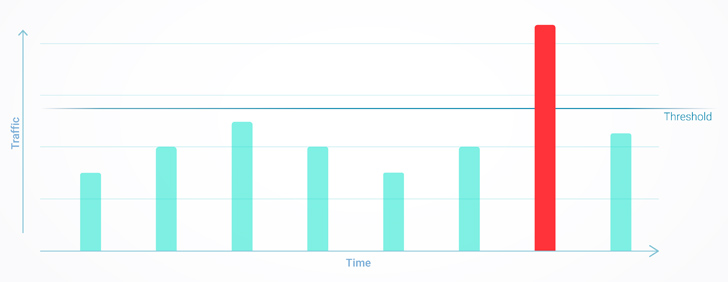 |
| Visualization: Alerts are triggered when traffic volume exceeds certain thresholds determined by learned profiles. |
Responding to ML-Driven Network Detection and Rescue
Network detection and response (NDR) The solution provides a comprehensive and insightful way to detect unusual network activity or unexpected spikes in data transmission. These solutions leverage machine learning (ML) to establish network communication baselines and facilitate rapid identification of outliers. This is true for both volume analysis and covert channels. Through this forward-thinking and proactive attitude, NDR can often detect the first signs of an intrusion well before a data breach occurs.
One of the NDR solutions is characterized by accurate data volume monitoring. Exion Trace. This Swiss NDR system, powered by award-winning ML algorithms, passively inspects and analyzes network traffic in real time to identify potentially dangerous or unauthorized data movements. Additionally, ExeonTrace seamlessly integrates with your existing infrastructure, eliminating the need for additional hardware agents. The benefits of ExeonTrace extend beyond just security, helping you understand normal and abnormal network behavior, a key factor in establishing a robust and efficient security posture.
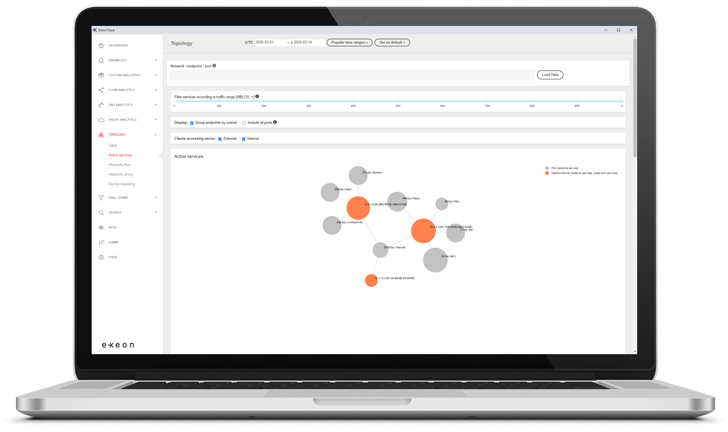 |
| ExeonTrace Platform: Data Volume Outlier Detection |
important point
In today’s digital environment, networks continue to expand and vulnerabilities increase. As a result, effective data breach detection becomes essential. However, due to the complexity of modern networks, manually setting thresholds for outlier detection can be not only cumbersome, but virtually impossible. Through volume-based detection and traffic behavior monitoring, you can identify data exfiltration and pinpoint anomalous changes in data volume and upload/download traffic patterns. This is where the power of machine learning (ML) in network detection and response (NDR) systems lies. It automatically identifies infrastructure-specific thresholds and outliers.
Among these NDR solutions, ExeonTrace stands out, providing comprehensive network visibility, effective anomaly detection, and an enhanced security posture. These features ensure that your business operations run safely and efficiently. request a demo Learn how to leverage ML-driven NDRs to detect data breaches and anomalous network behavior in your organization.
