









Bites (noun): more meaty news to sink your teeth into.
Barks (noun): peripheral noise worth your attention.
Want to have your doggie(s) featured in one of our future Barks & Bites Columns? Send your dogs photo(s) along with their name, breed (if you know it) and their age to [email protected]. All photos will be added to the IPWatchdog Dog Wall at IPWatchdog Studios and will be added to the queue of images we select from each week.
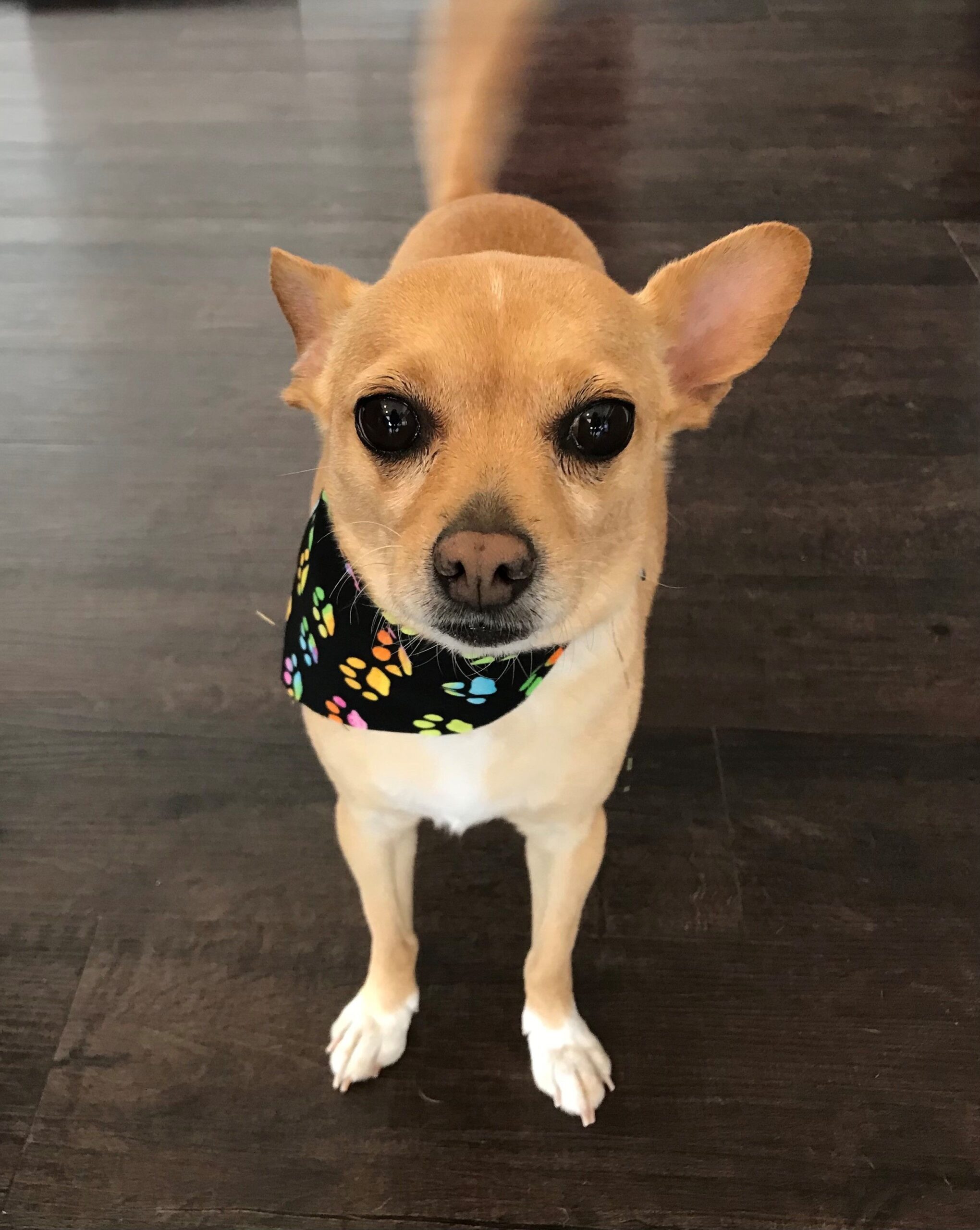
Erin Dunston’s rescue Chihuahua Mix – Toby with Kerchief
This week in Other Barks & Bites: Senators Hirono and Blackburn join the bipartisan collection of lawmakers supporting the current version of Section 101 legislative reform; the Federal Circuit clarifies that nexus does not need to be proved for specific patent claims-at-issue when licensing agreements involving their patents are entered as evidence; Advocate General Kokott recommends that the Court of Justice for the European Union dismiss Google’s appeal of €4.124 billion in antitrust fines levied for the corporation’s bundling and anti-fragmentation practices; and more.
Bites
AG Kokott Tells CJEU to Dismiss Google’s Appeal of €4.124 Billion Antitrust Fine – On Thursday, June 19, Advocate General Julianne Kokott issued an opinion proposing that the Court of Justice for the European Union (CJEU) dismiss Internet services giant Google’s appeal of the €4.124 billion antitrust fine set by the General Court of the European Union, slightly less than the original fine imposed by the European Commission for Google’s violation of EU antitrust laws through bundling, anti-fragmentation and revenue sharing practices. In so finding, AG Kokott remarked that “[i]t is not realistic, in the present case, to compare the situation of Google with that of a hypothetical as-efficient competitor,” noting that Google’s dominant position in several parts of the Android ecosystem allowed it to benefit from network effects to push traffic toward Google Search.
EPO’s Enlarged BoA Says Descriptions, Drawings Are Always Part of Patentability Inquiry – On Wednesday, June 18, the Enlarged Board of Appeal (BoA) of the European Patent Office (EPO) issued a ruling hailed by some followers as a landmark decision in European patent law impacting how patent claims are to be assessed when patentability issues are being determined during examination and opposition proceedings. In deciding how the BoA is to interpret patent claims when conducting patentability inquiries, the Enlarged BoA held that the patent’s description and drawings are always to be considered when interpreting patent claims, not only when disputed claim terms are unclear or ambiguous.
Recentive Rehearing Brief Tells CAFC That Section 101 Inquiry is Not a Prior Art Search – On Wednesday, June 18, predictive analytics firm Recentive Analytics filed a combined petition for panel rehearing and rehearing en banc at the U.S. Court of Appeals for the Federal Circuit challenging the appellate court’s panel decision this April invalidating Recentive’s patent claims to methods using machine learning models according to specified rules to generate network maps and event broadcast schedules that could not have been generated by the prior art. Recentive argues that the Federal Circuit panel decision improperly combined the novelty inquiry under 35 U.S.C. § 102, which sometimes overlaps with questions about conventional, routine or well-understood technologies at Step 2 of the 35 U.S.C. § 101 inquiry under the Alice/Mayo framework, with Step 1 of the Alice/Mayo test, which Recentive argues is a threshold test and not a prior art search, in finding that Recentive’s patent claims were directed to the abstract idea of generating maps and schedules using established machine learning models.
Judge Desai Dissents From Ninth Circuit’s Reversal of Photo Copyright Claims Against Walmart – On Wednesday, June 18, the U.S. Court of Appeals for the Ninth Circuit issued an unpublished decision in Russell v. Walmart Inc. affirming the Central District of California’s jury verdict finding Walmart liable for infringement over the sale of lamps copyrighted by interior designer Roxana Towry Russell but reversing the jury’s finding that online listings to those lamps on Walmart.com infringed Russell’s copyright in photos of the lamp. Circuit Judge Roopali Desai dissented on the reversal of infringement over the online listings, finding that Russell presented substantial evidence that Walmart posted the listings containing the photographs and faulted the majority for reweighing testimony in Walmart’s favor for witnesses who were repeatedly impeached at trial by Russell.
Senators Blackburn, Hirono Join Tillis, Coons as PERA Co-Sponsors – On Tuesday, June 17, Senators Marsha Blackburn (R-TN) and Mazie Hirono (D-HI) officially joined as co-sponsors to the Patent Eligibility Restoration Act (PERA) of 2025. Originally co-sponsored by Senators Thom Tillis (R-NC) and Chris Coons (D-DE), and introduced into the House of Representatives by Reps. Kevin Kiley (R-CA) and Scott Peters (D-CA), the bill would clarify subject matter eligibility under Section 101 with slight variations to this year’s version of the bill involving patents on human genes, with PERA 2025 excluding language from previous versions indicating that isolated human genes could be patented.
CAFC Reverses $300 Million Verdict After Finding Apple’s Seventh Amendment Rights Violated – On Monday, June 16, the Federal Circuit issued a precedential decision in Optis Cellular Technology, LLC v. Apple, Inc. reversing a $300 million damages verdict for mobile wireless developer Optis after finding that model jury instructions used by the Eastern District of Texas did not properly separate the infringement liability question on a patent-by-patent basis, leaving Apple open to infringement liability for all patents even if jurors were not in unanimous agreement as to which Optis patents were infringed. The Federal Circuit also reversed summary judgment rulings affirming subject matter eligibility under Section 101 for a pair of asserted patent claims and finding that other Optis patent claims did not invoke means-plus-function analysis under 35 U.S.C. § 112(6).
CAFC Clarifies Nexus Standard for Licensing Agreements as Secondary Considerations – On Monday, June 16, the Federal Circuit issued a precedential decision in Ancora Technologies, Inc. v. Roku, Inc. vacating the Patent Trial and Appeal Board’s (PTAB) invalidation of Ancora’s patent claims for restricting unauthorized use of licensed software programs. While the Federal Circuit agreed with the PTAB’s claim construction and obviousness findings, the appellate court found that the Board applied too exacting a standard for finding a nexus between Ancora’s patent license agreements and its challenged claims, clarifying that “[l]icenses to the challenged patent then, unlike products or other forms of objective evidence of nonobviousness, do not require a nexus with respect to the specific claims at issue, nor does our nexus law require that a particular patent be the only patent being licensed or the sole motivation for entering into a license.”
Barks
EPO Announces Six CodeFest Finalists Advancing Sustainability Through Patent Data – On Wednesday, June 18, the European Patent Office (EPO) announced six finalists for the agency’s CodeFest 2025 competition, which challenged entrants to create automated systems for classifying patent data to accelerate sustainability-focused innovation, with the winner to be announced during a virtual ceremony on July 3.
U.S./French Citizen Wins World Builders Category in EPO Young Inventors Prize – On Wednesday, June 18, the EPO announced three special recognitions among the ten inventors or teams aged 30 or younger honored as winners of the 2025 Young Inventors Prize, including dual U.S./French citizen Marie Perrin who was selected as a World Builder for her work in recycling rare earth elements from electronic waste.
ITC Institutes Section 337 Investigation Into D-Link, Linksys Wi-Fi Routers – On Tuesday, June 17, the U.S. International Trade Decision issued a notice announcing that the agency had instituted an investigation pursuant to 19 U.S.C. § 1337 into certain Wi-Fi routers and mesh Wi-Fi network devices imported into the U.S. for sale by D-Link, Linksys and ASUS based on a complaint for patent infringement by Delaware-based home security network developer Estelgia.
USPTO Extends Info Collection on Madrid Protocol Applications by 30 Days – On Tuesday, June 17, the U.S. Patent and Trademark Office announced in the Federal Register that the agency would be extending by 30 days its period for soliciting public feedback regarding the information collected by the USPTO in applications for international trademark applications filed under the Madrid Protocol.
WNBA’s Angel Reese Files Application for “MEBOUNDS” Trademark – On Saturday, June 14, Angel Reese, Forward for the Chicago Sky of the Women’s National Basketball Association (WNBA), filed a trademark application with the USPTO for the standard character mark “MEBOUNDS,” which news reports indicate is a term used by critics of Reese who point out that many rebounds collected by the WNBA’s single-season record holder for that statistic come from her own missed shots.
Novo Nordisk Reportedly Loses Canadian Patent Protection for Semaglutide – Last week, Science reported that, based on data available through the Canadian Patent Database, Danish pharmaceutical company Novo Nordisk did not pay maintenance payments for Canadian patent rights to semaglutide, the anti-diabetic medication used in blockbuster obesity drugs like Wegovy, leading Sandoz and other pharmaceutical firms to consider entering the Canadian market with a generic form of semaglutide by the mid-2020s.
This Week on Wall Street
Accenture to Combine Several Services With Increased AI Adoption – On Friday, June 20, global professional services company Accenture reported earnings for the third quarter of 2025, showing a year-over-year increase on revenue compared to the same quarter in 2024 despite declines in the company’s number of bookings in the recent quarter. Corporate guidance indicated that the company will be merging several services into a single product as part of the company’s adoption of artificial intelligence technologies.
Quarterly Earnings – The following firms identified among the IPO’s Top 300 Patent Recipients for 2024 are announcing quarterly earnings next week (2023 rank in parentheses):
- Monday: None
- Tuesday: None
- Wednesday: Micron Technology Inc. (16th)
- Thursday: Nike, Inc. (104th)
- Friday: None
