








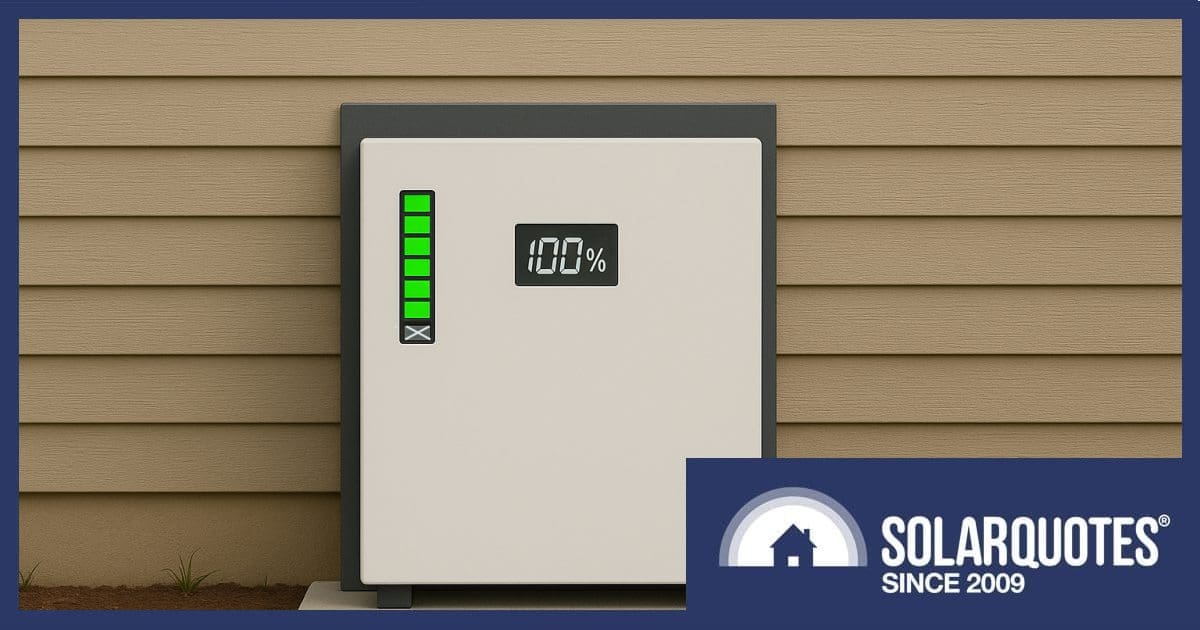
Failing to understand jargon like the difference between ‘nominal’ and ‘useable’ capacity can leave homeowners with less battery storage than expected and even disqualify their batteries from the federal rebate. Here’s what it all means and why it matters.
Scattered among SolarQuotes’ home battery customer reviews of various brands are a few comments from disappointed Australians who didn’t get quite the amount of storage they expected. When determining the size (capacity) of battery you’ll need, it’s important to understand several related terms.
Nominal (Or Total) And Useable Capacity
Nominal or total capacity, described in kilowatt-hours (kWh), is simply the total amount of energy1 a battery can store. Useable capacity is the amount of energy that can actually be accessed for your use.
Using the example of a Sigenergy Sigenstor 5S-13, its datasheet indicates a total capacity of 13.44 kWh, and a useable capacity of 13 kWh. But the difference between nominal and useable capacities in home battery systems varies.
The difference is particularly important to understand if trying to claim the federal battery rebate, for which the nominal (total) capacity of 5 kWh to 100 kWh will be eligible, but only the first 50 kWh of usable capacity is discounted.
Why the difference?
Leaving a small amount of capacity untouched helps to avoid damage to the battery and increase its service life. The good news is you won’t have to do mental gymnastics figuring out how much you can use after it is installed. Whatever the solar battery’s useable capacity is, that’s all you’ll be able to access.
Depth-Of-Discharge (DoD)
But sometimes the useable capacity isn’t specified on a datasheet — just a total or nominal figure, or even just ‘capacity’. If that’s the case, then this is a flag to look for another term: Depth-of-discharge (DoD).
Depth-of-discharge means how much of the total capacity of a battery, expressed as a percentage, is useable. For example, if a 10 kWh battery has a DoD figure of 90%, that means it has 9 kWh of useable capacity. Usually a DoD figure (if present) for a lithium-ion based system will be 90% – 95%, but I’ve seen it as low as 80%. In that particular case, it was buried in the battery’s warranty. This is why it’s important to go beyond the datasheet and marketing materials, and closely examine the warranty document as well — and more on this in a bit.
Don’t Forget To Factor In Backup Reserve
Many Australians are buying home battery systems for their backup capabilities. Backup reserve allows you to specify how much stored energy is set aside for use during a blackout. This limits the amount of useable capacity you’ll have for day-to-day use.
Using the Sigenstor 5S-13 example again:
- Total capacity: 13.44 kWh
- Useable capacity: 13 kWh
- Backup reserve set to 20% (2.6 kWh)
… this means you’ll have 10.4 kWh to play with. But backup reserve can usually be adjusted in the system’s app — the mySigen app in this case.
Capacity Degradation
Over time, a solar battery’s storage capacity gradually degrades, and some more than others. Another good reason to carefully scrutinise a warranty document is for the performance warranty, which guarantees a battery will retain a certain amount of its nameplate capacity after a specific period or number of charging cycles/energy throughput (usually whichever comes first).
A performance warranty of at least 70% of the battery’s nameplate capacity remaining at the end of a 10-year warranty period isn’t uncommon these days, but there are some models on the SolarQuotes home battery comparison table where the figure is as low as 50% – 60%. If you install a solar battery that only just meets your capacity requirements now, it may not a few years down the track — but that doesn’t mean buying a battery that’s too big to fill.
It’s the responsibility of a solar retailer to clearly explain these terms and recommend a solution that suits your circumstances, providing among other documentation accurate details on expected system performance (and what can affect it) before you sign on the dotted line. Battery manufacturers should also be clear about these aspects in their marketing and datasheets.
But it’s not a perfect world.
Learn about other common battery-buying mistakes to avoid and everything you need to know about choosing the right home battery for you.
