






The UK government says it wants more community energy projects. But the complexity of applying for funding and the lack of a guaranteed return have stymied progress. Ros Taylor reports.
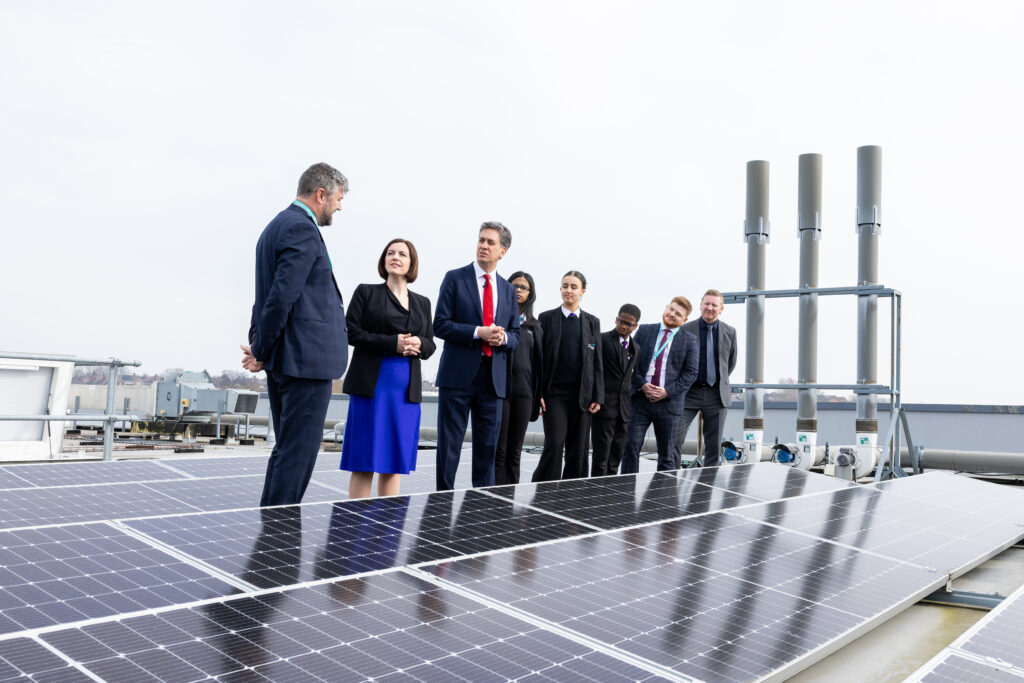
Ed Miliband & Bridget Phillipson view school solar panels. Credits: UK Government l Flicker, Public domain.
Ask most Britons what they know about Barnsley, a town in Yorkshire, and they might mention brass bands, the Pennines or the coalfields. The last of the coalmines closed 30 years ago. Solar power would probably not be on the list. Yet in the world of community energy (CE), Barnsley is a pioneer: it has the UK’s largest CE project, installing solar panels on 321 homes and putting in 89 storage batteries.
Energise Barnsley, which focuses on social housing, is one of about 580 projects around the country. But you would never know it. The success of Barnsley – and the problems it is now encountering in trying to replicate the scheme at scale – are little known because public awareness of CE in Britain, and especially England, is very low. While most people are aware of solar panels and insulation, they assume they are decisions for individual households, not something that could be bought and run collectively. For example, wind power has been almost impossible to install in England. New installations were essentially banned for nine years until Labour took power last year. England only finished one onshore wind turbine in 2023, which was built by Ambition Community Energy. At 150 metres tall, it is the UK’s highest. With a windier climate, supportive national governments and rural communities who can see the advantages of co-operating, Scotland and Wales have done better.
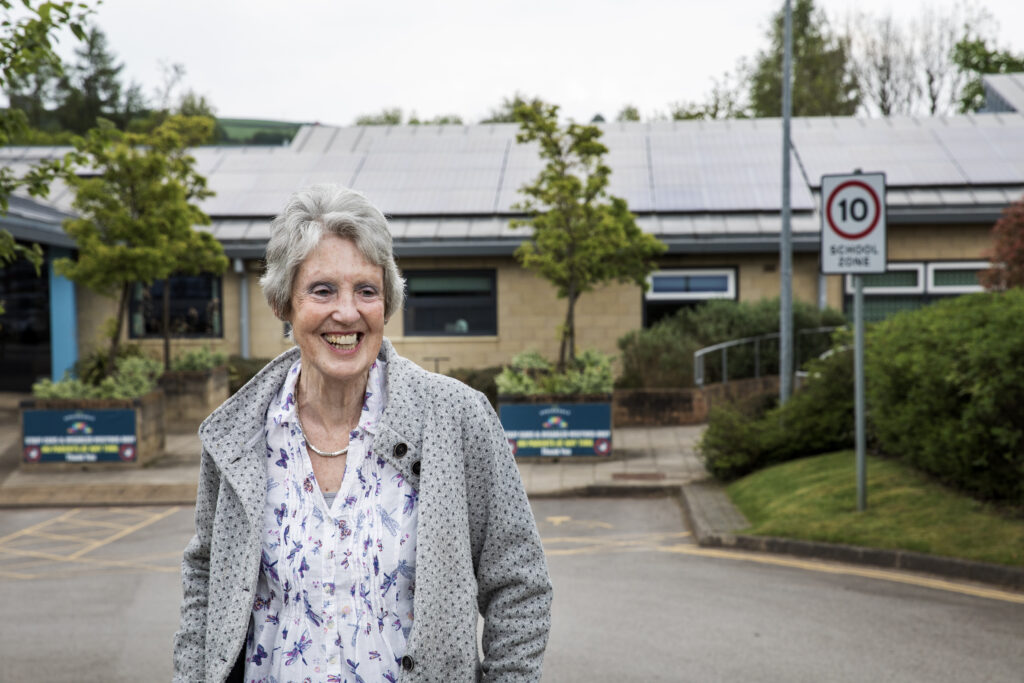
Margaret Andrew, a micro investor in the Energise Barnsley scheme to install solar panels on her children’s ex school. Credits: Ashden/Gary Calton.
The European federation for CE, Rescoop.eu, points to its many advantages: it generates two to eight times more local revenue than a project carried out by an external organisation, gives communities a stake in their energy needs and encourages them to use less energy. It can even help social cohesion. In Britain, however, the optimism of the early 2010s has petered out as Brexit, the consequences of austerity and the need to subsidise fuel bills have taken priority.
Holly Brazier Tope, the deputy director of politics at Green Alliance, is blunter. ‘Nearly ten years ago, the government predicted a million homes would be powered by community energy, but the reality is that around 228,000 homes are today. This is mostly because successive governments have taken away essential support for these projects, which often have no clear route to market.’
Good intentions
Yet the government is keen on community energy. Miatta Fahnbulleh, who is now a minister in the Department for Energy Security and Net Zero, was an enthusiast for CE schemes when she led the Resolution Foundation thinktank, regarding them as a way for places to take charge of their own energy needs rather than being forced to adapt their homes. They are (briefly) mentioned in the industrial strategy that was published this summer. ‘The government came in and made a number of very bold commitments around local power and community energy,’ says Will Walker, the UK policy lead at the climate consultancy Ashden, which has worked on the Barnsley scheme. ‘We’ve seen recommitments to that scale of ambition, but the actual funding we’ve seen so far is not really commensurate with [it].’
The original Community Energy Fund has been wound up and its activity has moved to the new publicly owned company Great British Energy, which distributes funds through Net Zero Hubs. The money available now through that pot is just £5 million. In March 2025, £180 million was allocated to pay for rooftop solar panels on schools and National Health Service sites, but the Treasury has put some of the school projects on hold while it decides whether the money for Power Purchase Agreements (PPAs) counts as public debt. Everyone is frustrated. ‘We have asked for the Treasury rationale on this given that PPAs are not counted as debt in any other country we know of,’ says Community Energy England. Meanwhile, some Labour MPs have complained the solar panels will come from China, where they may have been manufactured using forced labour. There could scarcely be a better illustration of how difficult it has become for Britain to invest in infrastructure.
But the biggest problem for CE projects has been the abolition of the feed-in tariff six years ago. This provided them with a guaranteed income through a fixed energy price. When that came to an end, new projects became far less attractive. ‘There was a transition period when there wasn’t any subsidy support,’ says Walker. ‘There was a lot of innovation and now they’ve come out the other side where certain projects are viable, but the business case is still very challenging.’
That means the main obstacle to CE projects, according to a survey the government commissioned last year, is now funding. The existing schemes are complicated and prescriptive, and communities say they do not know how to go about attracting private sector investment.
Cheaper bills for the better-off
Some communities have been able to raise enough money for their own schemes. Yealm Community Energy in Devon issued almost £500,000 in shares to buy three solar farms, which power 4,450 homes. This is not a conventional investment: shareholders can only sell back to the society itself, not to anyone else. Surplus funds – around £160,000 so far – go back into the community to pay for things like bike racks, heating village halls and an electric ferry.
But not all places can afford to do this. The government used to offer tax relief on share offers like Yealm’s, but it withdrew that two years ago. There is a risk – which the people responding to last year’s survey seemed to acknowledge – that CE projects become a hobby for investors who can afford to take on risk, with poorer communities who are struggling with energy bills left out. That is why green lobbyists would like to see the feed-in tariff replaced. Tope wants a dedicated community pot in the Contracts for Difference (CfD) scheme, which is the main form of support for low-carbon electricity generation, and a viable Smart Export Guarantee (SEG) tariff. Walker agrees. He points out that CE projects currently have no place to sit in the CfD scheme and ‘need a stable floor price’. Smaller rooftop solar projects won’t be viable unless an SEG tariff will guarantee them a fair price from energy suppliers. Importantly, too, help needs to be targeted at poor households. ‘Make sure this funding goes to places that need it most, low-income communities – ringfence a good chunk, perhaps a quarter, to go to the most disadvantaged communities.’
A shared ownership model can also work. ‘The government has talked about that a lot,’ says Walker. ‘We’re expecting it to be a big part of their plans. From an equity point of view, some communities won’t be in a position to own CE schemes. Communities could join up with local authorities or private developers. ‘Great British Energy should be investing at an early stage and maintaining equity stakes so they can be transferred later to communities, and CfDs could be tweaked fairly easily to reward developers who enter into shared ownership.’
Both Tope and Walker agree that the uncertainty and hiatus in funding needs to end if CE is to take off. ‘The positives are that Miatta and Ed [Miliband, the net zero secretary] and Michael Shanks [an energy minister] get it. They really get the need for this,’ says Walker. ‘I haven’t lost hope that that scale of ambition and funding is still being worked on.’ As so often in British politics, the Department for Net Zero is lobbying the Treasury for funding – money that may or may not be forthcoming.
The views and opinions in this article do not necessarily reflect those of the Heinrich-Böll-Stiftung European Union.
