











Solar panels have endless uses.from solar roof To photovoltaic glass, there are more and more surfaces that generate solar energy. One such application is solar trees, part of a wave of technological breakthroughs based on nature.
Some “leaves” of these photovoltaic trees are distributed according to the Fibonacci spiral, a pattern that repeats itself in nature.These nature-inspired solutions are commonly known as biomimicry, It is also found in some wind turbines and solar thermal power plants.
In this article you will learn about the following topics:
What is a solar tree?
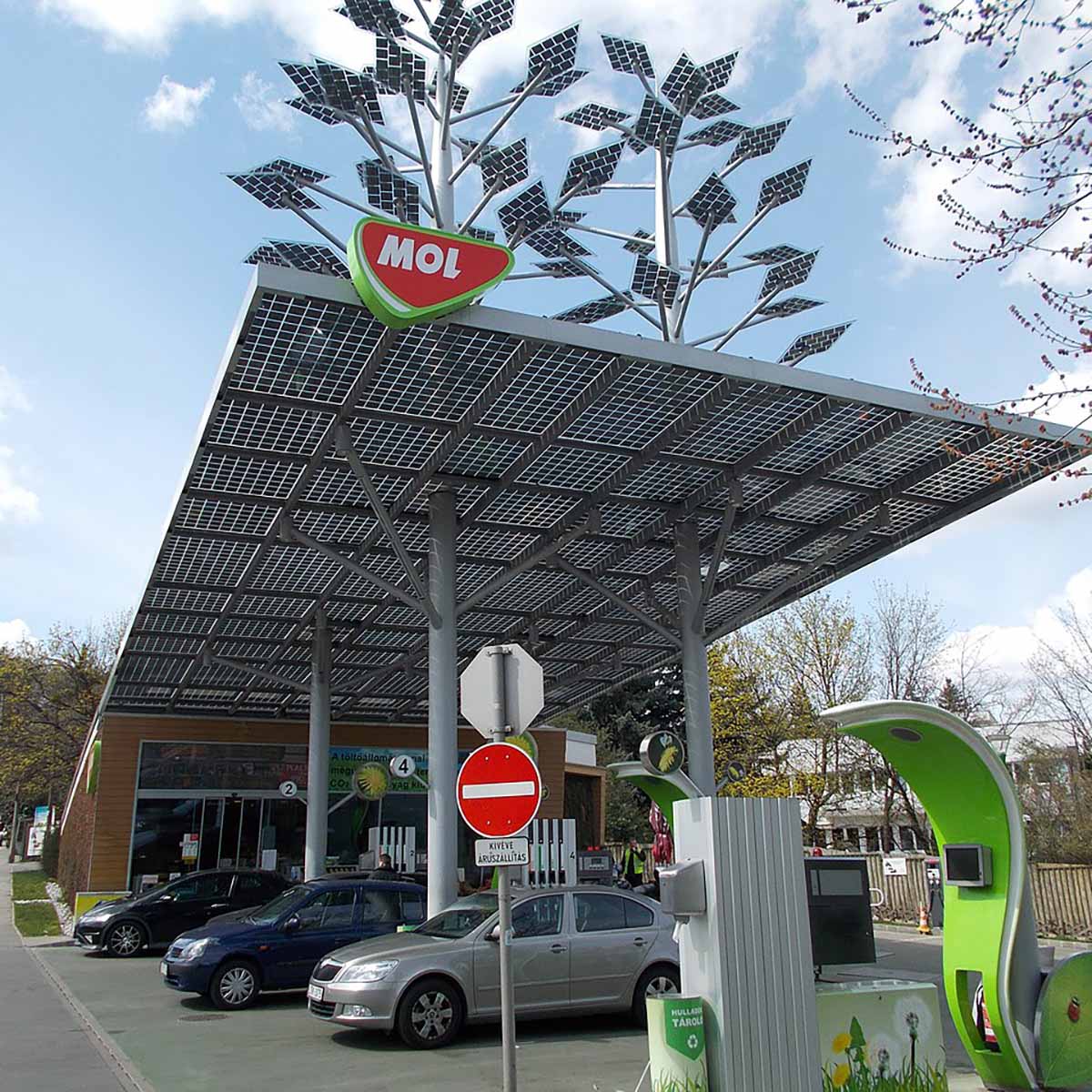
This technique has been on the market for several years now and is used in installations (usually in urban areas) that combine sustainability with functional and aesthetic dimensions. Solar trees are usually Several photovoltaic panels installed as “leaves” It has a distribution that optimizes the absorption of solar radiation. The most common solar tree designs are:
- a a main trunk with several branches regularly distributedThis is one of the most basic and least efficient designs.
- distribution based on fibonacci spiralThis is the most common design, based on attaching “branches” of varying lengths to the main trunk. The power generation efficiency is improved, but the cost is also increased.
- hemisphere. It forms a dome of leaves that receives solar radiation all day long.
- Spiral phyllotaxis“Philotaxy” describes the growth of branches and leaves in botany. In this case, panels of different heights and orientations attached to the branches from the main trunk form a kind of umbrella.
- Ross LovegroveA bouquet of stems with circular solar panels on each end.
- basic sun treeThe design is based on the image of a trunk with branches at the same angle at the top like a flat sunflower.
- solid geometry designIt uses a trunk based on three axes with a panel on each.
- super treeThese 50-meter-tall trees combine vertical gardens with 200 species of plants, water collectors, solar farms, lighting systems, and environmental climate control devices. This design is one of the most spectacular and can be seen at Gardens by the Bay Park in Singapore.
Among the latest solar tree projects is the University of Connecticut initiative. The final design resulted in an object that combines renewable energy generation with the aesthetic qualities of sustainable materials such as aluminium, in terms of urban furniture.
According to the promoter, the starting point for this project was the creation of artificial trees. Test optimal leaf position and shape to maximize energy production Deepen your understanding of the photosynthetic process.
The solar tree at this US university attracts professors and students from a variety of disciplines, including electrical engineering and urban planning. The result is a design based on recyclable materials. Several benches are integrated next to the main structure, Users can sit in the shade and charge their phonesAnd these are all solar powered.
world’s largest solar tree
However, there are also solar trees that try to maximize renewable energy in addition to their symbolic, artistic, or social aspects. manufacturing. This is the case with the Solar Tree at his CSIR-CMERI Institute of Technology in India. With a basic solar tree design, Largest device of its kindInaugurated in 2022, the total area exceeds 300 square meters, Generates up to 200 kWh daily.
Other examples of biomimicry applied to renewable energy
In addition to solar power, other renewable energies are benefiting from biomimetic approaches. There are several examples of biomimetics in the field, whether inspired by organic shapes to improve the aerodynamics of turbines or to optimize the layout of solar power plants.
- Fibonacci spiral. Present in many patterns in organisms and plants such as sunflowers, this helix has been used in solar power plants to improve the distribution of mirrors that concentrate solar radiation.
- Humpback whale flippers. The irregular edges of these cetacean flippers allow for optimized swimming motion and are also key to developing wind turbine blades with better aerodynamic properties.
- pattern of butterfly wings. Researchers have improved the cell performance of a new generation of solar panels by replicating a butterfly wing structure that maximizes the solar radiation absorbed.
For more examples of biomimicry, check out this article on a new generation of airplanes that mimics the movement of bird wings and this article on plant-inspired desalination systems.
sauce:
