











The Basque artist Eduardo Chillida installed one of his most famous series of sculptures on the seawall of Donostia and called it ‘The Comb of the Wind’. And so are the wind turbines that are beginning to be installed in coastal waters of many countries. Between 2020 and 2021, the energy capacity of these ‘wind combs’ will almost double, reaching 48.2 GW. Floating offshore wind farms, in turn, are starting to make up a significant portion of the total installed wind farms globally.
This article contains:
What is a floating offshore wind power generation?
The traditional approach to installing offshore wind farms has been to move onshore wind turbine structures to shallow coastal waters. One of the reasons is Offshore winds are more stable and strongbecause you don’t face obstacles like you do on land, such as mountains and woodlands.
One of the challenges of offshore wind power is Securing these wind turbine structures to the seabed Make it tough enough to withstand the onslaught of waves. The fact that such supports need to be installed limits the possibilities to the continental shelf closest to the shallow water landmass.
A floating platform, also known as a floating offshore wind platform (FOWP), overcomes some of these pitfalls by using a floating structure connected to the platform by steel or other cables. These cables keep the platform stationary. Provides some maneuverability in very strong waves.
Advantages of floating offshore wind turbines
As you can see, the floating offshore wind energy approach has many advantages, including:
- Can be installed in deep sea
- Easy to move if needed
- Reduction of seafloor environmental load
- Reduced installation costs
- take advantage of stronger winds
- Can be placed away from the coastline, reducing visual impact
Types of floating offshore wind power generation
Wind turbines used on platforms tend to share similar characteristics for the most part, with the exception of some developments using two-bladed wind turbines. The main difference is underwater, the type of floating platform used. In this regard, the following variants can be mentioned:
- super buoyThe platform uses a cylindrical base that offers a simple and efficient design, with weight applied at the bottom end. A depth of 100 meters or more is required to work properly.
- barge or pontoon modelUnlike the spar design, the platform resembles a ship in length and width.
- semi-submersible baseIt uses several semi-submersible cylinders connected by means of beams.
- TLP model (tension leg platform). It is based on a central strut and arm connected to a tensioner to ensure stability.
Wind Pyramid: An Innovative Approach
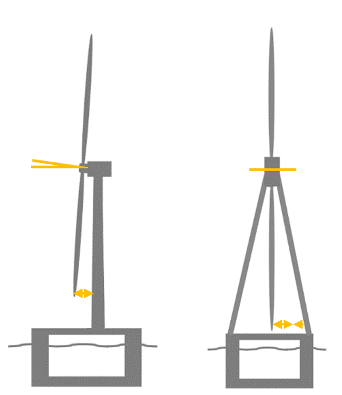
One of the few models with the most noticeable differences to surface is the French company Eolink’s proposal.This is because wind turbines have A model intended for floating offshore wind, its entire design exploits the peculiarities of the environment.
On land, wind turbines employ a design called a “nacelle.” In other words, it has an egg-shaped body like an aircraft engine. This design allows a heavy structure to rotate and behave like a head that “faces” the direction of the wind. Mobility at sea, on the other hand, is very different. And that is the first differentiator of the “pyramidal” turbine.
The model proposed by Eolink is a nacelle and It is inserted into a pyramid structure consisting of four mastsHere the entire platform rotates rather than the head of the wind turbine. Nacelle turbines have weight limits, especially at sea where they are exposed to waves and strong winds. To understand this, think of a very heavy “head” with a thin neck. Composite mast structures, on the other hand, can hold much larger turbines.
Another way to reduce structural wear in wind turbines is to Use flexible bladeThe problem with the nacelle model is that the close proximity of the main mast makes it too long to use flexible blades.
According to its developer, the mast “pyramid” Reduces the risk of impact and allows the use of longer, flexible bladesresulting in improved energy efficiency. In addition, this construction distributes weight and increases strength.
Coupled with a new floating platform design with 20-meter-deep buoys, the new wind turbine can generate 20 MW in one unit. 20-25% higher efficiency than current reference solutions.
This innovative floating offshore wind approach is still in the prototype stage, but the manufacturer plans to install a demonstration wind turbine with a capacity of 5 MW in the near future.
sauce
