











It might be a small briefcase for one person, but it could be a giant leap for mankind.it is the result of A decade of research by a group of MIT researchers It brings together several new technologies in a pioneering miniature format. In addition to portability, it has several advantages such as no filters and low energy consumption. Could it be the first step towards pocket-sized and above all sustainable desalination?
In this article you can read about:
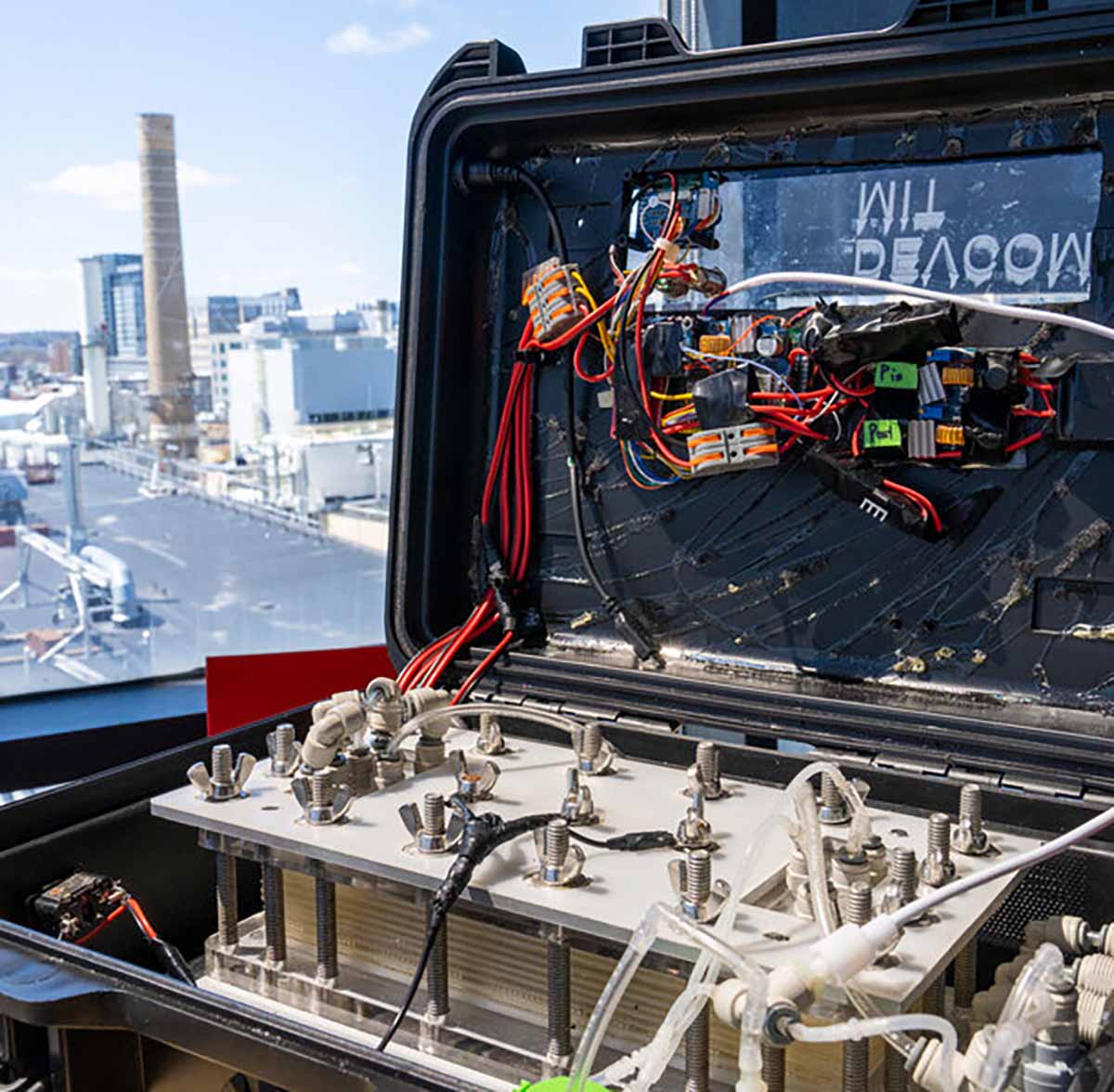
MIT’s Portable Desalination Unit
The innovative MIT device weighs less than 20 pounds, yet meets World Health Organization drinking water standards by reducing solid particles in water by more than 10 times.The first version of the desalination case can be created up to 0.3 liters of water drinkable Only 20 watts of energy per hourPlus, it’s designed so anyone with no technical knowledge can use it in minutes.
The user simply presses a button and when the particles in the water are reduced to safe levels, get notifiedIn fact, researchers have created a mobile app that allows them to wirelessly control the unit and get real-time information on water salinity and energy consumption.Regarding the latter, the team said that the machine There is a mobile phone charger energy consumptionBut how did they achieve this?
Photovoltaic, filter-free technology
MIT Portable Desalination System Integrates several innovative technologies, the most important of which is called ICP (ion concentration polarization). Large desalination plants typically use a process called reverse osmosis. This technology is most efficient for large desalination plants, but the need to apply pressure increases energy requirements and is not applicable to portable desalination plants. So the team adapted his ICP system, which he had developed ten years earlier.
Basically ICP no filter required It depends on the membrane to which the electric field is applied. These membranes are placed above and below the water stream so as to repel positively or negatively charged particles as they pass. These particles include salt molecules, bacteria, viruses, and more. The particles are then transferred to a second water stream that exits the circuit. This entire process can be done with a low pressure pump.
However, since ICP does not remove all salt ions, Second electrodialysis process You should remove them completely. Both modules can be integrated into a unit small enough to fit in a briefcase.

into a briefcase.
The lack of filters reduces the need for maintenance and cleaning, allowing the unit to run for extended periods of time without the need for service or replacement. Additionally, a small solar panel can power both the low-pressure pump and the ICP and electrodialysis modules. All of this makes the equipment completely portable and can be used in remote areas where electricity is not available on a regular basis or in humanitarian disaster situations. In short, to improve people’s lives.
A successful real-world demonstration
After integrating the above technologies and performing various laboratory tests, the researchers went out into the real world to test portable desalination unitThe first test took place in Carston Beach, Boston, USA. So they put a feeding tube into seawater and filled it with a glass of clean drinking water within 30 minutes.
The researchers themselves were surprised when it worked for the first time. My current goal is Improve technology efficiency and performance, reduce the cost of materials and transfer all this to a company that can commercialize the water purification case. MIT’s portable desalination unit also needs to handle highly turbid water without contamination compromising its functionality. If you want to learn more about this technology, watch the developer video.
sauce
