











Building a brick wall requires some skill, but is relatively easy. Bricks, cement and a trowel are the only elements that are practically needed. Also, in this field, robot technology that can build structures on its own has already begun to emerge. But in the microscopic world, the “bricks” that make up matter, atoms and molecules behave much more unpredictably. One of the notable achievements of the last few decades has been the use of scanning tunneling microscopy, which allows us to work with atoms and molecules at the nanoscale. The problem is that I’ve had to manually do this by trial and error. This is because behavior at these scales is very complex. Therefore, the microscope operator had to attach the molecule to the microscope cone and then move the molecule in the same way that a mechanical claw lifts a teddy bear, like an amusement park attraction.
Fortunately, the Jülich Institute for Quantum and Nanosciences in Germany has developed a technique that can identify patterns and variations at the molecular scale. The key lies in the use of artificial intelligence and machine learning. Specifically, a subfield known as reinforcement learning that punishes errors and rewards success. The same technology allowed Google’s AlphaGo Zero to beat a human for the first time in thousands of years of the Asian game of Go.
The process of learning while changing the rules
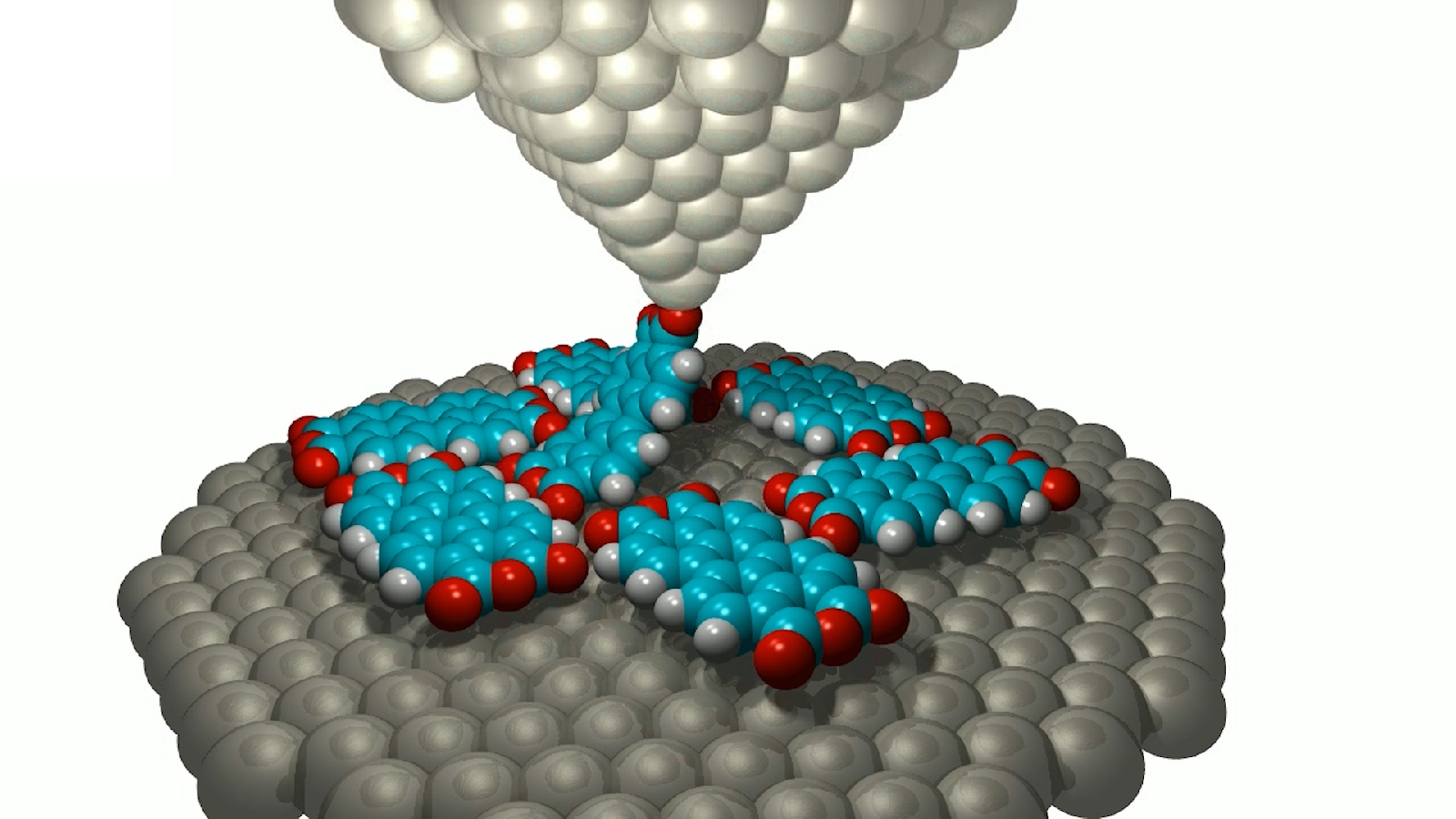
In the case of a German research center, they used this AI system to remove molecules that were integrated into complex networks of chemical bonds. These were perylenes, molecules used to make inks, and OLED diodes for TV screens and mobile phones. The challenge, the researchers said, was that the force with which the molecule was attracted to the tip of the microscope could not overcome the chemical bonding forces. Scientists had to manually determine movements that respected the integrity of the bond. In contrast, the AI system practiced over and over until it learned the optimal move. Put it this way, it seems relatively easy. The problem is that the atoms that make up the tip of the microscope can also move slightly. This gradually changes the level of force applied. It’s a bit like changing the rules mid-game.
Scientists have accelerated the learning process by using simplified simulators in parallel with manipulating physical manipulations of molecules. According to the software developer, this is the first time nanotechnology and artificial intelligence have been combined. Now, they explain, the door is open to his 3D printing of functional supramolecular structures. This will enable the fabrication of molecular transistors or qubits, the scaffolding for quantum computing. In short, we may be facing the first steps of a new era in molecular masonry.
sauce: Science Daily
image: Research Center Jürich
