









“Previously … it took about 2-3 weeks from the payment of the issue fee to the grant of the patent. , and/or there will no longer be a “time buffer” for filing a divisional application. ”
The United States Patent and Trademark Office (USPTO) sent the following warning by email on March 16, 2023:
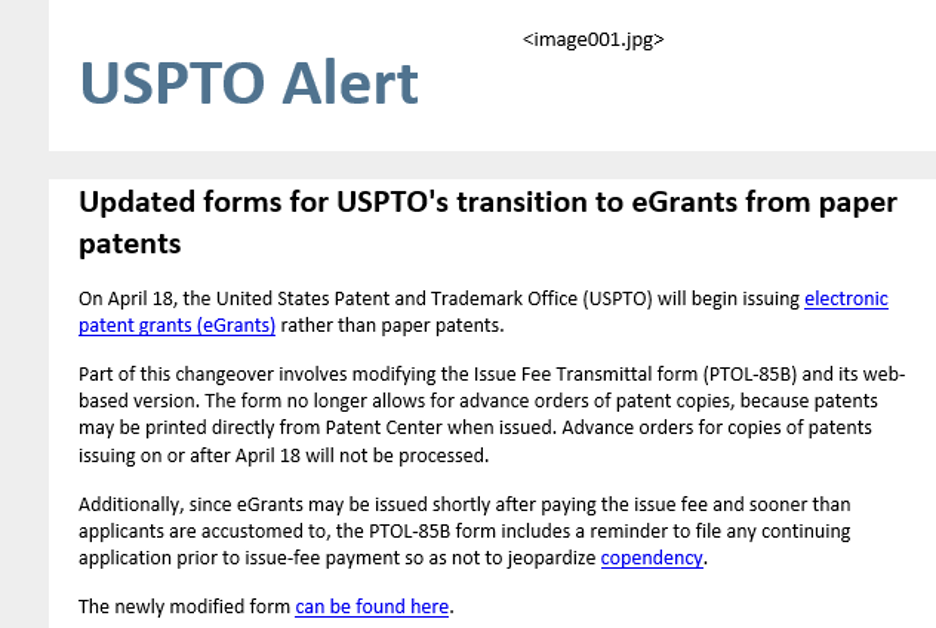
This change to electronic rather than paper patenting is consistent with the USPTO’s ongoing shift to an all-electronic, paperless system. Previous changes included all-electronic Office Actions and, of course, his EFS-Web system at the USPTO for electronic submissions to the USPTO.
One important point to be aware of is that a patent may be granted immediately after payment of the issue fee. (referred to as a “continuing application”), must be paid before or at the same time as the issue fee is paid in order to remain pending with the issued patent.
In the past, based on my experience, it took about two to three weeks from the time the issue fee was paid until the patent was granted. However, this will change on his April 18th, so there will no longer be a “time buffer” for filing continuations, CIPs, and/or divisional applications.
As such, patent attorneys should organize the filing of continuation, CIP, and/or divisional applications at the same time the issue fee is filed so that no loss of priority occurs. The filing of continuation, CIP, and/or divisional applications is subject to the co-pending requirements of 35 USC § 120. This requirement provides that each subsequent application cannot be filed after the parent application has issued, expired, or been abandoned. immediately depends.
Does the USPTO issue a patent the day after the issue fee is paid for the application? A divisional application must already be filed with the USPTO.
Of course, all clients should be notified of this change as soon as possible so that they can provide instructions for filing continuation, CIP and/or divisional applications earlier than in the past. If an applicant wishes to file a continuation, CIP, and/or divisional application but does not provide a new set of claims to include in the application, there are several approaches that can be taken. One approach is to submit a placeholder claim, such as original claim 1 of the granted application, and another approach is to submit a claim similar or identical to the patented claim 1 of the granted patent. is to In either case, a preliminary amendment containing the desired set of claims must be made immediately thereafter to avoid obtaining a First Office her action with a 35 USC §101 “same invention” rejection. A new continuation, CIP, or divisional application will act on the application immediately after it is filed with the USPTO.
Image Source: Deposit Photo
Image ID: 84032870
Author: Gustavo Frazao

