









Support IPWatchdog with an individual sponsorship: Click here
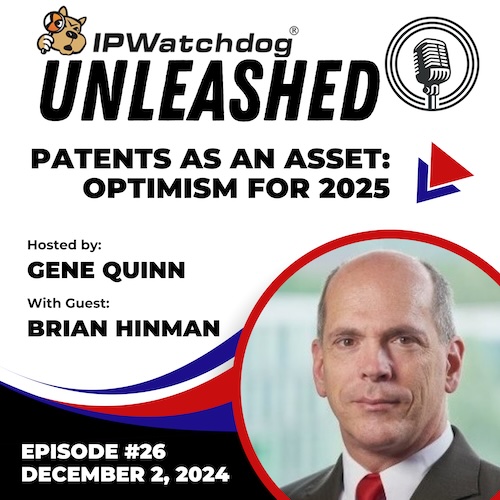
This week on IPWatchdog Unleashed, my conversation is with Brian Hinman, who is one of the leading IP executives and investors in the world. Brian has held senior executive positions at leading technology companies, such as IBM, Philips and Verizon. And after spending more than 6 years as the Chief Innovation Officer for Aon, today he is Chief IP Officer for Cote Capital. You can listen to our full discussion about monetizing streams of revenue backed by intangible assets wherever you get your podcasts (links here) or visit IPWatchdog Unleashed on Buzzsprout. You can also read the complete transcript.
Brian has held senior executive positions at leading technology companies, including IBM, Philips and Verizon. After spending more than six years as Chief Innovation Officer for Aon, today he is the Chief IP Officer for Cote Capital, which works to find, fund and scale the next generation of technology companies with breakthrough innovations that can deliver greener, more sustainable, more efficient and effective manufacturing, which can lay the foundation for bringing advanced manufacturing back to America.
 During our conversation, Hinman explains how Cote provides capital for scaling manufacturing and operations with IP assets-backed investment and with those assets including designs, patents, trade secrets, know-how, copyrights, proprietary equipment, customer contracts and even data. The way Hinman describes this IP asset-backed investment strategy sounds a lot more owner-friendly and startup-friendly than a typical venture capital round of investment. Which is not to say anything bad about venture capital or the venture capital business, but when VCs come in, they often want quite a lot of the company, frequently more than half of the company, in order to make an investment.
In exchange for an investment in the company, Hinman says they receive a percentage of the company’s revenue in the forms of an IP royalty that is paid quarterly. And if there is an exit at some point, the investors get a percentage of that exit, but ownership of the company stays in the hands of the founders.
During our conversation we also discuss pending legislation, particularly the RESTORE Act, which would effectively overrule eBay and create a presumption than a permanent injunction is the proper remedy, with Hinman explaining that the legislation places the burden on the infringer to demonstrate that a permanent injunction is not warranted, which according to Hinman is the way it should be. “I think this act is really going to restore the viability of the patent system as an instrument to protect innovation and hopefully facilitate the financing and monetization of technology transfer,” Hinman said.
And we discuss Hinman’s belief that the next Director of the USPTO should not come from the world of big-tech, and that it is important for President-elect Trump to nominate someone who brings the innovator’s perspectives. Someone who has not only advised patent owners, but who has real familiarity with innovation and advising innovators. In other words, someone who will promote the virtues of innovation. “We need somebody that… is really going to encourage more innovation in the areas like artificial intelligence. That should be a mandatory prerequisite.”
Without further ado, here is my conversation with Brian Hinman.