

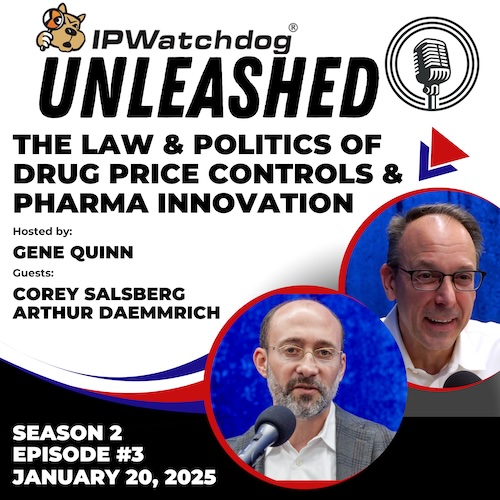
This week on IPWatchdog Unleashed we talk about pharmaceutical patents, pharmaceutical patent policy, drug price controls and innovation. You can listen to our full discussion wherever you get your podcasts (links here) or you can visit IPWatchdog Unleashed on IPWatchdog.com.
As you may recall, back in 2022, the Inflation Reduction Act passed. And as part of that law, it gave the federal government the opportunity for the first time to “negotiate” drug prices for Medicare. The Biden Administration has viewed this as fantastic. It has allowed them to control drug prices and drug costs for Medicare. The problem is it’s not really a negotiation in any fair sense of the word. What happens is the federal government identifies the drugs on which the U.S. government spends the most amount of money, and then they tell the drug companies that you will either take our offer or you will be fined, and the fines are ruinous—in the billions of dollars. So, the IRA negotiation nothing more than a price fixing, price controlling scheme.
 So why is this an issue for us to consider today if the IRA passed in 2022? Literally on the way out the door, last week the Secretary of Health and Human Services identified 15 more drugs that are now going to be forced into this price fixing “negotiation” scheme.
Shockingly perhaps, there was no need for the Biden Administration to put out this list. In fact, Neil Bradley, Executive Vice President and Chief Policy Officer of the U.S. Chamber of Commerce wrote to the Department of Health and Human Services on Friday, January 17th to express deep concern and opposition to HHS deciding to release this next set of medicines, which is, according to the letter, well in advance of the February deadline for doing so and seems to be, in their words, nothing more than a midnight rule to undermine transparency, accountability, and sound policymaking while hamstringing the incoming Trump Administration’s ability to reform the program and safeguard American leadership in medical innovation.
And that’s the real problem with this “negotiation.” Economists and others, including the Congressional Budget Office, who have looked at this issue, have all concluded that this price setting, price fixing, price controlling “negotiation” scheme being employed by the federal government will without question lead to fewer drugs being discovered and fewer drugs making it to market, which will only hurt society. So, if you haven’t heard about this issue yet, you will hear about it in the coming weeks and months.
The question in the minds of many in and around Washington, DC, is what will the Trump Administration do? Nobody knows for sure what the Trump policy is going to be relating to these drug price controlling measures. So, all eyes turn to the Department of Health and Human Services as we await information relating to what President Trump plans to do with these Medicare drug “negotiations.”
In the meantime, I thought it might be useful to take a look at what it really means when the federal government uses the horribly misleading term “negotiate,” at purposefully used and misleading term that is intended to get the public to believe something completely and totally inaccurate, because who could possibly be against allowing the federal government to negotiate with drug companies? It sounds so sensible. If only it were true. The problem is it’s just not a negotiation.
We addressed this issue about 16 months ago at our annual Life Sciences Program, on a panel with Corey Salzberg, who is Vice President and Global Head of IP Affairs for Novartis and Arthur Daemmrich, who is the Director of the Consortium for Science, Policy and Outcomes at Arizona State University. Which is where we start our podcast this week before jumping forward to a one-on-one conversation I recently had with Arthur Daemmrich about pharmaceutical innovation and lessons learned from history, including the recent COVID pandemic and TRIPS waiver fiasco.
So, without further ado, here is my conversation with Corey Salsberg and Arthur Daemmrich.
More IPWatchdog Unleashed Episodes