

“Aldi was able to achieve substantial sales of [Taurus Cloudy Lemon Cider] in a short period of time without spending a penny on promoting it.” – UK Court of Appeals
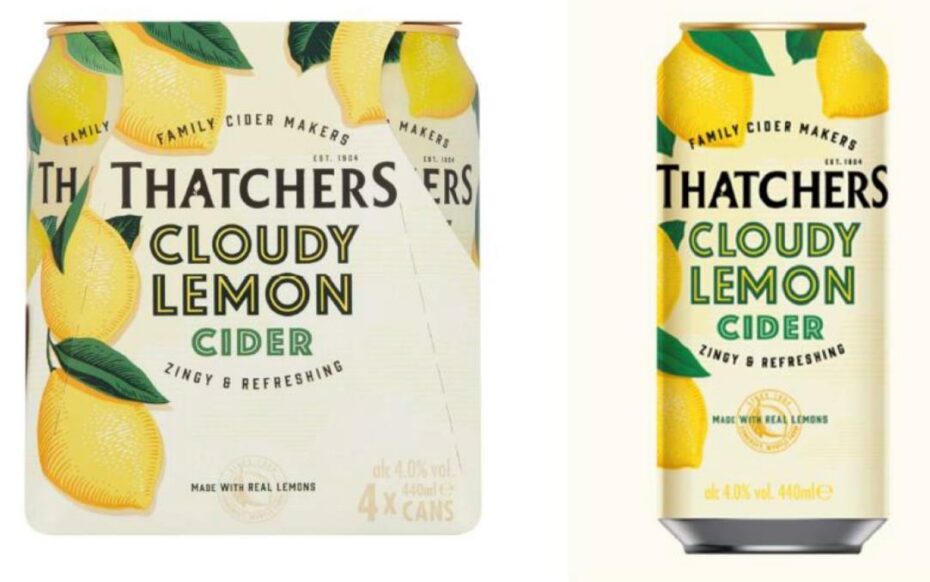 On January 20, the United Kingdom’s Court of Appeal issued a ruling in Thatchers Cider Co. Ltd. v. Aldi Stores Ltd. expected to have major impacts on the availability of lookalike products in British supermarkets. In Thatchers, the Court of Appeal reversed a ruling by the Intellectual Property Enterprise Court (IPEC) dismissing trademark infringement claims filed by Thatchers over competing brands of cloudy lemon cider sold by German supermarket chain Aldi. Significantly, the appellate court found no reason to depart from the Court of Justice of the European Union’s (CJEU) 2009 landmark ruling in L’Oréal v. Bellure, which clarified what constitutes the use of a sign taking unfair advantage of a registered trademark.
 This case stems from a lawsuit filed by Thatchers Cider against Aldi in IPEC back in September 2022, four months after Aldi began selling a cloudy lemon cider under the store’s Taurus line of hard ciders. Although Thatchers’ product was not the only cloudy lemon cider available in the UK beverage market, evidence entered at trial showed that Aldi used Thatchers’ version as a benchmark for developing its own Taurus-branded version. Although IPEC’s January 2024 ruling found a link between Aldi’s product and Thatchers’ trademark, the lower court found that Aldi had no intention to take advantage of goodwill in Thatchers’ trademark, and that there was no unfair advantage in part because higher sales numbers for Aldi’s cloudy lemon cider relative to other seasonal variants were due to the popularity of lemon-flavored drinks.
L’Oréal Sets Definition for Unfair Advantage by Transfer of Image under Section 10(3)
Near the outset of its ruling, the UK Court of Appeals acknowledged that Thatchers Cider has attracted a great deal of attention among trademark law commentators, creating a split between detractors of looklike packaging and proponents of cheap consumer products. While the Court of Appeal explicitly declined to enter the policy debate, the court noted the controversy based on Aldi’s invitation to depart from the CJEU’s reasoning in L’Oréal, the leading CJEU case on the subject.
In L’Oréal, the well-known French beauty brand filed trademark infringement proceedings against Bellure in the UK over fragrances imitating L’Oréal but sold in packaging that, while generally similar to L’Oréal’s products, was unlikely to mislead the public. Like the present case, L’Oréal involved a claim for trademark infringement under Section 10(3) of the UK’s Trade Marks Act 1994. Under that provision, it is an act of trademark infringement to use a sign identical or similar to a registered trademark where that sign takes unfair advantage of the trademark’s reputation in the UK.
The UK Court of Appeals certified five questions for the CJEU to answer in L’Oréal, including the application of Section 10(3), specifically whether an unfair advantage could be found without additionally showing a likelihood of consumer confusion or detriment to the registered mark. In its ruling, the CJEU defined “unfair advantage” as covering cases where a transfer of the mark’s image or characteristics to goods identified by a similar sign creates “clear exploitation on the coat-tails of the mark with a reputation.” Although the UK Court of Appeals interpreting L’Oréal in Thatchers noted that a defendant’s conduct is likely unfair when it intends to take advantage of the mark’s reputation, showing subjective intent is not required to objectively find that a defendant’s benefit amounts to unfair advantage.
Thatchers Cider: A Death-Knell to Supermarket Lookalikes in the UK?
Analyzing Thatchers’ appeal, the Court of Appeals agreed with Thatchers that IPEC erred in construing the allegedly infringing sign as Aldi’s entire can and not the graphics printed on Taurus Cloudy Lemon Cider cans and boxes. The appellate court also agreed that IPEC erred in finding that Aldi’s sign was three-dimensional and thus different from Thatchers’ two-dimensional registered mark. Thatchers also successfully argued that IPEC muddled an intention to deceive with an intention to take unfair advantage of the registered mark, although the Court of Appeals recognized that inexact Section 10(3) analysis from PlanetArt v. Photobox (2020) may have contributed to IPEC’s confusion.
Moving along to Thatchers’ unfair advantage argument, the Court of Appeals found that IPEC had rejected without discussion Thatchers’ contention that the current case falls into the framework of unfair advantage by transfer of image under L’Oréal. Several factors made it clear that Aldi intended to use a sign reminiscent of Thatchers’ trademark, including Aldi’s departure from its house style for Taurus ciders, the imitation of faint horizontal lines, and Aldi’s use of Thatchers’ product in its benchmarking process. Further, “Aldi was able to achieve substantial sales of the Aldi Product in a short period of time without spending a penny on promoting it,” the appellate court noted.
Finally, the Court of Appeals declined Aldi’s invitation to depart from L’Oréal, a decision rendered by the EU’s highest court prior to Brexit. However, the appellate court noted Section 10(3) unchanged following Brexit, indicating Parliament’s will that those provisions remain harmonious with EU trademark law. Further, L’Oréal provides a principled basis for unfair advantage decisions, and it was based on a series of earlier decisions on the issue.
The Thatchers decision is being seen by some as a watershed moment long overdue for British trademark law. “The scale and proximity of look-alike packaging in the UK is far worse than anywhere else in Europe,” according to Geoff Steward, Partner and Co-Head of IP at Addleshaw Goddard. “Armed with the correct packaging trade mark registrations, UK brandowners can now sound the death-knell on the practice of supermarket own-brands free-riding on their brand IP.”