










Small businesses are the backbone of Nigeria’s economy, from neighbourhood barbing salons and POS kiosks to cyber cafés, mini-marts, cold storage operators and so on. Yet one challenge cuts across almost every sector: unreliable electricity.
For years, small business owners have relied on generators to fill the power gap. But high fuel costs, frequent breakdowns, and noise pollution have turned power into one of the biggest operating expenses.
Today, that is gradually changing. Across Nigeria, small businesses are embracing solar energy, not just as a backup power source, but as their primary power source. The impact of this shift is substantial.
The Power Problem Facing Small Businesses
Most small enterprises experience:
- Frequent grid outages
- Rising electricity tariffs
- High generator fuel costs
- Lost customers during blackouts
- Equipment damage from unstable voltage
- High maintenance costs
For businesses that rely on continuous power, like internet cafés, cold rooms, salons, POS operators; even a few hours without electricity means lost revenue. It is worthy to note that solar is changing that equation.
Real-Life Examples of Solar in Action
1. Barbing Salons and Hairdressers
Salons require steady power for electric clippers and for rechargeable clippers depending on frequency of use, dryers, lighting, and fans. With solar systems:
- Salons stay open during outages
- No fuel is needed
- Customers experience quieter, cleaner service
- Daily operating hours increase
Many salon owners report that solar allows them to serve more customers per day and improve comfort inside their shops.
2. POS Operators and Retail Kiosks
POS businesses depend on:
- Internet connectivity
- Terminals and printers
- Lighting at night
- Recharging the POS machine
Solar ensures continuous transactions even when the grid is down, helping operators avoid lost income and customer frustration.
3. Cyber Cafés and Digital Services
Cyber cafés, photocopying centres, computer business centres and ICT hubs rely on constant electricity. Solar allows them to:
- Operate through blackouts
- Protect sensitive equipment
- Offer reliable service that attracts repeat customers
This reliability becomes a competitive advantage.
4. Cold Rooms and Perishable Goods
Solar-powered cold rooms are transforming food storage for farmers and traders:
- Fruits, vegetables, fish, and meat last longer
- Spoilage is reduced
- Traders earn more from preserved inventory
Projects like solar cold storage hubs in markets across southwest Nigeria show how clean energy directly improves food security and income.
The Financial Impact
Businesses that switch to solar benefit from:
- Eliminated fuel costs
- Zero/Lower maintenance expenses
- Fewer equipment failures
- Longer operating hours
- More predictable energy budgeting
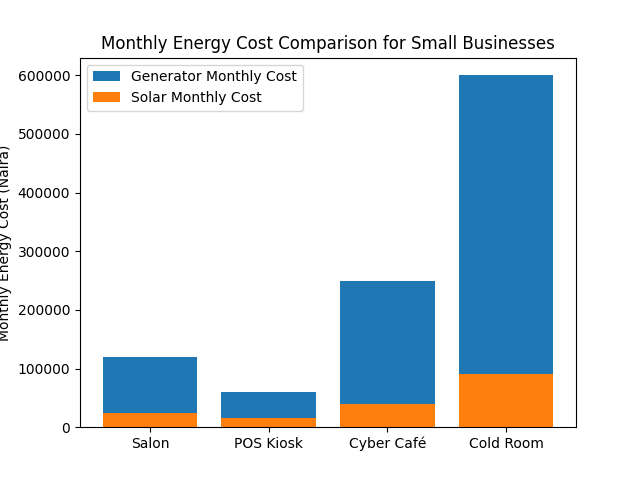
While solar requires upfront investment, many businesses recover the cost within 2-3 years and then enjoy significantly zero or lower energy expenses for over 2 decades.
More Than Cost: Stability and Growth
Solar does more than reduce expenses, it stabilises business operations:
- No sudden shutdowns during outages
- Better customer experience
- Improved staff productivity
- A more professional brand image
In an economy where reliability is rare, stable power becomes a strategic advantage.
Challenges and the Path Forward
Barriers still exist:
- Initial cost
- Access to financing
- Lack of awareness
But financing models such as instalment plans, solar loans, and pay-as-you-go systems are making solar increasingly accessible to SMEs.
Conclusion
Solar energy is no longer just an environmental solution, it is an economic one.
For small businesses in Nigeria, solar offers:
✔ Reliability
✔ Lower long-term costs
✔ Better customer experience
✔ Improved profitability
From salons, laundry shops and POS kiosks to cyber cafés and cold rooms, solar is helping small businesses move from survival to sustainability.
About Kowatek Solar LTD
Kowatek Solar designs and installs dependable solar and energy storage systems for Nigerian homes and businesses. These systems empower entrepreneurs to achieve energy independence and secure long-term cost savings.
