










Introduction
Solar energy is no longer a futuristic concept in Nigeria; it has become an essential component of homes, businesses, and microgrid systems. Nigeria boasts some of the highest solar potential in the world, with average solar irradiation levels of 5.5–7.0 kWh/m²/day in many areas. However, despite strong demand, a significant number of installations fail prematurely or do not perform well. This issue is not due to the ineffectiveness of solar technology but is primarily a result of poor installation quality.
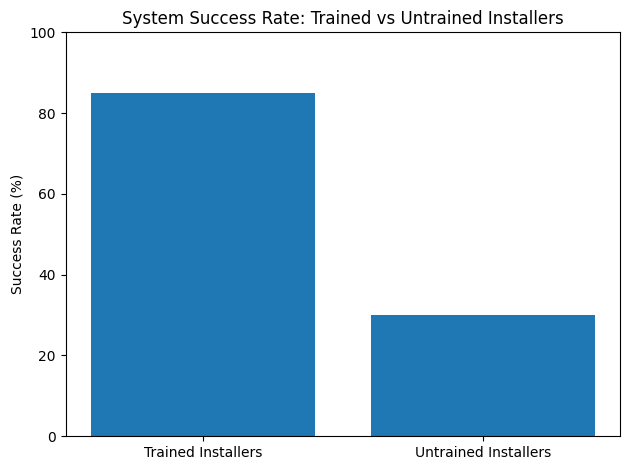
Industry surveys and field observations indicate that up to 90% of solar installers in Nigeria lack formal training or certification. This lack of expertise leads to widespread technical faults, safety hazards, and customer dissatisfaction.
This article explores the practical causes of underperformance, identifies key failure modes, outlines potential solutions, and delivers a clear message to solar clients in Nigeria.

Common Solar Installation Issues in Nigeria
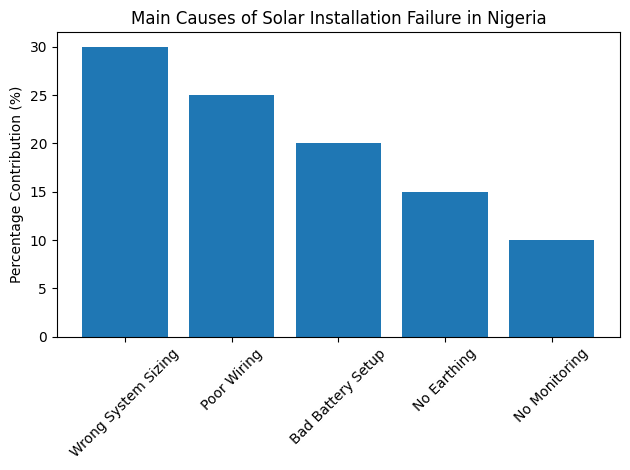
1.1 Improper System Design and Sizing
- Underlying Issue: Installers often rely on rules of thumb instead of engineering calculations.
- Typical Problem: Systems may have undersized inverters, battery banks, or mismatched photovoltaic (PV) modules.
- Result: This leads to frequent system overloading, early battery failure, and inverter tripping.
- Cause: Many installers lack skills in load analysis, energy consumption profiling, and proper system matching.
- Practical Example: A household with 10 appliances is quoted for a “2 kW system” without conducting a load calculation. When all appliances are in use, the inverter shuts down due to overload.
1.2 Incorrect Cable Sizing and Poor Electrical Practices
- Underlying Issue: Essential electrical fundamentals are often ignored.
- Typical Problem: Small gauge cables (< 4 mm²) are used for high direct current (DC) applications.
- Result: This results in excessive voltage drop, overheating, and increased fire risk.
- Cause: Many installers are not adequately trained in electrical codes or cable sizing standards.
- Impact: There are frequent component failures and ongoing stress on the systems.
1.3 Inappropriate Battery Configuration
- Issue: Batteries are often wired in unsuitable series or parallel combinations.
- Effect: This can shorten battery life, create imbalances, and lead to premature failures.
- Cause: There is generally a lack of understanding of battery chemistry, current rates (C-rates), and the implications of state of charge.
- Practical Detail: A lithium iron phosphate (LiFePO4) battery bank requires careful voltage and current control. Improper wiring can compromise battery management system (BMS) protection.
1.4 Poor Earthing and Lightning Protection
- Issue: Installation frequently lacks proper earth rods, lightning arrestors, or surge protection devices.
- Effect: This can result in damage from lightning strikes, destruction of inverters, and shock hazards.
- Cause: Many installers are unfamiliar with grounding principles and local soil resistivity considerations.
- Implication: This leads to expensive damage that could have been prevented with basic earthing design.
1.5 Lack of Monitoring and Maintenance
- Issue: Systems are often installed without real-time monitoring systems.
- Effect: Faults may go unnoticed until they result in total failure.
- Cause: Installers often fail to implement monitoring dashboards, alarms, or sensor systems.
- Result: Customers are unable to plan maintenance, and performance degradation continues unchecked.
2. What Causes These Failures? A Practical Look
2.1 Informal Training and Skills Gaps
Many technicians learn through apprenticeships rather than formal education. As a result, they often lack awareness of design calculators, solar standards, and electrical safety codes. This knowledge gap can lead to poor system specifications, unsafe wiring, and incorrect sizing of components.
2.2 Low Certified Personnel and Lack of Standards
Currently, Nigeria does not have a widely enforced certification framework for solar installers. Without mandatory licensing, anyone with basic electrical knowledge can install solar systems. This lack of standardization results in inconsistent quality across different projects.
2.3 Market Pressure and Cost-Cutting
Clients frequently seek the cheapest quotes, prompting installers to cut corners. This can lead to the use of inferior cables, undersized components, and makeshift mounting solutions. Consequently, quality is often sacrificed in favor of lower prices.
2.4 Poor Customer Awareness
Many clients struggle to differentiate between issues related to module quality and those stemming from installation problems. This misunderstanding leads to misplaced blame on the products and results in repeat purchases rather than addressing the underlying systemic issues.
3. How to Solve These Problems
3.1 Strengthen Formal Training and Certification
- Require certified training for solar installers that includes AC and DC electrical fundamentals, design, occupational health and safety (OHS), and compliance with NEC/NESC/Nigerian standards.
- Establish accredited training centers equipped with hands-on labs and assessments.
- Encourage continuous professional development (CPD) and require recertification every 2 to 3 years.
3.2 Adopt Standardized Design Tools
- Utilize reliable sizing software, such as PV sizing calculators, battery design tools, and shading analysis applications.
- Mandate the documentation of string design, load analysis, ground design, and safety checklists.
3.3 Mandate Quality Materials and Installation Standards
- Enforce the adoption of industry standards, such as NEC-derived codes, IEC 61724 for PV performance, and IEC 62109 for safety.
- Implement best practices for lightning and surge protection, including the installation of surge protection devices (SPDs), earth pits, and equipotential bonding.
3.4 Promote Real-Time Monitoring
- Ensure systems include performance monitoring features such as inverter logs, irradiance/wind sensors, and temperature sensors.
- Use dashboards that provide alerts for voltage drops, temperature spikes, and the state of health of batteries.
3.5 Client Education and Procurement Transparency
- Educate clients on the importance of asking installers for:
- Load calculations and system specifications
- Wiring diagrams
- Test reports (including insulation and earth resistance)
- Warranty details and maintenance plans
4. Practical Considerations vs. Theoretical Concepts
| Issue | Real Impact | Nigerian Context |
|---|---|---|
| Improper cable sizing | Fire hazards and equipment damage | Many urban and rural installations utilize undersized DC cables. |
| Poor battery wiring | Premature battery replacement (1-2 years instead of 5-10 years) | High battery costs negatively impact return on investment (ROI). |
| Lack of monitoring | Undetected faults | Users often discover failures only when energy supply stops. |
| Absence of earthing | Increased risk of lightning and fire hazards | Nigeria experiences a high incidence of lightning in certain regions. |
| No design documentation | Lack of accountability | Installations are performed without proper specifications. |
Message to Clients/End Users
“Your solar system doesn’t fail because the sun is weak; it fails because it wasn’t designed, sized, and installed by a qualified professional. Invest wisely now to avoid high costs later.”
Before You Hire an Installer, Ask:
- Can you provide a formal design, including a load analysis and component sizing?
- Are you trained or certified? Can you show me your certificates?
- Will you provide as-built wiring diagrams and test results?
- Do you guarantee your workmanship and offer maintenance?
- Will monitoring be included, such as a performance dashboard?
If the installer cannot confidently answer these questions, do not hire them.
Conclusion
Nigeria’s solar revolution can only succeed if systems are installed safely, professionally, and in accordance with established standards. Poor installations are not simply a technological issue; they stem from a lack of skills.
By ensuring proper training, certification, documentation, and raising client awareness, we can reduce installation failures by at least 90%. Solar energy is effective, but poor installations undermine its potential.
