











Abstract:
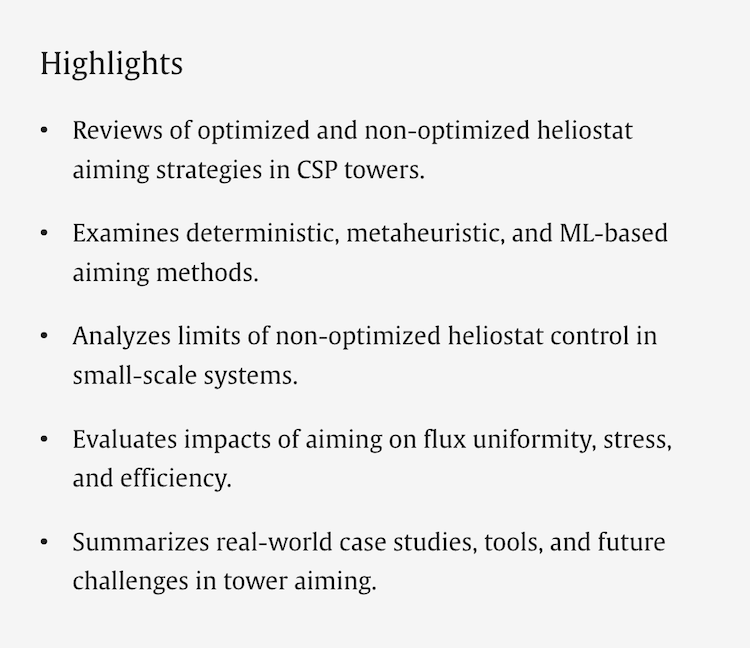
In conventional solar power tower (SPT) systems, heliostats typically aim at a single point on the receiver, such as the cavity aperture center or external receiver equator. While these traditional strategies minimize spillage losses, they often cause excessive thermal stresses due to non-uniform solar flux distribution, reducing receiver efficiency and lifespan. To mitigate this, multi-point and optimization-based aiming strategies, encompassing deterministic, metaheuristic, and machine learning methods, have been developed to achieve more uniform flux profiles and enhance overall performance. This review examines heliostat aiming strategies in SPT systems, categorizing them into non-optimized (e.g., single- or fixed multi-point) and optimized approaches. It provides detailed insights into their methodologies, key parameters (such as aiming factors and allowable flux densities), and application contexts, including single- and multi-objective optimizations. For instance, studies show that optimized strategies can reduce peak flux by up to 65 % while improving thermal efficiency by 10–16 %. Incorporating recent advancements, this paper identifies research gaps, such as real-time adaptability under variable weather, and proposes future directions to advance SPT technology for maximized energy yield and sustainability.
Toufik Arrif, Samir Hassani, A. Sánchez-González, Abdelfetah Belaid, Mawloud Guermoui, Farid Melgani, Heliostat aiming strategies in concentrated solar power towers: A review,
Renewable and Sustainable Energy Reviews, Volume 227, 2026, 116489, ISSN 1364-0321, https://doi.org/10.1016/j.rser.2025.116489
