











In 1883, the violent eruption of Indonesia’s Krakatoa volcano produced the most deafening sound ever recorded. The sound reached 310 dB, an explosion equivalent to a cannon fire he heard 3,000 miles away. The sound waves were so powerful that they even affected waves in England.Numerous technical and scientific breakthroughs today Harmlessly harness the potential of sound in medical, cleaning, or underwater echolocation applications.You can now add to these 3D printing with sound waves.
DSP: 3D printing technology with sound waves
Ultrasound has been used in the past for destructive applications, such as removing tumor tissue, as noted by the developers of the new 3D printing technology, whose results were published in the journal Nature. Is it possible to use it for creative purposes? The short answer is yes, as you can see in the sample image next to it. As always, the devil is in the details.
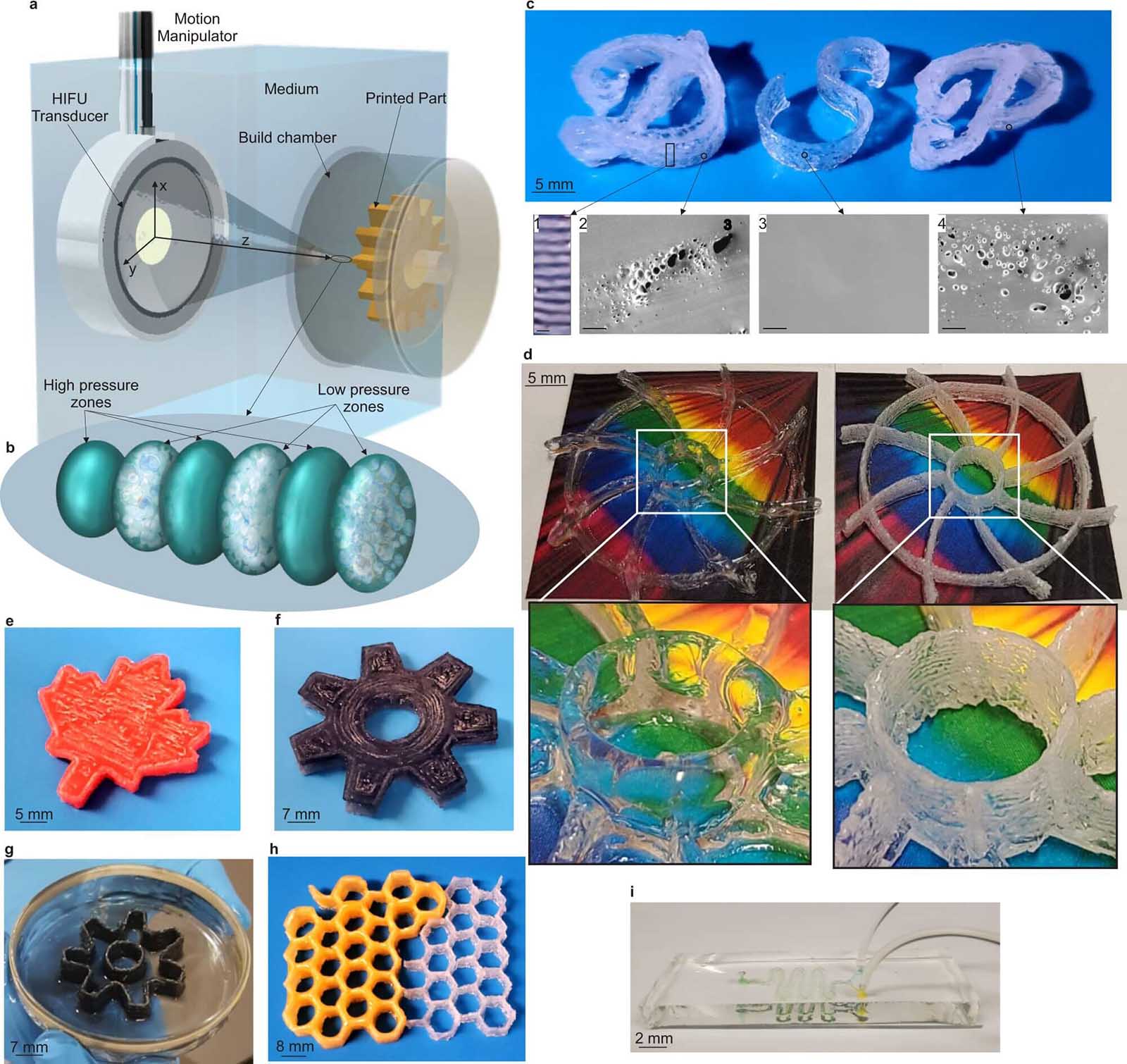
There are two main 3D printing technologies. The first and most common method is to heat melt a polymer or other material. Another, less common method is to use optical radiation to solidify a liquid resin with a laser beam. A third option is 3D printing using waves or direct sound (DSP). Moreover, it enables the creation of highly complex structures with unprecedented precision.
An approach used by researchers at Canada’s Concordia University uses ultrasound of specific wavelengths to create chemical reaction zones in a liquid polymer solution. Sound waves cause extreme pressure changes in microscopic bubbles, raising their temperature to about 15,000 Kelvin in a few picoseconds.
The raw material used is a PDMS polymer commonly used in additive printing. However, thanks to the ultrasonic field, which can be modulated according to the viscosity of the liquid and the type of wavelength, the 3D printing process can be carried out point-by-point. as if it were a pixel in an image.

The technology has applications in the aeronautical industry, sensor manufacturing and even printing implants inside the human body, and has already been tested with polymer and ceramic materials. The next step is to use polymer-metal composites to finally realize his 3D printing with metal waves.
A Generational Leap in 3D Printing Using Light and Nanomaterials
As already mentioned, 3D printing using light and resin is a less popular technique than thermal additive printing. But even in this area there is great progress. Researchers at Stanford University used a blue laser beam to solidify a gel-like resin.
But that’s not all. Under normal conditions, the resin solidifies along the entire laser beam. Additional strategies are required to enable selective solidification (or hardening as it is technically known). Scientists achieved this with nanomaterials and a red laser beam spread throughout the resin.
These nanomaterials are droplets as small as 1,000 times smaller than a human hair, with a protective silica coating. According to the scientist, one of the major challenges of the project was to coat the liquid inside to prevent it from leaking out.
When a red laser beam encounters these nanomaterials, the low-energy red photons are converted into high-energy blue photons.And it is at that moment that the resin solidifies, the so-called 3D printing.
This technique is currently relatively slow, but developers hope to print multiple dots simultaneously to speed up the process and improve print resolution.
The nanocapsules developed in this project can also be used in solar panels to convert low-intensity light energy into usable wavelengths for solar cells.
If you want to learn more about the uses of 3D printing, check out this article on its use in biomedical or its growing popularity in the construction sector with new biomaterials.
Whether through wave 3D printing or new metal alloys like the ones mentioned in this article, 3D printing could eventually reach large-scale industrial applications soon.
sauce:
