












As the digital age continues to evolve and shape the business environment, enterprise networks are becoming increasingly complex and distributed. The amount of data companies collect to detect malicious behavior is constantly increasing, making it difficult to detect deceptive and unknown attack patterns or so-called “needles in the haystack.” I’m here. With cybersecurity threats on the rise, including data breaches, ransomware attacks, and malicious insiders, organizations face significant challenges in successfully monitoring and protecting their networks. Additionally, a shortage of talent in the cybersecurity space has made manual threat hunting and log correlation a tedious and difficult task. To meet these challenges, organizations are turning to predictive analytics and machine learning (ML)-driven network security solutions as essential tools to protect their networks from cyber threats and unknown evils. .
The Role of ML-Driven Network Security Solutions
ML-driven network security solutions in cybersecurity refer to the use of self-learning algorithms and other predictive techniques (statistics, temporal analysis, correlation, etc.) to automate various aspects of threat detection. The use of ML algorithms is becoming increasingly popular in scalable technologies due to limitations present in traditional rule-based security solutions. This involves data processing with advanced algorithms that can identify patterns, anomalies, and other subtle indicators of malicious activity. This includes new and evolving threats that may have no known bad symptoms or existing signatures.
Detecting known threat indicators and blocking established attack patterns remains an important part of overall cyber hygiene. However, the traditional approach of using threat feeds and static rules can be time consuming when maintaining and covering all the different log sources. Additionally, indicators of attack (IoA) or indicators of compromise (IoC) may be unavailable or quickly outdated at the time of an attack. Therefore, businesses need a different approach to fill this gap in their cybersecurity posture.
In summary, the aforementioned shortcomings of rule-based security solutions highlight the importance of adopting a more holistic approach to network security. Today, ML-powered Network Detection and Response (NDR) solutions must be included to complement traditional detection capabilities and proactive security measures.
Benefits of ML for network security
So how is machine learning (ML) shaping the future of network security? We are revolutionizing network security by enhancing our threat detection capabilities.
- big data analysis: As the amount of data and variety of log sources continues to grow, organizations must be able to process vast amounts of information in real time, including network traffic logs, endpoints, and other sources of information related to cyber threats. . In this regard, ML algorithms can help detect security threats by identifying patterns and anomalies that might otherwise go unnoticed. Therefore, the ability and flexibility of a solution to incorporate various log sources should be a key requirement for threat detection capabilities.
- Automatic analysis of abnormal behavior: AI enables the required health monitoring of network activity by using analysis of normal network traffic as a baseline. Outliers and anomalous behavior can be detected with the help of automated correlation and clustering, reducing the need for manual detection engineering and threat hunting. Key questions that need answers include “What is the activity of other clients in the network?” and “Does the client’s behavior match previous activity?” can detect anomalous behavior such as lateral movement). Therefore, comparing a client’s current behavior to that of its peers serves as a good baseline for identifying subtle anomalies.
- Real-time detection of unknown attacks: Detecting known bad indicators directly (specific IP addresses, domains, etc.) is relatively easy, but many attacks may go undetected in the absence of these indicators. Statistical, temporal, and correlation-based detections are then very valuable for detecting unknown attack patterns in an automated manner. By incorporating an algorithmic approach, traditional security solutions based on signatures and indicators of compromise (IoC) can be enhanced to become less dependent on known malware indicators and more self-contained.
- Self-learning detection function: ML-driven solutions learn from past events to continuously improve threat detection capabilities, threat scoring, clustering, and network visualization. This may involve training the algorithms themselves and adjusting how information is displayed based on analyst feedback.
- Enhanced incident response: By learning from an analyst’s past incident response activities, ML can automate certain aspects of the incident response process, minimizing the time and resources required to respond to a security breach. This involves using algorithms to analyze text and evidence to identify root causes and attack patterns.
Examples of ML-driven network security solutions
When it comes to ML-driven network detection and response (NDR) solutions that incorporate the benefits outlined, ExeonTrace stands out as Europe’s leading network security solution. Based on award-winning ML algorithms that incorporate 10 years of academic research, ExeonTrace provides organizations with advanced ML threat detection capabilities, complete network visibility, flexible log source integration, and big data analytics . Additionally, because the algorithm relies on metadata analysis rather than the actual payload, it is cryptographically agnostic, completely hardware-free and compatible with most cybersecurity infrastructures. As a result, ExeonTrace can process raw log data into a powerful graph database, which can be analyzed by supervised and unsupervised ML models. Correlation and event fusion allow algorithms to identify high-fidelity anomalies and malicious behaviors, even when dealing with new or emerging cyberthreats that may not have established signatures or known malicious indicators. Subtle clues can be pinpointed with precision.
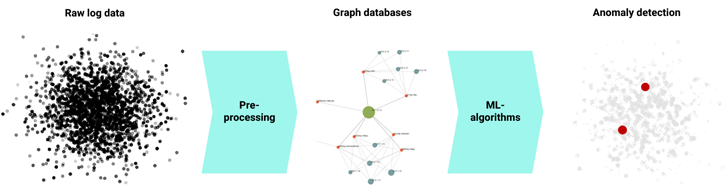 |
| Security Analytics Pipeline: Detect Network Anomalies with ML |
Conclusion
As cyber threats become more complex, organizations must go beyond traditional security measures to protect their networks. As a result, many businesses are turning to machine learning (ML) and predictive analytics to bolster their security defenses. In this regard, ML-driven Network Detection & Response (NDR) solutions such as ExeonTrace are designed to help organizations stay ahead of the ever-evolving threat landscape. By utilizing advanced ML algorithms that analyze network traffic and application logs, ExeonTrace provides organizations with rapid detection and response to even the most sophisticated cyberattacks.
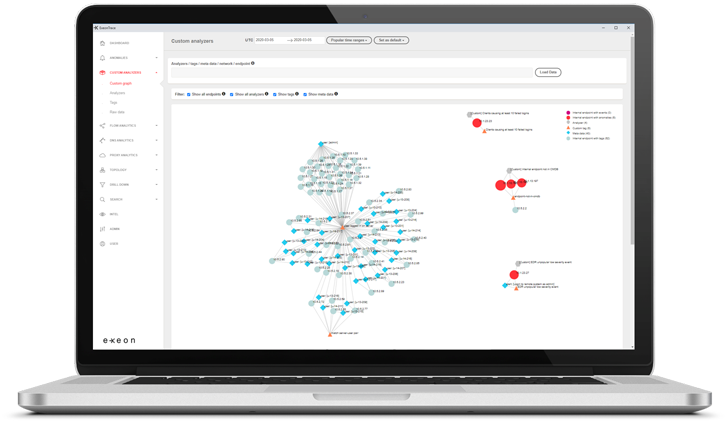 |
| ExeonTrace Platform: Network Visibility |
Book a free demo to see how ExeonTrace leverages ML algorithms to increase your organization’s cyber resilience—fast, reliable, and completely hardware-free.
