










The Core Principle: Solar Depends on Sunlight Intensity
At the heart of every solar system is a simple physics relationship:
P=A×r×H×PR
Where:
- P = Power output
- A = Panel area
- r = Panel efficiency
- H = Solar irradiance (sunlight intensity)
- PR = Performance ratio (system losses)
One thing to note is that during rainy season, only ONE variable drops significantly: H (irradiance)
What Actually Happens During Rain?
Cloud Cover Reduces Solar Irradiance
| Condition | Irradiance (W/m²) | Expected Output |
| Full sun (clear sky) | 800 – 1000 | 100% |
| Light clouds | 400 – 700 | 40% – 70% |
| Heavy clouds / rain | 100 – 300 | 10% – 30% |
Technical Reality:
- Solar panels are rated at 1000 W/m² (Standard Test Conditions)
- During heavy rain, irradiance can drop to as low as 10% of that value
That means your 5kW system may behave like a 0.5kW – 1.5kW system
Real Measurable Example (Nigeria Context)
Let’s take a typical 5kW solar system in Asaba:
☀️Dry Season:
- If Irradiance is 900 W/m²
- Output will be 4.5 – 5kW
- While charging current = 80A to 100A under 48V system
🌧️ Rainy Season:
- If Irradiance is 200 W/m²
- Output will be around 1kW
- While charging current = 15A to 25A
In extreme cases (thick clouds):
- Output drops below 500W andcharging current falls to 5A- 10A
Why This Confuses Customers
Most users expect:
“If I installed 5kW, I should always get 5kW” But solar does NOT work like a generator.
Key Difference:
| System Type | Behaviour |
| Generator | Constant output |
| Solar | Variable output (depends on sunlight) |
Solar is an energy source that is variable in nature, not a fixed power machine
Diffuse Light vs Direct Sunlight
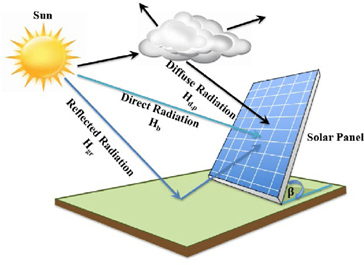
Even when the sun is not visible:
- Panels still receive diffuse radiation (scattered light)
- But diffuse light is less concentrated
Engineering Impact:
- Lower voltage stability
- Reduced MPPT efficiency
- Slower battery charging
The Battery Effect (Critical)
Invariably, low irradiance directly affects battery performance:
What happens During Rainy Days:
- Battery charges slowly during the day
- Does NOT reach full capacity
- Discharges faster at night
Long-Term Risk:
- Chronic undercharging
- Reduced battery lifespan
- Customer believes “battery is bad”
In reality: energy input is insufficient during the rainy days.
System Design Mistakes That Make It Worse
This is where most installers fail, because they engage in:
❌Undersized PV Array
- Designed only for sunny conditions, sometimes without considering power to sustain loads
- No margin for cloudy days or days of autonomy.
❌Poor Energy Audit
- Load is higher than the realistic solar production
❌No Seasonal Design Adjustment
- Nigeria has distinct wet vs dry seasons
Engineering Solutions (What KOWATEK SOLAR LTD Do Differently)
✅Oversize Solar Panels (Critical Strategy)
- Add 30% – 60% extra PV capacity
- Compensates for low irradiance days
✅Optimize MPPT Range
- Ensure inverter operates efficiently at low voltage/light
✅Intelligent Load Management
- Prioritize essential loads during low generation
✅Hybrid Integration
- Seamless switch to grid or generator when needed
The Business Reality (ROI Perspective)
Let’s quantify:
Diesel Cost:
- ₦500/kWh
Solar (annual average):
- ₦35 -₦60/kWh
Even with rainy season losses:
Solar is still 5x – 10x cheaper long-term
Final Technical Conclusion
Rain does NOT damage solar systems.
It simply reduces power output due to available sunlight (irradiance)
- Which reduces:
- Power output
- Charging speed
- Daily energy production
Key Takeaway (For Clients)
“Your solar system is not failing, just that the sun is simply weaker during rainy days.”
