











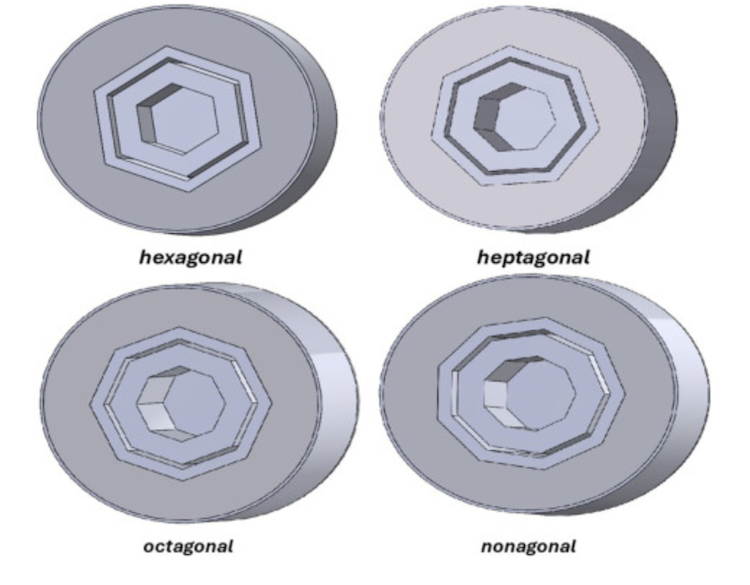
 Concentrated solar power researchers have long known that porous ceramic “volumetric” receivers can deliver very high temperatures.
What a new study from Cranfield University shows is that the internal shape of the cavity impacts heat retention. After testing different polygonal internal geometries, they found that the nine‑sided design – the nonagon – holds onto more of the sun’s energy than simpler polygons, pushing outlet air temperatures above 1,500 K. Above nine sides, results were poor.
In their paper, Geometric optimisation of volumetric solar receivers: a study of polygonal cavity configurations, the Cranfield team showed that more curved geometries delivered better radiation distribution and higher temperatures than simpler straight‑walled designs.
A modular solar receiver designed for higher temperatures
The receiver they tested is compact and simple: an open cavity whose walls are made of reticulated porous ceramic (SiSiC). Ambient air is drawn in through the front aperture, and heated by the reflected sunlight (How concentrated solar works) as it flows through the hot porous structure, and then sent on to the reactor or thermal storage unit as very hot air.
The tested options all had the same aperture diameter, wall thickness, and internal radius. What changed in each test was the cavity’s internal shape.
Instead of a cylindrical or spherical internal shape, the team assembled the porous blocks into various polygons: a hexagon, heptagon, octagon, and nonagon.
Using ANSYS Fluent coupled with a Monte Carlo radiation model, they then applied the same concentrated solar inputs (4.1 kW and 4.9 kW) and swept through a range of air mass flow rates to see how much difference geometry alone makes to radiative absorption, convective heat transfer, and resulting outlet temperature.
Ahmed Aldubayyan said the shape of the receiver’s internal geometry clearly impacted the receiver’s ability to reach the very highest temperatures.
“The nine-sided nonagonal internal shape is the geometry that helps distribute radiation more evenly inside the cavity and best boosts the energy absorbed by the porous walls,” he said in a call from the UK.
Why temperatures are needed above those for power generation
For power generation, temperatures in the 450-560°C range are more than enough to generate electricity in any thermal power plant, including concentrated solar thermal.
But as higher-temperature concentrated solar power is increasingly explored for thermochemical production of solar fuels, research is needed to develop higher-temperature components, such as the solar receiver. Sulfur cycles are an example.
“What I really need from the receiver is the very high temperature needed to run the SI cycle, for example,” Ahmed Ali Aldubayyan explained.
Concentrated sunlight enters through the open aperture on the left and is absorbed volumetrically within the porous SiSiC, whose roughly 0.9 porosity allows radiation to penetrate deep into the foam while allowing air to flow through the struts.
Ambient air at about 300 K enters through the cavity aperture, while solar radiation heats the porous SiSiC wall; heat is then transferred from the hot solid matrix into the air as it flows through the porous region.
The air entering the receiver is initially at ambient temperature, but that the applied solar flux and internal heat transfer are sufficient to raise the outlet temperature at the back dramatically.
The porous ceramics sit inside a carefully insulated sandwich: an internal air gap, ceria‑based insulation, an alumina‑silica front seal, and a steel shell with an aluminum shield around the aperture to reduce re‑radiation losses.
Why more facets lead to higher efficiency
Keeping the distance from the cavity center to the inner wall fixed, increasing the number of polygon sides slightly reduces both the internal surface area and volume, concentrating incident flux onto a smaller area and raising the surface energy density.
That also introduces more edges and corners within the cavity, where simulations suggest turbulence and mixing intensify, increasing contact between hot solid surfaces and the flowing air; together, these effects raise both the outlet temperature and thermal efficiency.
The winning internal shape, the nonagon, had peak thermal efficiency around 75% at 4.1 kW and 73% at 4.9 kW, compared to the hexagonal design’s 56% under the same conditions.
In the temperature contour plots, the nonagon shows the most compact, symmetric high‑temperature core, with static temperatures approaching 1,672 K at the efficiency optimum, whereas hexagonal and heptagonal cavities show more diffuse, less uniform hot zones.
“The choice of SiSiC reticulated porous ceramic with high porosity was guided by earlier experimental work, which showed that such structures can reach very high temperatures in volumetric receivers while still allowing good airflow,” Aldubayyan explained.
Aldubayyan conceded that doing full high‑flux receiver experiments on-sun in the UK would be challenging, so he relied on a previously tested receiver from the literature in earlier work by V. Patil and co‑authors for validation instead of building his own from scratch at this stage.
Aldubayyan explained that he first reproduced their experimental receiver numerically; once he matched those measurements, he applied the same simulation setup to his new cavity geometries.
So, first, the team had to prove the computational model could reproduce reality. They did that by recreating computationally the Patil receiver that had already been tested experimentally, reaching outlet air temperatures up to about 1,406 K and an efficiency of 69% under a 4.9 kW input in
When the Cranfield team ran the same geometry and boundary conditions numerically, simulated outlet temperatures tracked the experimental data closely at 4.1 kW and within reasonable error bars at 4.9 kW, giving them confidence to extend the setup to the other shapes.
A nonagon is likely the sweet spot
Once that validation step was in place, the geometry sweep revealed a clear trend: every additional side brought a gain in peak efficiency, and those gains grew as the cavities became more compact and edge‑dense.
From six to nine faces, peak efficiency climbed by roughly 19 percentage points, with the biggest jump between octagon and nonagon. But beyond nine faces, fabrication complexity and pressure drop could erode those benefits.
