











Solar panels do not work efficiently when they are dirty. German engineers have developed an ultra-thin coating that can self-clean solar panels and other surfaces.
Solar is the largest source of renewable energy and is growing rapidly. But, as you might imagine, sending people with squeegees to clean each park’s millions of solar panels isn’t practical. The ideal would be to clean them yourself, and researchers at the Fraunhofer Institute in Germany are now working towards that concept.
The team created a coating that reacts differently to water depending on the time of day, allowing it to shed dust and dirt buildup fairly quickly. The main ingredient is titanium oxide, which under normal conditions repels water and forms easy-to-roll droplets. However, when titanium oxide is exposed to UV light, it changes state and becomes highly water-attracting, keeping its surface moist with a thin layer of water.
In fact, it becomes a self-cleaning coating. Dust and dirt accumulated during the day are hard to adhere to the surface with a thin layer of water, and at night they become water droplets and easily roll off, removing the dirt together. As a bonus, when titanium oxide is activated by UV light, the organic molecules are destroyed, effectively sterilizing the surface.
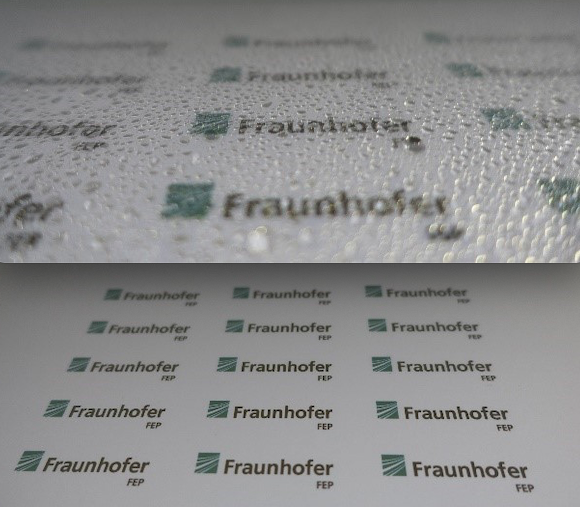
Fraunhofer FEP
The general idea has been implemented before in self-cleaning glass, but typically involves either water-repellent or water-absorbing mechanisms, but not both. Even better, the new coatings from the Fraunhofer team are designed to be mass-produced roll-to-roll and can be applied to existing solar cells, windows and other surfaces.
In tests, the team used a pilot plant to produce thin rolls of glass 30 cm (11.8 in) wide, 20 m (65.6 ft) long, just 100 micrometers thick, and up to 150 nanometers thick. with a fine titanium oxide coating.
Of course, there are still hurdles to overcome. The team says the thin glass is still very fragile and sensitive to heat. Future work will focus on improving this by investigating the possibility of using polymer films instead.
The research will be presented at the BAU trade fair in Munich in April.
Source: Fraunhofer Institute
