











Raphael Kaye, Adrian So
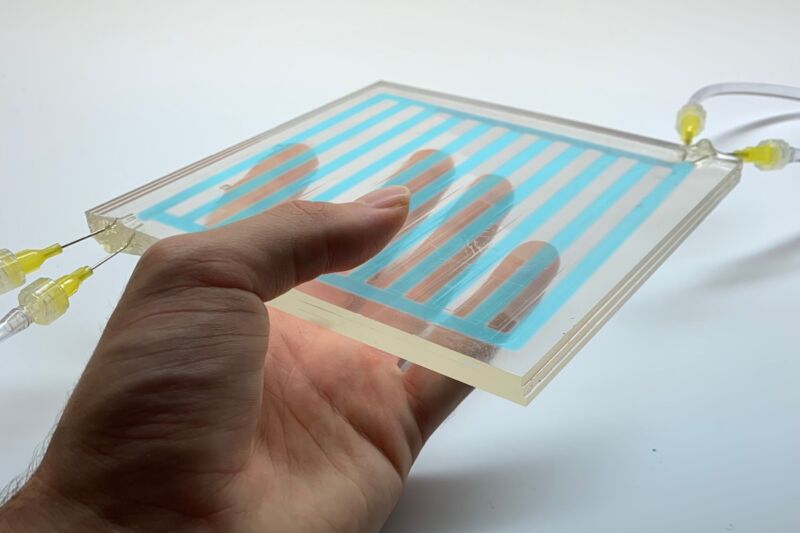
Squid and some other cephalopods are capable of rapidly changing skin color thanks to the unique structure of their skin. Inspired by squid, engineers at the University of Toronto have prototyped a ‘liquid window’ that can shift the wavelength, intensity and distribution of light transmitted through the window, thereby saving significant energy costs. They describe their work in a new paper published in the Proceedings of the National Academy of Sciences.
“Buildings use a lot of energy to heat, cool, and light the spaces inside,” says co-author Raphael Kay. “If we can strategically control the amount, type, and direction of solar energy entering a building, we can significantly reduce the amount of work required for heating, cooling, and lighting.” I like to think of it as a creature with an outer layer of windows. However, these functions are mostly static and limit the extent to which the building ‘system’ can be optimized in changing ambient conditions.
Installing openable blinds is a crude way of offloading lighting and heating and cooling systems. An electrochromatic window that changes opacity when a voltage is applied is a more sophisticated option. But these systems are expensive, have complex manufacturing processes, and have a limited opacity range, according to Kay. Also, it is not possible to shade part of the window glass and shade another part.
So they turned to nature for inspiration. Last year, engineers in Toronto built a system with an array of optofluidic cells inspired by marine arthropods such as krill, crabs and tilapia-like fish. This system can disperse and collect pigment granules in the skin to change color and shade. These prototype cells consisted of a thin layer of mineral oil between two transparent plastic sheets. Injecting a small amount of water with pigment or dye through a tube connected to the center of the cell creates a bloom of color. The shape of the bloom is related to the flow rate that can be controlled with a digital pump. Low flow produces circular bloom. Higher flow velocities create complex branching patterns.
In these prototype optofluidic cells, inspired by tilapia, krill and crab skin, injecting the dye at different flow rates results in different branching patterns. Credits: Raphael Kay, Charlie Katrycz.
Cuttlefish skin is translucent and has an outer layer of pigmented cells called chromatophores that control the absorption of light. Each chromatophore is attached to muscle fibers that line the surface of the skin, and these fibers are connected to nerve fibers. It’s easy to stimulate these nerves with electrical pulses to make the muscles contract. And as the muscle is pulled in different directions, the cells expand along with the pigmented area and change color.
Below the chromatophore is another layer of iridophores. Unlike chromatophores, iridophores are not pigment-based, but are examples of structural colors similar to butterfly wing crystals, except that squid iridophores are dynamic rather than static. It can be tuned to reflect a certain wavelength of light. A 2012 paper suggested that this dynamically tunable structural color of iridophores is related to a neurotransmitter called acetylcholine. The two layers work together to produce the unique optical properties of squid skin.
