











As the saying goes, a picture is worth 1,000 words. And now, a startup called Nuralogix is taking this idea to the next level. Selfies will soon be able to give you 1,000 diagnostics about your health.
Anura, the company’s flagship health and wellness app, takes a 30-second selfie and uses that data to create a catalog of measurements about you. They include important stats such as heart rate and blood pressure. Mental health-related diagnostics such as stress and depression levels. Details about your physical condition, such as body mass index and skin age. Your level of risk for things like high blood pressure, stroke, and heart disease. Biomarkers such as blood sugar levels.
Some of these readings are more accurate than others and have improved over time.Just in time for CES in Vegas when I stumbled upon the company today, Nuralogix announced that non-contact blood pressure measurements are available. It announced that it is more accurate, and specifically has a precision equivalent to a standard deviation of error of less than 8mmHg.
Anura’s growth is part of a larger trend in the world of medical and wellness. The Covid-19 pandemic has given the world a golden opportunity to normalize what many considered experimental or sub-optimal and to use and develop more telemedicine services.
This, coupled with the growing awareness that regular monitoring can be key to preventing health problems, has led to a proliferation of apps and devices on the market. Anura isn’t the only one out there, but it’s a remarkable example of how companies are following the equation of relying on low friction to deliver big results. In some ways, it’s the holy grail of much modern medicine, and one of the reasons many wanted his Theranos to become a reality.
So while some pandemic-era behaviors aren’t as entrenched as people thought (e.g., e-commerce hasn’t completely replaced in-person shopping), observers have noted that telemedicine, Nuralogix, and others of companies will implement
Grandview Research estimates that telemedicine will be a $83.5 billion global market in 2022, a figure that will swell to $101.2 billion in 2023, becoming a $455.3 billion market in 2030, a 24% CAGR. estimated to grow in
Based in Toronto, Canada, with support such as the city’s Mars Innovation initiative (a consortium of universities and research groups that help spin out academic research), the startup uses a B2B business model to partner with Japan’s NTT and counting Spanish insurance companies. Provider Sanitas is included as a customer. Automakers also believe it could be used to track drivers when they are tired, distracted, or in other types of health crises. We are discussing
Anura’s results are now positioned as guidance for ‘investigative’ insights that complement other types of assessments. The company complies with his HIPAA and other data protection regulations and is currently going through the FDA approval process to make the results more proactively available to customers.
There is also a Lite version of the application (iOS and Android) that allows individuals to obtain some but not all of these diagnostics.
The Lite version is notable not only as a way for companies to advertise themselves, but also as a way to collect data.
Nuralogix built Anura behind an AI trained on data from approximately 35,000 different users. A typical 30-second video image of her of the user’s face is analyzed to see the movement of blood around it. “Human skin is translucent,” the company says. “The light and its respective wavelengths are reflected off different layers under the skin and can be used to reveal blood flow information in the human face.”
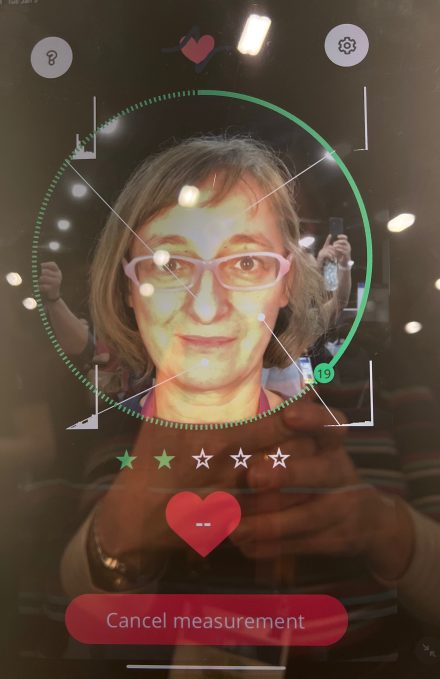
Ingrid testing the app at CES
This is matched against various diagnoses of people using traditional measurement tools and uploaded to the company’s “DeepAffex” emotion AI engine. Anura app users are then essentially “read” based on what the AI is trained to see. The blood flowing in one direction or another, or the color of a person’s skin, can say a lot about that person’s physical and mental state.
DeepAffex has potential uses beyond telemedicine diagnosis. The company’s AI technology uses this technique of “transcutaneous optical imaging” (abbreviated to him as TOI by the company) to “read” the face, allowing the user’s emotions to be measured before pivoting to health. was applied to read One of its potential applications is using the technology to augment or replace traditional lie detector tests routinely used by law enforcement and others to determine whether a person is telling the truth. but has been proven to be flawed.
There is also a view that extends to the hardware. The current version of Anura is based on an app accessed from smartphones and tablets, but in the long term the company will work on its own scanning device, adding other types of face scanning and other tools such as infrared. You may also get more information by Generates more diagnostic results. (For example, one area currently untouched is blood oxygen, which the company definitely wants to address.)
I tried out the full version of the Anura app in Las Vegas this week, and I have to say it’s a pretty engaging experience, and one that’s low enough friction for many to accept. (And to that end, the company’s demo had a perpetual line of people waiting to try it out.)

