











In 2018 Costa Rica set a new record for green electricity production. For 300 consecutive days, the country ran entirely on renewable electricity. On the other hand, Iceland, fueled by abundant geothermal power, uses renewable electricity almost year-round, and Norway is a firm follower of renewables thanks to its large wind farms.Sustained growth seen year after year Renewable energy Besides improving the efficiency of established technologies such as solar power, other green power sources are also being considered.Latest news in the field tidal power It suggests that the future of green energy could lie in the ocean.
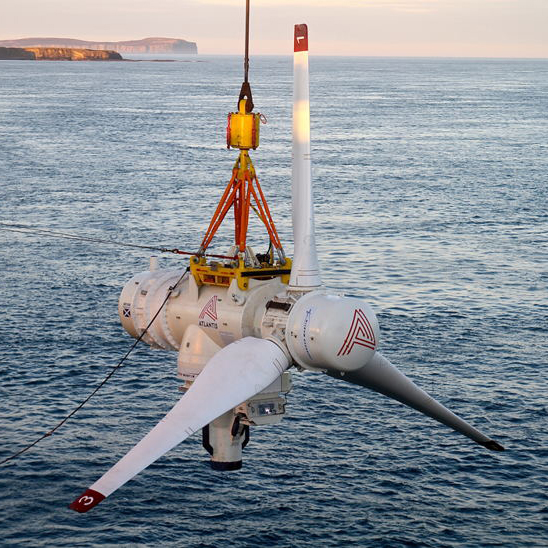
In 2018, the company responsible for the Orkney tsunami power station on the Scottish coast announced that it had produced 3GWh worth of electricity in the past 12 months, breaking all tidal power records in Scotland. Developed by Orbital Marine Power, the SR2000 model uses a series of turbines suspended from a floating platform and rotating with the tide. What’s more, this year the world’s largest tidal turbine (undersea, in this case) will also start operating on the Scottish coast. Boasting a total weight of 150 tons and a blade length of 20 meters, it will be installed on the seabed. The technology was introduced as part of Project Stroma, originally founded in 2010. The total projected output of the plant is expected to reach up to 400MW, making it the most powerful plant of its kind in the world.
So what are the current options renewable ocean energy? Here are some of the most important ones: By the way, check out our cool video about the renewable energy of the future that we recently prepared.
tidal power
As already pointed out, tides are perhaps the most promising source of renewable energy from the ocean. Its most important advantage is that as long as the moon continues to orbit the earth and gravity maintains its gravitational pull, it will continue to generate electricity reliably and regularly. The most common tidal power system works like a wind turbine. It uses an underwater turbine powered by the tide. This type of tidal power station is known as Tidal Stream Generators (TSG). Another, more expensive option for renewable ocean energy is tidal barrages. This allows high and low tides to flow through the turbines instead of damming the water.
wave power
Even though it’s the first technology project Harnessing the kinetic energy of waves can be traced back to the late 19th century.th The first commercial power plants of the century did not come online until the last decades of the 20th century.th century, Norwegian and Scottish coasts. The latter, Isla Limpet, was decommissioned in 2012, but was taken over by other renewable ocean energy plants. A similar facility he opened in 2011 in the Bay of Biscay on Spain’s Cantabrian coast.unlike the wind Solar power, has a wide range of wave power technologies. These are some of the most common wave energy converters (WECs).
- Peramis (attenuator)A kind of floating snake— Named after a sea snake Peramis Platurus—, the technology consists of a series of linked cylinders that follow the waves on the ocean surface. Its low maintenance cost is one of its main advantages.
- Salters Duck (Terminator)This technology, which has a similar principle to Pelamis, is based on a row of independently moving devices resembling duck heads placed facing the waves and attached to the ocean floor. Waves move each piece, which acts like a piston.
- millimeter waveIn this case, the platform rests on the seabed and has air chambers and membranes on its sides. Waves push the membrane, driving air through a conduit with a turbine at one end.
- oyster (oscillating wave surge converter)A vertical oscillator mounted on a subsea platform in the near sea. This hinged buoyancy flap moves back and forth with the waves, pumping water to the mainland hydroelectric power station.
- vibrating water column (OWC)The technology is installed on the shore, leaving an air chamber to catch the waves, pushing air inside to spin the turbines.
In fact, some of these renewable energy technologies could provide a stable, efficient and clean source of electricity in the future, enabling the transition to a more sustainable energy model.
sauce: Science Direct, Research Gate
