











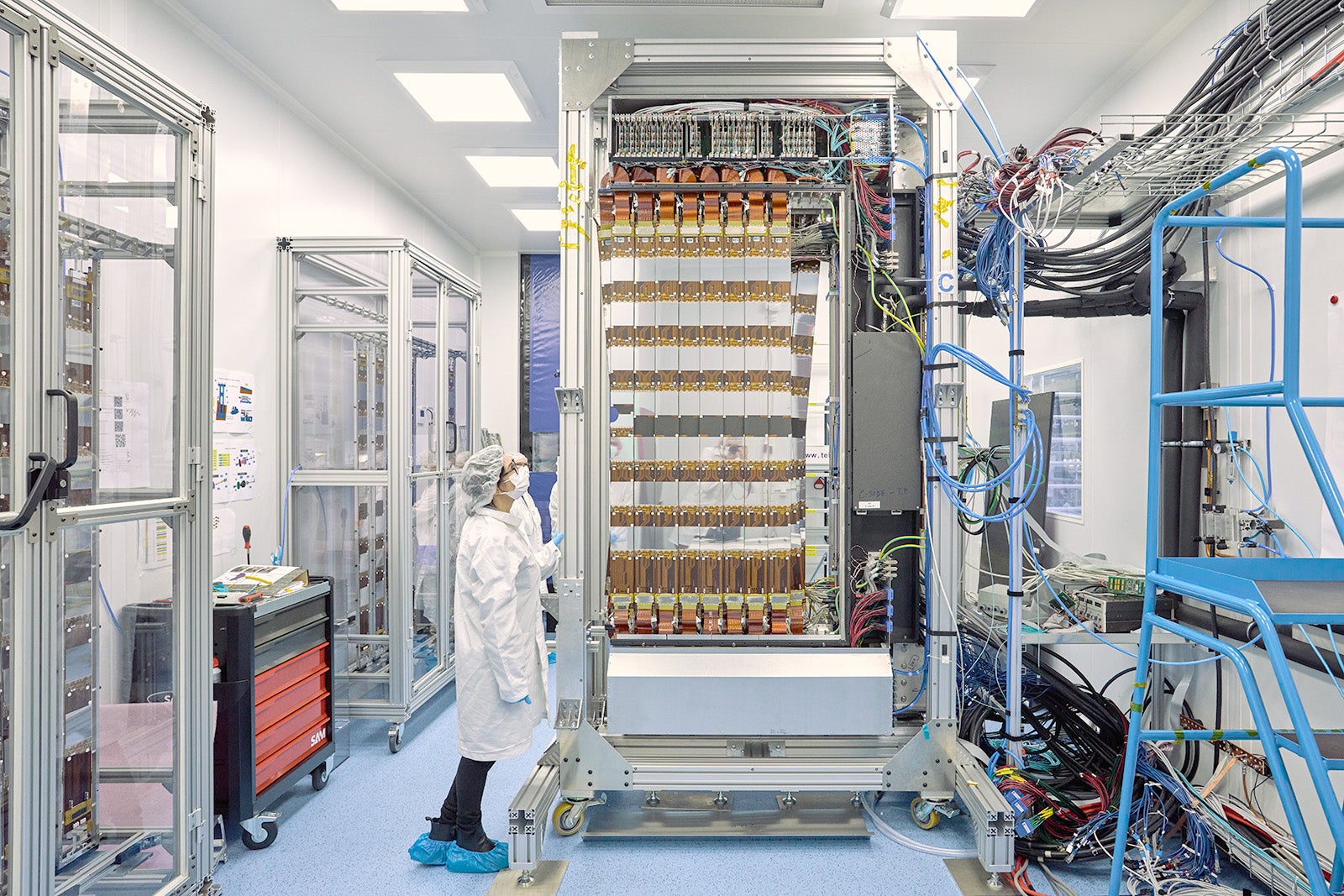
A once-promising hint of new physics from the world’s largest particle accelerator, the Large Hadron Collider (LHC), has melted away, dashing one of physicists’ best hopes for a major discovery.
The apparent anomaly was the unexpected difference between the behavior of the electron and that of its more massive cousin, the muon, as it arises from the decay of certain particles.
But the latest results from the LHCb experiment at CERN, the European particle physics laboratory near Geneva, Switzerland, which hosts the LHC, suggest that electrons and muons are produced at the same rate after all. .
Another senior member of the LHC experiment, Florencia Canelli, an experimental particle physicist at the University of Zurich in Switzerland, said: It reveals how many surprising subtleties conspired to produce the apparent anomaly, she says.
Renato Quagliani, an LHCb physicist at the Swiss Federal Institute of Technology in Lausanne, presented the results at a seminar held at CERN on December 20th, drawing more than 700 viewers online. The LHCb collaboration has also posted two preprints he has on the arXiv repository.
unbalanced attenuation
The LHCb first reported a slight discrepancy in muon and electron production in 2014. B. Mesons, these quickly disintegrated. The most frequent decay patterns produced pairs of particles and their antiparticles, either electrons and positrons or muons and antimuons, in addition to another type of meson called a kaon. Although the standard model predicted that the two types of pairs would occur with approximately equal frequency, the LHCb data suggested that electron–positron pairs occur more frequently.
Experiments in particle physics often give early results that deviate slightly from the standard model, but as more data are collected in the experiments, they prove to be statistical flukes. But that was not the case this time. Instead, over time B.Meson anomalies seemed to have become more pronounced and reached a level of confidence known as 3 sigma, but not yet to 5 sigma, the critical level often used to claim discoveries. did.number of relevant measurements B. Mesons also reveal deviations from theoretical predictions based on the standard model of particle physics.
Results reported this week included more data than previous LHCb measurements B.– Meson decay, and a more thorough study of possible confounders. Chris Parkes, a physicist at the University of Manchester in the UK and spokesman for the LHCb, said the apparent discrepancy in previous measurements involving kions was partly due to misidentification of other particles as electrons. said that it was found The LHC experiment is good at catching muons, but hard to detect electrons.
Search Refocus
This result may disappoint many theorists who have spent time coming up with models that could explain the anomaly. “People must have hoped to find cracks in the standard model,” Parkes said. Say. “That’s just how science works.”
The latest results have been rumored for months, but the confirmation is surprising, says Gino Isidori, a theoretical physicist at the University of Zurich who attended the CERN talk. This could indicate the existence of hitherto unseen subatomic particles that influence the decay of matter. B. meson. Isidori acknowledges that the LHCb collaboration was “honest”, acknowledging that there were problems with the previous analysis, but regrets that it took the collaboration so long to find the problem. I’m here.
However, several other anomalies, including those documented B.Meson decays without -K mesons could still turn out to be real, Isidori added. “Not all is lost.”
Marcella Bona, an experimental physicist at Queen Mary University in London who has participated in yet another LHC experiment, agrees. “Theorists are already thinking of ways to console themselves and refocus,” she said.
The remaining promising hints of new physics include: W. Boson was announced in April to be larger than expected. But another anomaly, also involving muons, could disappear. The muon’s magnetic moment appeared to be stronger than predicted by the Standard Model, but the latest theoretical calculations suggest otherwise after all. Instead, this discrepancy could be attributed to miscalculations in the standard model’s predictions.
This article is reproduced with permission and was first published on December 20, 2022.
