











There are many reasons why water is not drinkable.Still, the two most common are high salinity or pollution, due to human activity, as in wastewater, or simply due to microbial growth in stagnant water. Various desalination technologies exist to address this issue.The problem is that most of them Requires external energyUnfortunately, access to the electricity grid is often a problem in areas most affected by drinking water shortages.Therefore New solar desalination system The ones developed by MIT students are particularly encouraging.
What is a Passive Solar Evaporation System?
Evaporation is one of the most common techniques for making wastewater or saline water potable. This removes not only microorganisms, but also harmful elements such as heavy metals. Evaporation, of course, requires energy. Actively or passively availableA proactive approach involves the use of electricity or fuel. Passive solar evaporation, on the other hand, Works easily in sunlightOf course it is complemented with solar concentrators and other technologies. This is the approach of the solar desalination system.

On a previous occasion, we talked about some technologies that make this possible. For example, the use of gel polymer composites that are both hydrophilic and semiconducting. This system has successfully desalinated the water of the Dead Sea. Another technology that has caught our attention is an absorbent paper containing a carbon solution that can handle up to 2.2 liters of water per square meter of material per hour. So what’s so special about the MIT solution?
Solar Desalination Systems: The MIT Approach
Innovative technologies used for wastewater treatment, desalination, etc. avoid salt contamination of hygroscopic membranes, a common problem in these systems. And it does so without resorting to sophisticated hydrogels or liquid metals. Its design is based on the use of layers of everyday materials.
The top of this solar desalination system consists of a layer of dark material that has the ability to absorb the sun’s radiation. Beneath it is inserted a layer of perforated material (polyurethane in the experiment) with a thickness of 2.5 mm. Narrow compartments are left in between to allow the water to be potable. Then place the device over salt water or contaminated water.
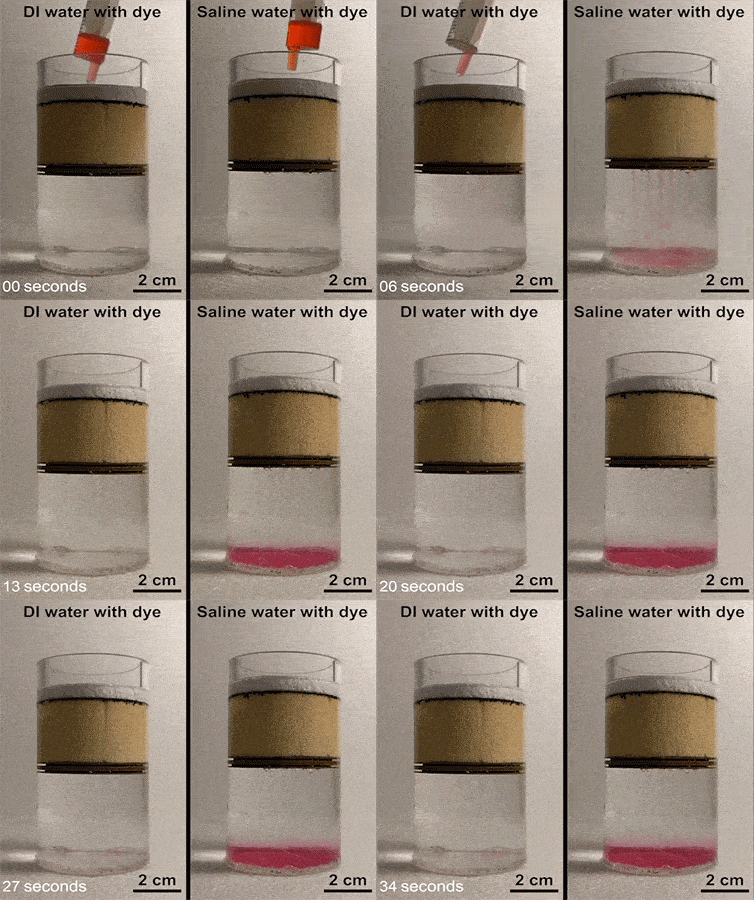
Because of the temperature difference, convective circulation occurs. this is, Water circulation moves salt particles from the warmer top to the bottomThe rest of the evaporated water is recovered by condensation.
The solar desalination system process can be seen in the adjacent GIF. This GIF shows the pink salt water quickly descending into the lower tank.
What are the most common desalination technologies?
The MIT study is promising and may open the door to desalination in remote and resource-poor areas, but this solar desalination system Not likely to be a large-scale solutionIn that sense, the most widespread and effective technology at the moment is reverse osmosis. If two liquids with different concentrations are added to the separation membrane, the one with the lower concentration will flow more easily into the one with the higher concentration. This is known as “salinity difference”.
In reverse osmosis, a highly concentrated liquid is forced to flow in the opposite direction, trapping salt ions as they pass through a filter membrane.
The technology is increasingly optimized to gradually reduce energy demand in addition to using renewable energy, as described in this article. Based on similar principles, a new type of renewable energy based on salinity difference, also called blue energy, is being researched.
If you’d like to stay up to date on other technologies like this new solar desalination system, subscribe to our newsletter at the bottom of the page.
sauce:
