











of Renewable energy storage It is one of the big challenges for wind and solar energy to become a major power source. Today, it offers efficiencies that were unthinkable just a few years ago. Already more than 20% photovoltaic power generation – Nighttime or windless periods will continue to affect production stability.Fortunately, a unique semi-solid battery A new technology developed by researchers at MIT could be one of the scientific breakthroughs that could provide an answer to this challenge.
In addition to addressing the innovative MIT Battery, this article will also cover other renewable energy storage solutions such as:
“molasses” battery
Technically, the MIT device is a semi-solid flow battery, but its consistency and color are reminiscent of molasses.The researchers recently published a paper in the scientific journal Joules that their solution was Cheaper, more efficient, and more scalable than current ones.
These new batteries are the so-called variable renewable energy (VRE) 1 day or more. In this case, the main ingredient that scientists used to achieve this is zinc manganese oxide.
One of the main obstacles for flow batteries such as vanadium batteries is the High cost of chemicals used to store electricity on the megawatt scaleTo get around this hurdle, researchers have resorted to mixing manganese with carbon black. This gives the molasses-like appearance above. conductive zinc solution.
Their viscosity allows these electrolytes (known as solutions) to flow while at the same time preventing the conductive particles from settling to the bottom when not in use. Importantly, researchers point out. A balance of cost, performance and durability from the prototype stage.
Zinc-manganese batteries are an evolution of flow batteries that have been developed over the past decades. High charging and storage capacity in a very short timeWe discuss this and other renewable energy storage technologies below.
do you like what you see? Download PDF here
redox flow battery
Flow batteries began to be investigated in the 19th century when they were used in a prototype airship called La France. 0.5 ton zinc-chlorine flow battery Developed for the project. This battery was a liquid type, but it never got beyond the experimental stage.
NASA revived the idea a century later in 1973, building the first redox flow battery. Futuristic electric lunar base. Unfortunately it was never used. Finally, in the 1990s, vanadium redox flow batteries began to be used industrially at Mitsubishi power plants in Japan. This time based on iron and chromium.
These batteries are typically more expensive to manufacture, but strangely enough, The pitch used as fuel was very rich in this metalNot only the soot it produces, but also allows for competitive production.
But What is a redox system? These renewable energy storage flow batteries use liquid electrolytes and Reduction and oxidation process (hence the “redox”).
Electrochemical processes are based on two components dissolving in a liquid solution. pass through adjacent membranes A place where ion exchange takes place. For vanadium, different oxidation and reduction states Applied on both sides so that the elements exchange protons to achieve equilibrium.
In addition to replacing vanadium with bromide to reduce costs, other redox batteries developed in recent years are based on organic materials, closing the loop on the renewable energy ecosystem.
green hydrogen
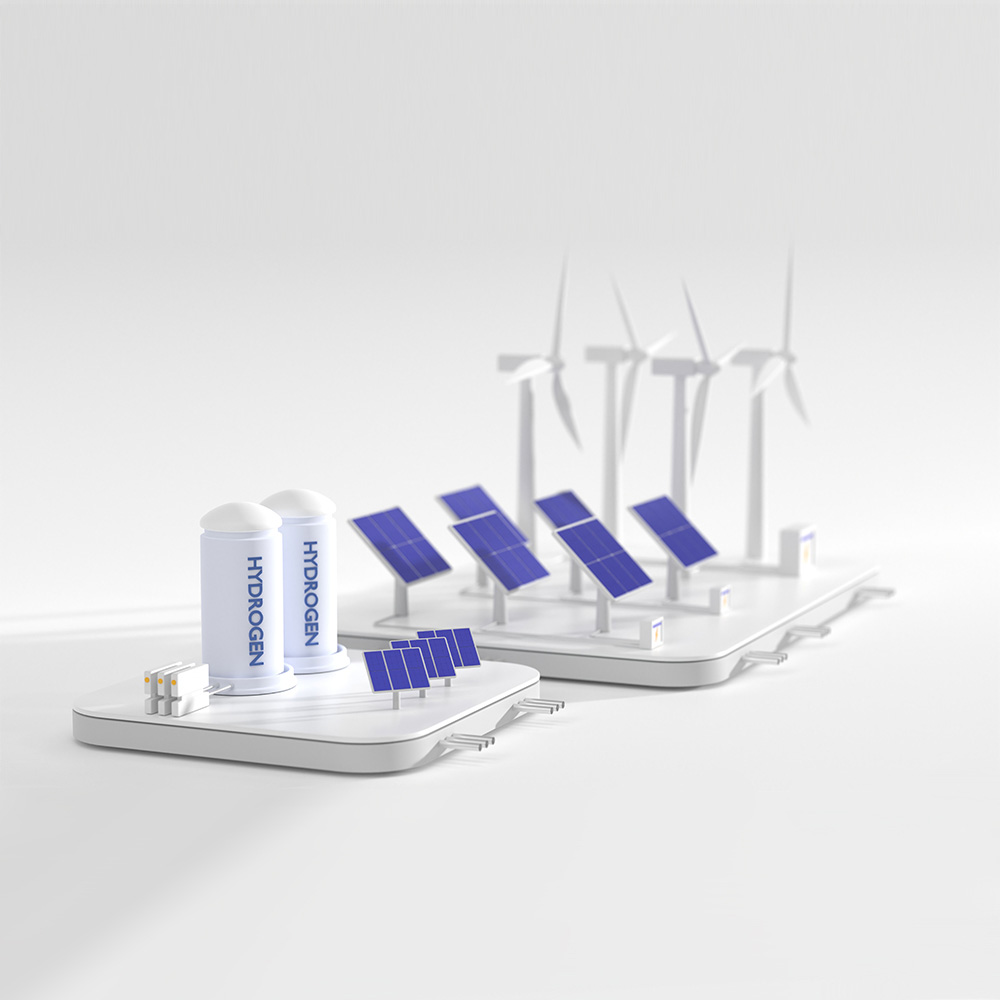
Another way to store renewable energy is to convert it into fuel. In particular, green hydrogenBecause the electrolysis process produces hydrogen, renewable energy can be used to extract hydrogen from water, as is done in this project.
This solution is one of the most promising.countries such as Spain The US is betting on green hydrogen. One of the solutions to stabilize renewable energy supplyIt is estimated that by 2040, or possibly before, the cost of green hydrogen will be the same as the cost of producing gray or blue hydrogen (including carbon capture), i.e. hydrogen produced by fossil fuels. .
pumped hydro power
Gravity is one way to generate electricity. It enables the operation of hydroelectric dams.of Pumped storage (PSH) An approach involves reversing this process.In other words, using renewable energy Pump water to higher reservoirs when electricity is surplus Pass the electric turbine for the required period.
There are several approaches to this type of renewable energy storage.which one Natural or artificial reservoirs are possible. Already used. You can use seawater, or even subways and underwater reservoirs. In any case, a combination of a pump system and an electric turbine is required.
Compressed air
Ontario, Canada, has a compressed air renewable energy storage plant.facility can Generates 1.75 MW/hr for 6 hoursThe goal is to achieve up to 8 hours of continuous supply and there are already plans for two more plants.
The operation of this technique is relatively simple. At times of peak renewable energy production, electricity is used to compress air and force it into man-made or natural subway cavities.When energy is needed, Air is released through a system of valves to drive an electric turbineThe advantage of this technology is that it does not require lithium or chemicals like traditional battery systems.
molten salt
While compressed air uses pressure to store energy, Molten salt system It does so by heat. The operation of this technology is somewhat different from its predecessor. in this case, solar thermal power plant It is used. Solar concentrators are used to heat various salt combinations. sodium, potassium, calcium, others. The molten salt is stored in tanks for later use.
When this energy needs to be released, the waste heat from the salt is used to generate steam, which drives an electric turbine. Adequate insulation, Heat can be retained for a weekis a technology with considerable potential. The first molten salt energy storage project late 1990s.
If you want to learn more about alternative renewable energy in addition to renewable energy storage, I recommend this article. Here are some tips. The key may be in the ocean.
sauce: When
