











Physicists at Brookhaven National Laboratory (BNL) have discovered a completely new type of quantum entanglement. In the particle collider experiment, new entanglements have allowed scientists to explore the interior of atomic nuclei in greater detail than ever before.
Pairs of particles are so intertwined with each other that no matter how far apart one can become inexplicable without the other. Even stranger, changing one will instantly change the partner, even if you are on opposite sides of the universe. Sounds possible. Even Einstein was nervous about this, calling it “creepy action from afar.” But decades of experiments have consistently backed it up, forming the basis of emerging technologies such as quantum computers and networks.
Quantum entanglement is usually observed between pairs of essentially identical photons or electrons. But this time, for the first time, the BNL team detected pairs of different particles undergoing quantum entanglement.
The discovery was made at the Relativistic Heavy Ion Collider (RHIC) at Brookhaven Laboratory. RHIC investigates the morphology of matter in the early universe by accelerating and bombarding gold ions. But the team found that there is much to be learned from near misses, even when the ions do not collide.
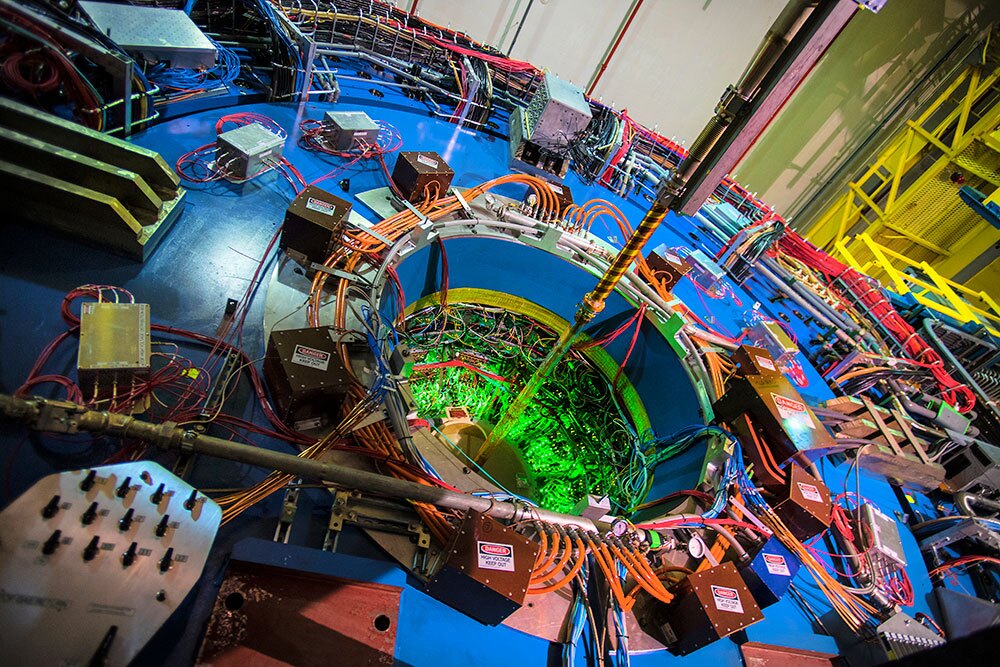
Brookhaven National Laboratory
The accelerated gold ions are surrounded by tiny clouds of photons, and when the two ions pass close together, one photon can capture an ever-more detailed picture of the other’s internal structure. That alone is enough to intrigue physicists, but this only happens thanks to an unprecedented form of quantum entanglement.
Photons interact with subatomic particles in the nucleus of each ion, causing a cascade and ultimately producing pairs of positive and negative particles called pions. As you may remember from high school physics, some particles can also be described as waves. In this case, the waves from both negative pions reinforce each other, and the waves from both positive pions reinforce each other. As a result, only one positive and negative pion wavefunction reaches the detector.
This indicates that each pair of positive and negative pions are intertwined with each other. If not, the wavefunctions hitting the detector would be completely random, the team says. As such, this is the first detection of quantum entanglement of dissimilar particles.
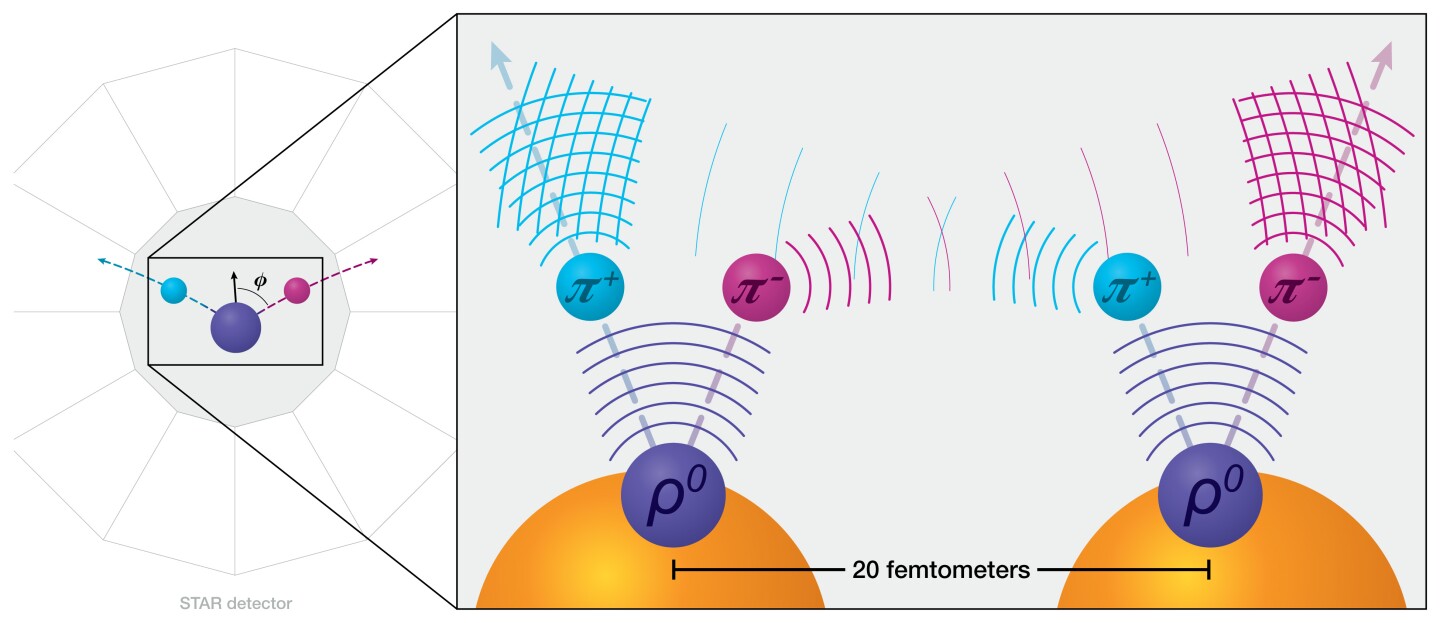
Brookhaven National Laboratory
“We measured the two outgoing particles and obviously their charges are different – they are different particles – but we don’t know if these particles are entangled or if they are distinguishable particles. Nevertheless, we see interference patterns that indicate they are in sync with each other,” said Zhangbu Xu. Study author.
The discovery not only advances our understanding of quantum physics, but could lead to new techniques, such as the method the team is using to peer inside the nucleus of gold ions.
A study was published in a journal scientific progress.
Source: Brookhaven National Laboratory
