











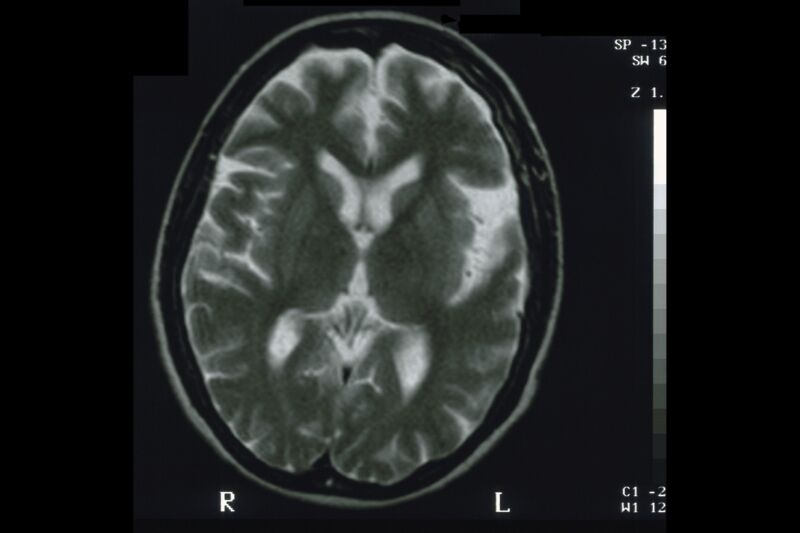
The Food and Drug Administration on Friday gave expedited approval for a new Alzheimer’s drug. This may slightly slow the progression of cognitive decline in the early stages of the disease, but it also increases the risk of cerebral hemorrhage and brain swelling.
The treatment, manufactured by the pharmaceutical companies Eisai and Biogen, is lecanemab, branded Leqemb, an intravenous monoclonal antibody that targets the amyloid-beta protein that accumulates in plaques in the brains of people with Alzheimer’s disease. Researchers have yet to determine whether amyloid plaques are the underlying cause of the disease, and whether removing amyloid plaques can significantly slow or stop cognitive decline.
The FDA’s approval of lecanemab is via an accelerated pathway using “surrogate endpoints that are likely to reasonably predict clinical benefit to patients.” In this case, the surrogate endpoint was the ability of lecanemab to reduce amyloid-beta plaques in the brains of Alzheimer’s disease patients.
uncertain efficacy
However, its meaning and medicinal efficacy are still unclear. A phase III clinical trial published this week in the New England Journal of Medicine found that treatment with lecanemab for 18 months only modestly delayed cognitive decline in patients with early Alzheimer’s disease. The trial included 1,795 participants, of whom 898 were assigned to receive lecanemab and 897 to receive placebo. Their cognitive abilities were assessed using an 18-point scale from established clinical trials in dementia. At the start of the study, baseline test scores for both groups (treatment and placebo) were approximately 3.2. After the 18-month trial, the lecanemab-treated group score decreased by 1.21 points, while the placebo group score decreased by 1.66 points. A difference of 0.45 points translates to a 27% slower decline in the treatment group.
Not sure if that change makes sense. Dr. Madhav Thambisetti, a senior fellow at the National Institute on Aging and his neurologist, told The New York Times that the drug’s ability to clear amyloid plaques is “exciting” from a scientist’s perspective. says there is. “From the perspective of physicians treating patients with Alzheimer’s disease, however, the difference between lecanemab and placebo falls far short of what would be considered a clinically meaningful therapeutic effect.”
The researchers behind the clinical trial conclude that “longer trials are needed to determine the efficacy and safety of lecanemab in early Alzheimer’s disease.”
safety concerns
Meanwhile, the treatment has raised concerns about its safety, especially amid reports that three patients who received the drug died of brain swelling and hemorrhage. This includes her 65-year-old woman with early-stage cognitive decline who died of a massive cerebral hemorrhage. Rudolph Castellani, a Northwestern medical neuropathologist who has studied Alzheimer’s disease and performed an autopsy on the woman at her husband’s request, said last November that the drug had weakened the woman’s blood vessels, causing them to burst from a common treatment for blood clots. after she suffered a stroke.
“It was a one-two punch,” Castellani told Science, which first reported the death. , she would still be alive today.”
A report of the woman’s death was also published in the New England Journal of Medicine this week.
Prescribing information for lecanemab includes warnings and cautions regarding cerebral hemorrhage and swelling and the use of blood thinners.
The FDA approval comes just a week after lawmakers released the results of an 18-month congressional inquiry into the FDA’s highly critical approval of a similar Alzheimer’s drug, Aduhelm. Data on amyloid-targeted antibody therapy were even less conclusive than those of lecanamab, and the FDA granted approval after objections from an external advisory panel and internal experts.
Unevenness
A congressional investigation found the FDA’s approval process “rife with irregularities” and “inappropriate” communications between the FDA and Aduhelm’s maker, Biogen. The report also accused Biogen of setting an “unreasonably high price” of $56,000 a year for Aduhelm.
“This report chronicles the extraordinary FDA review process and corporate greed that preceded the FDA’s controversial decision to grant Aduhelm expedited approval,” said an incoming ranking member of the Energy Commerce Commission. A Frank Pallone, Jr. (D-NJ) said at the time.
Following the approval of lecanemab, Parone issued the following statement: We will set a fair price for lecanemab to ensure that patients have equitable access to this drug.
In a press release Friday afternoon, Eisai announced a one-year supply price for lecanemab of $26,500. This is above the range estimated by the Institute for Clinical and Economic Review to make the drug more cost-effective, with the analytical group estimating his one-year treatment costs from $8,500 to $20,600. increase.
It is unclear whether lecanemab, which has a dramatic impact on marketability, will be covered by Medicare. Medicare severely limited Aduhelm’s coverage because of its high price, lack of evidence of benefit, and risk. Only Medicare beneficiaries during clinical trials can cover the price of his Aduhelm, after which the annual supply was reduced to his $28,200.
