











Many people are already creeped out by quadrupedal robots that walk on four legs instead of wheels or tracks. Well, the MARVEL robot can walk straight through ferromagnetic metal walls, so it’s unlikely to change those feelings.
MARVEL, an acronym for “Magnetically Adhesive Robot for Versatile and Expeditious Locomotion”, was designed by a team at the Korea Advanced Institute of Science and Technology (KAIST) led by Professor Hae-Won Park.
Each of the robot’s four legs incorporates both permanent magnets (EPM) and magnetorheological elastomer (MRE) soles.
Unlike conventional electromagnets, EPMs require power only to switch between magnetic and non-magnetic states. In other words, it uses no power to maintain its magnetism. The MRE used in the sole is a mixture of urethane rubber and iron particles, and is a material that has both elasticity and ferromagnetism.
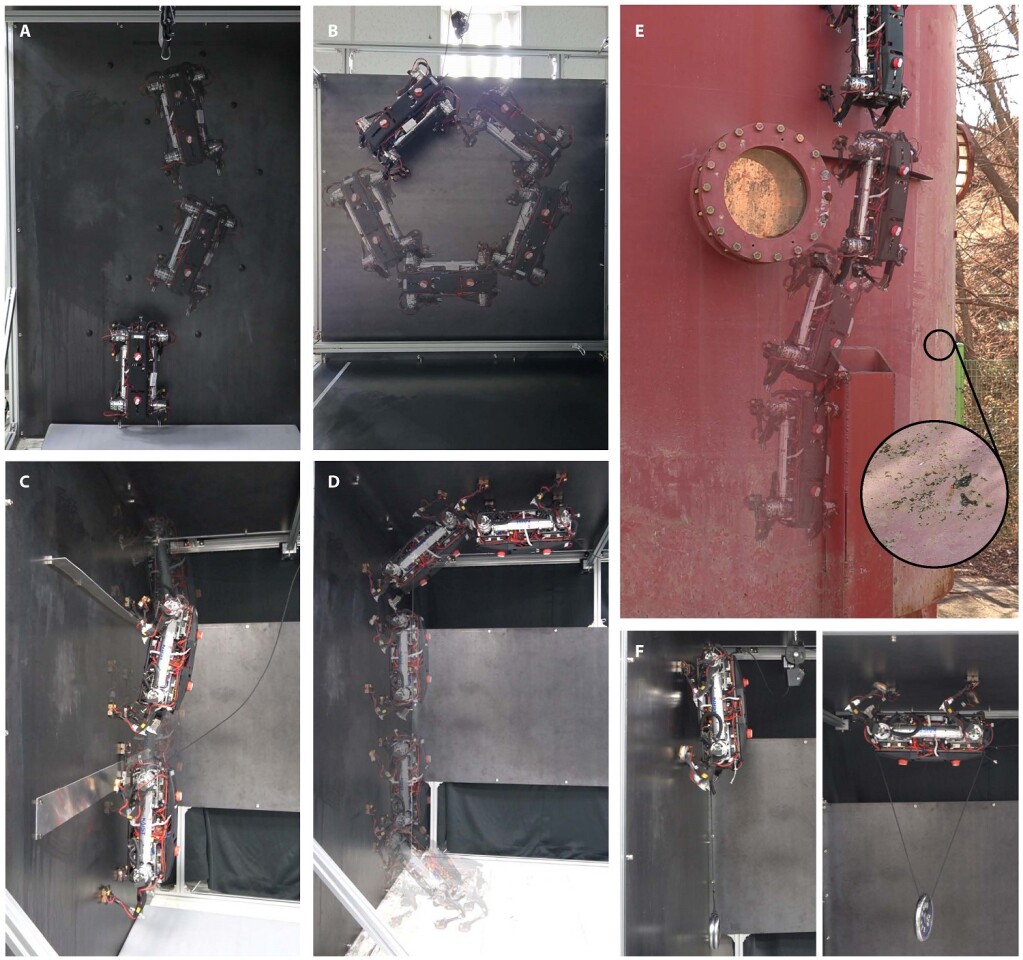
Whether you’re climbing a vertical metal surface or walking upside down on a metal ceiling, MARVEL simply turns the magnetic force on your feet on and off to propel each one forward. The EPM provides all the traction, while the MRE sole provides the necessary grip to keep the robot from sliding underneath.
The combination of the two technologies allows MARVEL to withstand vertical external forces up to 54.5 kg (120 lbs) or horizontal forces up to 45.4 kg (100 lbs) on metal walls or ceilings. position can be maintained. MARVEL itself weighs about 8 kg (18 lb).
Kaist
In tests conducted so far, the robot was able to climb walls at a maximum speed of 70 cm (28 inches) per second and traverse ceilings at up to 50 cm (20 inches) per second. It had no problem walking on floors, walls, and ceilings, and was able to step over obstacles as high as 5 cm (2 inches).
The latter capability gives Marvel a distinct advantage over tracked or wheeled wall-climbing robots, which are likely to be hampered by such challenges.
Additionally, even when vertical metal surfaces were covered in paint, dust, or rust, the robot was able to climb at speeds of 35 cm (14 inches) per second. This is an important consideration for potential real-world applications, including inspection, maintenance, and/or repair of ships, bridges, radio towers, storage tanks, construction site steel girders, and more.
“By using a magnetic sole composed of EPM and MRE and a non-linear model predictive controller suitable for climbing, the robot can move quickly not only on flat ground, but also on various ferromagnetic surfaces such as walls and ceilings. .”park. “We believe this will be a cornerstone for expanding mobility and expanding the areas where pedal-powered mobile robots can enter.”
MARVEL is described in a paper recently published in the journal. science roboticsYou can see the bot in action in the video below.
Agile and versatile climbing on ferromagnetic surfaces by a quadrupedal robot
Source: KAIST
