











In 2012, we heard about tiny bipedal “biobots” robots that used real muscle tissue to walk. Now, the descendants of these bots are equipped with his LEDs and can be remotely steered in a practical way.
The original biobot, developed by scientists at the University of Illinois, was less than a centimeter long. Each had a 3D-printed soft hydrogel body and consisted of a horizontal spine attached to two vertical legs.
While the first of these models incorporated heart tissue within the spine, subsequent versions utilized portions of mouse spinal muscle tissue. When exposed to an external pulsating electric field, its tissues (and thus the spine) contract repeatedly, causing the legs to alternately move forward. This allowed the biobot to only walk in straight lines.
That was changed in 2016, adding a third version that added a ring of bioengineered, light-sensitive mouse muscle tissue. By directing an external blue light source precisely at one or the other side of the biobot, we were able to shrink tissue on that side only. This way the robot can be rotated left or right. That said, the bot needed to stay within reach of the light, so this approach was a little impractical.
The latest version of this technology, called the eBiobot, changes things even further.
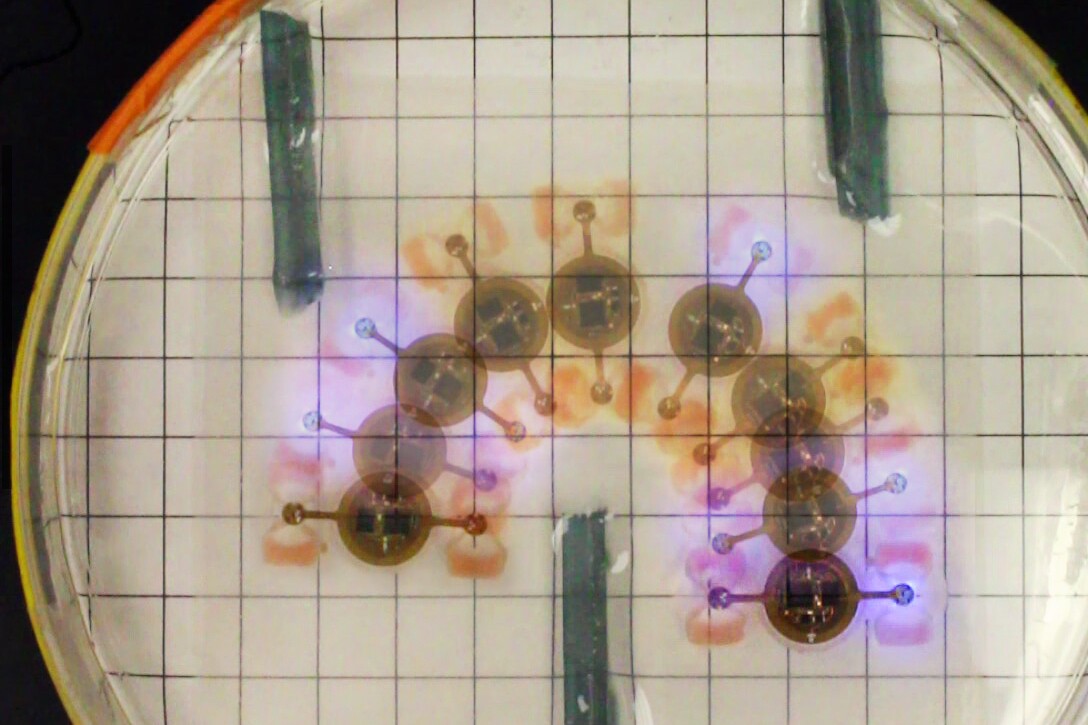
Instead of legs, there are two hydrogel/muscle tissue actuators, each equipped with a micro LED. Between these actuators is an electronic module containing the receiving coils. In response to an externally applied radio signal, the coil powers and pulses the LED. This light source repeatedly contracts muscle tissue, shuffling the actuator forward.
However, by modulating the signal, both LEDs can be illuminated at the same time. Also either individually. In this way the eBiobot can move forward or turn left or right. external light source.
Kim Young-duk
“The integration of microelectronics enables the fusion of the worlds of biology and electronics, both of which have many unique advantages and the potential to serve many medical, sensing and environmental applications in the future. We will be able to manufacture some of these electronic biobots and machines,” said the professor. Rashid Bashir, who led the study with Professor John A. Rogers of Northwestern University.
A paper on this study was recently published in the journal science roboticsYou can see the eBiobot in action in the video below.
remote controlled electronic biobot
Source: University of Illinois
