











The challenge of securing fresh water for human consumption is undeniably one of the most pressing problems of the 21st century.st century. Global warming and desertification, combined with the pollution of rivers and reservoirs, are severely impacting the availability of drinking water. seawater desalination, especially in the Middle East, is one of the most common techniques used to tackle this problem. Unfortunately, seawater desalination is a power-intensive process and tends to use fossil fuels. In the early stages, around the middle of the 20th century, results were achieved by the evaporation of water. However, this process is costly and time-consuming, and new and improved techniques had to be sought.the next big step Reverse osmosis paves the way for capacitive deionization, the latest desalination technology (CDI).
at 60% utilization desalination plant, reverse osmosis is by far the most popular technology. We already discussed reverse osmosis in one of our previous articles on blue energy, but let’s briefly recall the process here. As explained in this infographic, reverse osmosis is based on a series of membranes that separate two water solvents. One is salt water and the other is fresh water. Normally liquids tend to be in solvent equilibrium, with less salty water flowing into the most salty water compartment. However, when salt water is put under pressure, it will flow towards fresh water and a semi-permeable membrane will filter out the salt particles. However, this system is very energy intensive.
Toward a new-generation seawater desalination plant
Enter capacitive deionization, a new system still in development that can not only filter salts out of water, but also store energy. how does that work? Roughly speaking, it uses a series of electrodes (cathode and anode) that attract salt ions when an electric current is passed through them. Then, in the regeneration phase, a reverse current or zero voltage causes the ions to be ejected and electricity to be generated. The main hurdle to overcome is the development of the required electrochemical capacitors. This second stage can severely rust the electrodes. Also, electrode corrosion increases dramatically above 1.2 V as the electrodes release ions, so the system can currently remove only a small concentration of salt.There are several labs working on this promising research Water desalination technologytheoretically requires 5 to 6 times less energy than reverse osmosis.
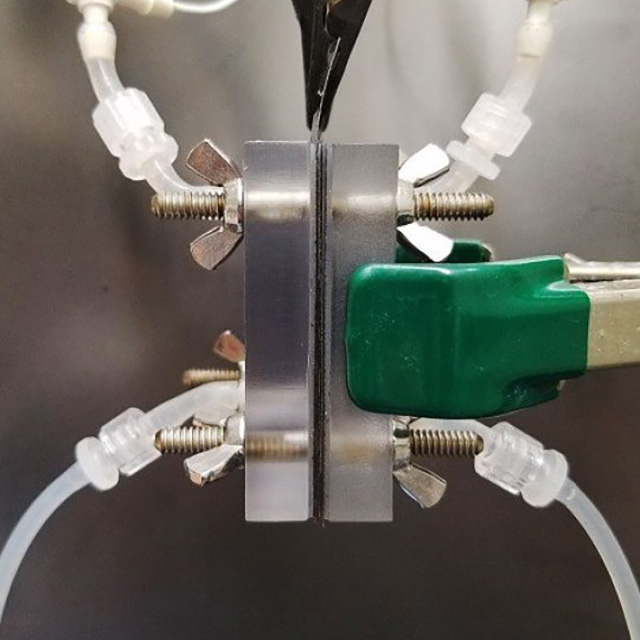
One of the latest advances in this field was made by a team of researchers at the University of Pennsylvania.They are water desalination A process called battery electrode deionization (BDI) systems. Their technique is based on a cell with two His electrodes at each end and two His channels separated by a membrane. The scientists circulated two solvents, one saline and one fresh water, with a constant electrical current. The first advantage is that the same result as before can be obtained with half the voltage (0.6V). Then simply reverse the cell voltage flow (+0.6 v or -0.6 v) to desalted concentrated water Two channels also avoided a two-cycle approach and a challenging regeneration phase. Finally, we found that stacking additional membranes could further reduce energy consumption.
The technology is currently only suitable for low-concentration brines, but the development team is confident of future applications once the technology matures to some degree.
sauce: science daily
