











People who suffer from ALS (amyotrophic lateral sclerosis) often have difficulty lifting their arms due to deteriorating cells in the brain and spinal cord. It is designed to
Created by a team of scientists at Harvard University and Massachusetts General Hospital, the Holter setup incorporates two Y-shaped soft robotic actuators under each of the wearer’s armpits. A hose connects both fabric actuators, mounted behind the user’s waist, to a battery-powered air pump.
When integrated sensors detect slight upward movement of the arm that the wearer can still manage on their own, those sensors trigger a pump to inflate the corresponding actuators to lift the arm smoothly and gently. . Similarly, moving the muscle downward slightly causes the actuator to contract, bringing the arm down again.
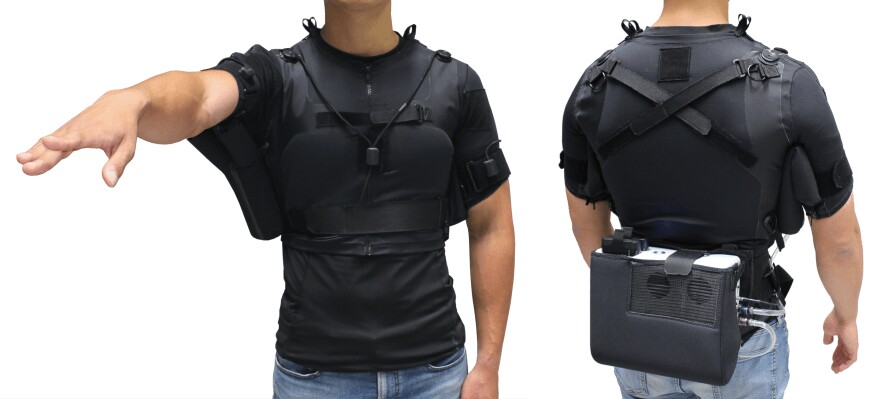
Harvard SEAS Walsh Institute
The system has already been tested on 10 ALS patients. Her 30-second calibration process was first required to measure each user’s different levels of arm/shoulder strength and mobility. All participants then learned to use the setup within 15 minutes of her and successfully performed tasks such as reaching and lifting an object.
Given the fact that ALS usually progresses to the point where even the slightest muscle movement becomes impossible, scientists are now looking at ways to trigger actuators using only brain signals. These are detected by a wearable brain-computer interface.
“This research gives us hope that soft robotic wearable technology could help develop new devices that can restore limb function in people with ALS and other conditions that cripple their mobility.” says Professor Connor Walsh. research.
The paper was recently published in the journal Science Translational Medicine.
Source: Harvard John A. Paulson School of Engineering and Applied Science
