












Why is visibility in your OT environment important?
There is no denying that operational technology (OT) is important to your business. The OT sector is thriving alongside the already thriving IT sector. OT includes industrial control systems, manufacturing equipment, and devices that monitor and manage industrial environments and critical infrastructure. In recent years, attackers have become aware of the lack of detection and protection in many industrial systems and are actively exploiting these vulnerabilities. In response, an IT security leader has become more aware of the need to protect her OT environment with security monitoring and response capabilities. This deployment has been accelerated by past major cyber incidents that have targeted critical OT environments and even caused physical damage to infrastructure. Given the critical role these systems play in business operations and modern society, ensuring their security is paramount.
The underlying trend is clear. OT and IoT networks are increasingly integrated with traditional IT networks for management and access purposes, increasing internal and external communication between these devices. Not only does this affect the network itself, but it also has significant implications for the security teams responsible for protecting the environment. This convergence of OT and IT brings many benefits, such as increased efficiency and reduced operating costs, but it also introduces new security risks and challenges, making the OT environment more vulnerable to cyber threats. increase. As evidenced by past attacks, these threats often go undetected due to poor security monitoring, and threat actors can remain undetected for long periods of time. Achieving holistic visibility and effective anomaly detection in is critical to maintaining solid security and control.
What are the challenges of monitoring OT environments?
First and foremost, it is important to understand the threat landscape unique to OT environments. Traditional IT security detection methods are inadequate in this context as they require different sensitivity thresholds and more sophisticated monitoring for network segments or device groups, as well as OT-specific detection mechanisms. Unlike IT attacks that focus on data theft, OT attacks typically aim at physical impact. Moreover, as recent examples show, ransomware in the context of OT is on the rise, directly impacting the availability and safety of control systems.
Second, monitoring the OT environment requires consideration of various aspects such as supplier access control, device management, and network communication. Supplier access to OT and IoT networks is difficult to control and oversee, as connectivity between external and internal networks can occur through a variety of means, including VPNs, direct mobile connections, and jump hosts. Another hurdle is device management. This includes update mechanisms and protection against unauthorized access and manipulation. Implementing regular update routines and deploying endpoint detection and response (EDR) to OT and IoT devices is often limited or infeasible. The variety of devices, their lifetimes, and device-specific operating systems make deploying security software to monitor OT devices difficult and cumbersome.
Third, traditional IT network discovery methods require in-depth knowledge of protocols, which in the context of OT include a wide variety of protocols and attack scenarios not found in traditional rule sets. OT network devices connect IoT sensors and machines using communication protocols not common in traditional IT networks. Active vulnerability scanning methods can also be an issue in his OT environment when it comes to more intrusive security solutions. The same applies to intrusion prevention systems (IPS). Because they can block network packets and affect the stability and business continuity of your OT environment. As a result, passive network detection systems like Network Detection & Response (NDR) solutions are better suited for this purpose.
How can I effectively monitor and protect my OT environment?
Secure access management and device lifecycle management are essential, but seamlessly implementing them can be very difficult. In this context, network detection and response (NDR) solutions offer a non-intrusive and effective approach to monitor OT environments. By focusing on OT device communication patterns, the intersection of IT and OT, and third-party access to OT networks, the NDR system provides comprehensive visibility and detection without disrupting industrial operations and business processes. provide functionality.
In particular, NDR solutions with advanced baseline capabilities are good at identifying new and unusual communication patterns that may indicate malicious activity within the OT network. These NDR systems provide protocol- and device-independent anomaly detection by leveraging flow information to baseline and learn who communicates with whom and how often. Instead of manually configuring these parameters, NDR learns baselines and alerts security teams to unusual requests or changes in frequency. In addition, a flexible use case framework enables fine-tuned thresholds for OT-specific monitoring, including the ability to configure load monitoring at network zone-specific granularity. Additionally, machine learning algorithms can detect anomalies and potential threats more accurately than traditional rule-based systems.
As a result, the passive monitoring capabilities of NDR solutions are essential for OT and IoT environments where implementing alternative monitoring methods can be difficult or disruptive. A particularly robust and easy-to-implement ML-driven NDR system for OT environments, ExeonTrace analyzes log data from traditional IT environments, OT networks, and jump host gateways to provide a comprehensive and holistic view of network activity. provides a great view. Flexibility to integrate various third-party log sources, including OT-specific logs, is key here. Additionally, ExeonTrace’s ability to integrate with other OT-specific detection platforms enhances its capabilities and ensures broad security coverage.
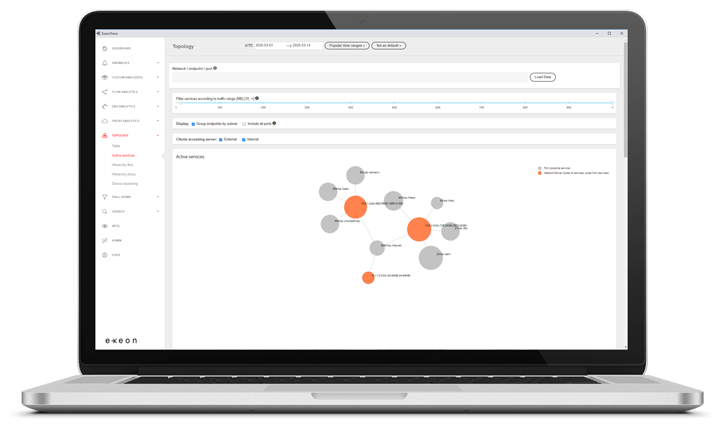 |
| ExeonTrace Platform: OT Network Visibility |
In summary, an NDR solution like ExeonTrace effectively addresses the distinct challenges of OT monitoring and establishes the Swiss NDR system as the preferred detection approach for securing OT environments. By implementing an ML-driven NDR system such as ExeonTrace, organizations can reliably monitor and protect their industrial operations, ensuring business continuity through an automated, efficient, hardware-free approach. Find out if ExeonTrace is the ideal solution for your business and request a demo today.
