











In 2016, four years before a pandemic brought the world to a halt, the United Nations Environment Program (UNEP) sounded the alarm on zoonotic diseases, identifying them as a significant emerging issue of global concern.
Currently, according to the World Health Organization, approximately one billion cases and millions of deaths each year are the result of zoonotic diseases, in which pathogens are transmitted from vertebrates to humans. And of the 30 new human viruses identified in the last 30 years, 75% mostly originated in other animals.
But scientists at the University of Montreal believe their new artificial intelligence modeling has the ability to highlight and predict notable new viral “hotspots.” -19 from happening again.
After three years and 10,000 hours of calculations by the researchers, the algorithm was able to identify 80,000 new potential interactions between viruses and hosts and where they are most concerning in the world. .
Timothy Poiseau, professor of biological sciences at the University of Montreal, said:
Through machine learning, rather than manually linking data, the algorithm was able to evaluate thousands of mammalian species and thousands of viruses and solve all viable combinations.
“The fundamental problem is that we only know 1-2% of interactions between viruses and mammals,” Poisot said. “The network is decentralized, with few interactions, concentrated in just a few species. We can establish which is most likely to occur.”
The team used CLOVER, the largest open dataset describing 5,494 interactions between 829 viruses and 1,081 mammalian hosts. Most of it focused on wildlife. Infectious Diseases Database (EID2) and Global Mammal Parasite Database V2.0 (GHMPD2).
“Some of the datasets we had were outdated. They contained old names for certain species, and there were errors because the data was entered manually,” Poiseau said of machine learning. “The main task after that was to determine the level of confidence in the model’s predictive ability.”
The researchers then focused on 20 viruses that were considered of concern and could spread to humans.
“At first some of the results seemed strange to us, so we had a lot of discussions with the team,” said Poiseau, who was surprised to see the mouse linked. Ectromeria virus Identified as notable. “We were skeptical, but after searching the literature, we found that there were human cases.”
Researchers were also able to identify areas through the model. This could help scientists pursue virus and vaccine research in a more targeted manner.
“Our model makes spatial predictions, but more precisely, the model pinpoints groups and locations in mammals where certain types of viruses are likely to be found.” said Poisot.
The results showed two areas of particular interest. It is the Amazon basin where virus-host interactions are more original and where novel interactions are most likely to be seen. In sub-Saharan Africa, algorithms have identified new hosts likely to harbor zoonotic viruses.
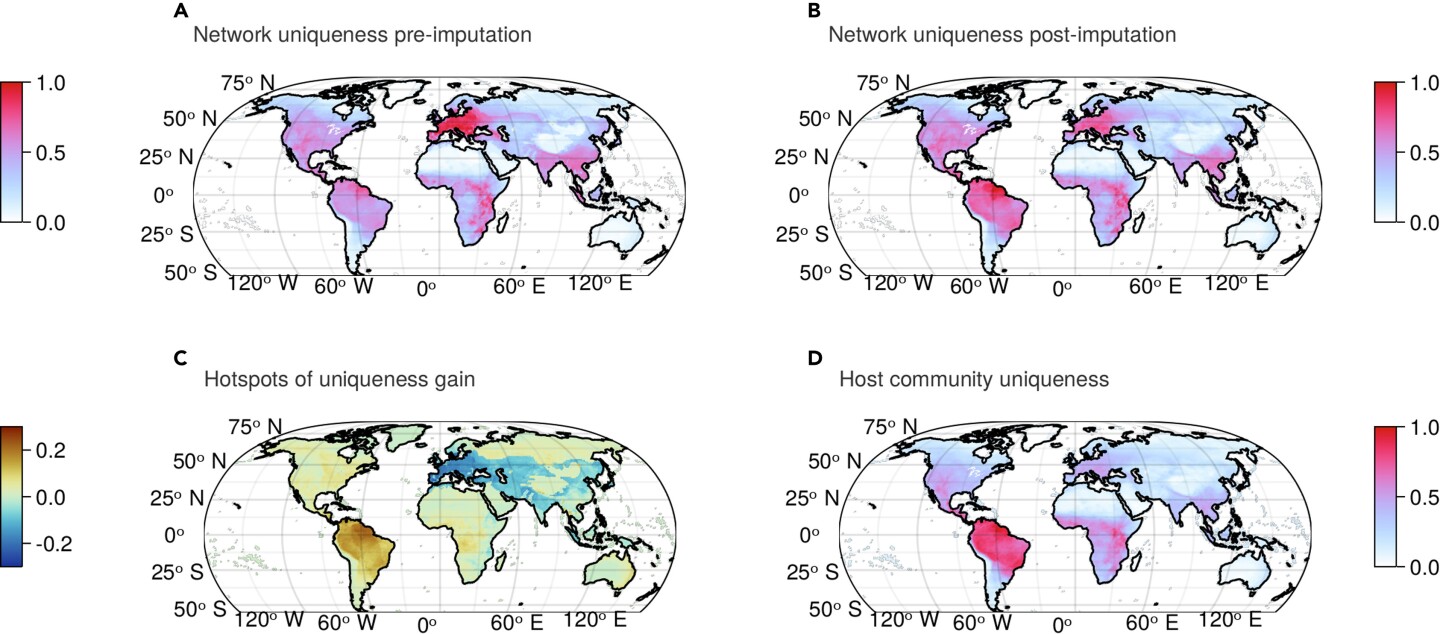
“We’re really changing where we need to study mammals to discover new viruses,” Poiseau explained.
Zoonotic pathogens can take many forms, including bacteria, parasites and viruses, but their prevalence is expected to increase as humans and non-human animals continue to occupy more of the same space. are expected to become increasingly common.
The team hopes that the model can inform new starting points for research as well as provide real-world surveillance. A more complete examination of the global virome, including its biological and ecological mechanisms.
“The algorithm takes the network we already know and projects it into a new space like shadow theater, which sheds light on interactions in new ways,” said Poisot. I’m here. What kind of virus? ”
A study was published in a journal pattern.
Source: University of Montreal
