











Summary – V2L vs V2G vs V2H for backup power
V2L – Vehicle-to-load
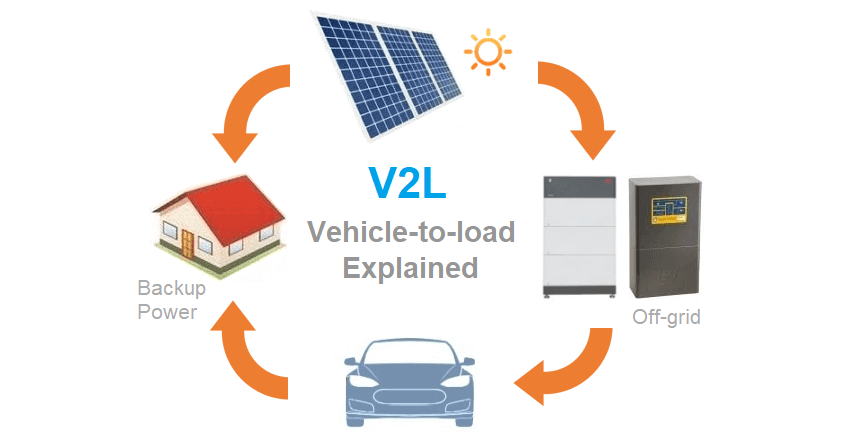
As explained earlier, V2L is essentially a backup power system; the vehicle has a built-in DC to AC inverter that converts high DC voltage from the EV battery system to 240V AC power via 10A or 15A socket outlets. Once battery power is low, the EV can be recharged using a regular EV charger or DC fast charger. The key point here is that V2L operates independently of the grid, which is essentially a stand-alone power system.
When using V2L in conjunction with an off-grid power system, to safely and effectively integrate V2L with an off-grid home requires the vehicle’s AC supply to be connected to a smart control system such as an off-grid inverter or an automatic changeover switch as described above.
V2G – Vehicle-to-grid
Vehicle-to-grid (V2G) is used to export power into the electricity grid network and requires a dedicated bidirectional EV charger that can synchronise with the grid. For any system to inject power into the grid, it must do so at a voltage slightly higher than the grid voltage; this is precisely how all solar inverters operate and export excess solar energy into the grid. For example, if the grid were operating at 235V, the inverter (or charger) would need to ‘push’ power out at 236V or higher for the current to flow in the right direction. For this reason, V2G cannot technically operate in an off-grid situation, as the off-grid system cannot absorb or regulate the excess power from the vehicle. Additionally, V2G functions are controlled externally via the electricity network service provider, usually in conjunction with a VPP (Virtual power plant) program. Unless an external control signal could somehow override the vehicle’s V2G system, it would be impossible for it to function in an off-grid situation.
V2H – Vehicle-to-home
Much like V2G, vehicle-to-home (V2H) systems also require a specialised bidirectional charger and other equipment to operate. However, what sets V2H apart from V2G is that it’s designed to function independently from the grid. A V2H backup system, like the Ford home integration system used with the new Ford F150 EV, is essentially an off-grid (grid-forming) system that can island from the electricity network during a grid outage. The operating principle is very similar to a hybrid solar system, where the bidirectional charger operates much like a hybrid inverter. Common hybrid inverters are bidirectional, as they can import and export energy from the grid. The main difference is that the battery is contained within the electric vehicle, and no solar is required.
Disclaimer: This is to be used as a guide only. All electrical installations must comply with local, state and country regulations & standards. All EV chargers, solar and battery storage systems must be installed by a licensed electrical professional.
