











Technical Explanation – Voltage Activation of Bypass Diodes
The bypass diode activates when one or more cells in the group are shaded or underperforming, resulting in a voltage and current drop. Solar cells in a typical panel generate about 0.5 to 0.6 volts under standard conditions. For a group of 20 cells, the total output would be around 12 volts. Meanwhile, a typical bypass diode has an activation voltage of approximately 0.7 volts, known as the forward voltage threshold. If a section of cells is shaded, the voltage and current can drop significantly. When the forward voltage across the diode (i.e., the voltage from the unshaded cells in the rest of the string is higher than the voltage of the shaded section) exceeds about 0.7 volts, the diode becomes forward-biased and allows current to flow. This effectively bypasses the shaded cells, allowing the rest of the panel and string to operate at a higher efficiency.
The current that flows through the bypass diode is essentially the same as the current generated by the unshaded sections of the panel. When the diode is active, it simply allows the current to bypass the shaded section to maintain consistent flow through the circuit.
How shading can lead to bypass diode failure
When a bypass diode is activated due to severely shaded cells, some energy passing through the diode is dissipated as heat. Continuous operation of bypass diodes under shaded conditions can eventually lead to overheating and potential failure. Diodes are more prone to failure over time due to factors such as high temperatures, humidity, and electrical stress during continuous operation—learn more about bypass diode failure modes. The different types of shading (light or heavy shading) have a big influence over whether or not the diodes will be activated and what amount of stress they will be under. Light shading from nearby trees is less problematic than heavy shading from close, fixed rooftop-mounted objects.
Light shading
If your system suffers from regular shading over a large area due to a nearby tree, the panels will encounter what could be judged as medium or light shading, especially if the tree loses its leaves in winter. In this instance, the bypass diodes may not be forced to activate due to the large shaded area over numerous panels. Significant shading also results in lower string voltage and current, resulting in less heating if the diodes are activated. In this situation, the diodes may not need to function and could work without issues for a long time.
Additionally, if the shading occurs early in the morning or later in the afternoon, the amount of sunlight (solar irradiance) will be much lower, reducing the voltage and current in the string. This, in turn, results in far less thermal stress on bypass diodes if they are active due to shade.
Heavy shading
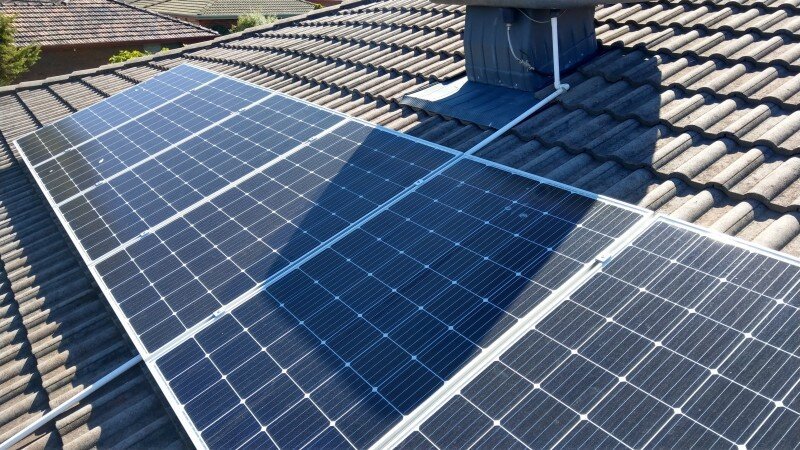
On the other hand, it has been found that rigid or fixed shading over a small area on panels installed next to roof vents and chimneys can cause diodes to be active for long periods of time, leading to premature failure. This is especially true if the shading occurs in the middle of the day when the solar irradiance is at its peak.
Failed bypass diodes can allow a reverse current to heat up the shaded cells, resulting in burn marks from extreme hot spots. This accelerated failure can occur for two reasons: the overall panel and junction box temperature is much higher when most of the panel is exposed to sunlight, and voltage and current flowing through the panels and diode are higher when only a small portion of a panel is shaded during the middle part of the day. These two factors result in increased thermal stress on the diode, leading to failure.
