











 Today is the winter solstice. The darkest day of the year. If you’ve got solar on your roof, this is about as bad as it gets.
Which makes it the perfect time to ask: Is your system pulling its weight when you need it most?
Averages Are For Amateurs
It is likely that your existing solar was designed based on average generation. That’s a novice move. Or as my hero Nassim Nicholas Taleb put it:
“Never cross a river that is on average four feet deep.”
Averages hide the bad days and solar is all about the bad days. Design for those, with a bigger system and the rest of the year is a breeze.
The Temptation To Under-Size Your Solar Array
Feed-in tariffs are dropping, falling to just 1-3c per kWh from July 1. Understandably, some solar owners are wondering if it’s even worth having a big system anymore. Why oversize when exports are practically worthless?
And it gets worse: export charges are already here with some local electricity networks (SA Power Networks just joined the party). For now, most retailers absorb the networks’ charges, but that won’t last. Sooner or later, households will likely have to pay for exporting some of their excess solar.
But the answer to lower value exports isn’t smaller solar arrays. It’s smarter solar inverters.
Cover your winter needs with panels, and make sure your inverter can be set to zero export on command – protecting you against future export charges. More importantly, make sure your installer is someone who’ll help you configure that when tariffs change. Spoiler alert: it probably won’t be the one with a retired cricketer in the ads.
What About Batteries?
Batteries should not be sized to minimise solar exports. They should be sized to minimise grid imports overnight. And tonight your home’s overnight load, especially with heating, is likely at its highest.
So measure it. Track your usage from sunset to sunrise. Assuming you’ve already done what you can to address your home’s gaps, glazing and insulation, that’s the number to bear in mind when sizing a battery. And if you don’t have consumption monitoring to look at? Come on. It’s 2025. Get it sorted.1
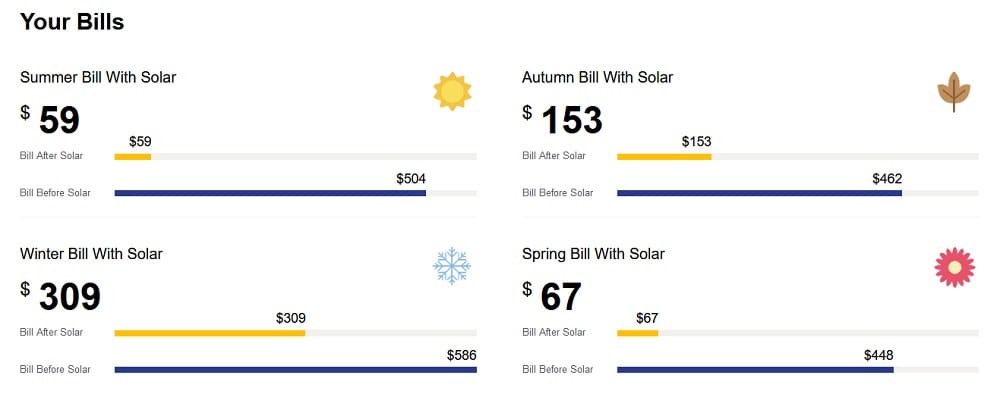
An example of seasonal estimates of bill changes before and after solar, using our Solar & Battery Calculator.
Common Pushbacks Against Bigger Systems
1. “Mr Frugal on Facebook gets by fine with 6.6kW.”
Great! He’s got the right size system for him, and maybe lives in a super efficient home. That doesn’t mean you should copy him. Audit your usage, not a Facebook stranger’s.
2. “I’ll just use off-peak day tariffs to charge up cheap from the grid.”
Maybe. But those super-cheap day rates often come with sky-high peak rates. You’re giving up energy autonomy for a tariff carrot that can vanish without warning.
3. “I’ll just game Amber.”
Go for it, if you’ve got a giant battery and time to babysit wholesale prices. But if you want stability and sanity, there’s a better way: design your system to work well without needing to game the system. It’s a lot less stressful.
Get Started Now (But No Rush To Get Quotes)
With the battery rebate kicking in, installers are flat out. So you won’t get a system change done before July 1, when most tariffs flip. Instead of rushing, use the next month or two wisely as your solar audit window.
Look at your last 7 days of generation. Shift loads to the daytime. Track your overnight usage.
Ask yourself:
In Most of Australia, Even Mid-Winter Solar Works
That’s the beauty of it. Even in the depths of winter, the sun still shows up.
So, design for the darkest days. And build yourself a solar setup that earns its keep year round.
Footnotes
- To measure overnight consumption without monitoring, take a meter read at sunset and a meter read at sunrise. The difference is your overnight usage.
