










In Nigeria, one of the primary reasons people hesitate to adopt solar energy is the perception of high costs. Many believe that solar energy is expensive. However, paradoxically, numerous households and businesses that avoid solar are spending significantly more each month on fuel, generator maintenance, and unreliable electricity from the grid.
The real issue is not about cost; it’s about how we measure cost. To evaluate energy expenses accurately, we need to consider the Levelized Cost of Electricity (LCOE).
What Is LCOE (Levelized Cost of Electricity)?
LCOE is a standard financial metric used internationally to compare various energy sources. It calculates the total cost of constructing and operating a power system over its lifetime and divides it by the total electricity produced during that lifetime.
In simpler terms, LCOE represents the real cost per kilowatt-hour (kWh) of electricity over time. This allows for a direct comparison between:
- Solar systems
- Diesel generators
- Petrol generators
- Grid electricity
The Reality of Electricity Costs in Nigeria
Diesel Generator Costs
For many small businesses and homes in Nigeria, diesel generators serve as the primary backup power source.
- Average Diesel Price (2026 Estimate): ₦1,200 – ₦1,400 per litre
- Typical Small Generator Consumption: 0.3–0.4 litres per kWh This means the cost for fuel alone translates to approximately:
- ₦360 – ₦560 per kWh
Excluding other factors such as: - Maintenance
- Oil changes
- Engine wear
- Replacement costs When these additional costs are considered, the realistic total cost often exceeds:
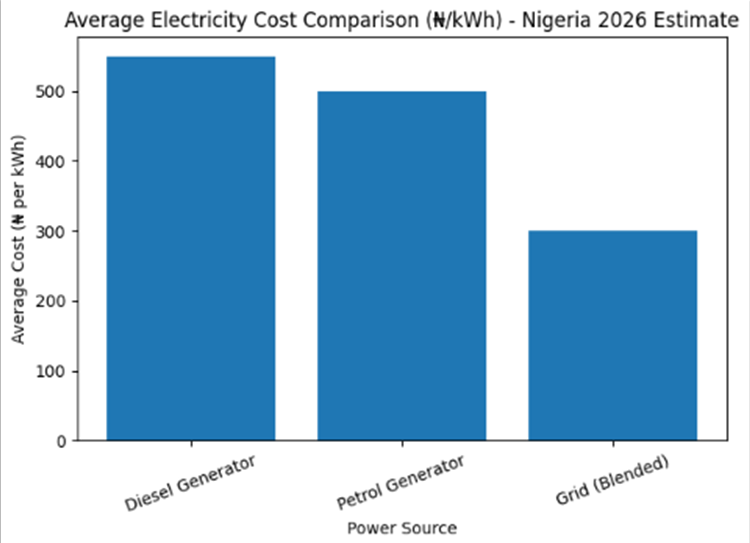
- ₦450 – ₦650 per kWh
Petrol Generators
Petrol generators are commonly used in residential settings.
- Average Petrol Price (Estimate): ₦700 – ₦800 per litre
- Fuel Cost per kWh: ₦300 – ₦450 per kWh Including maintenance, the overall cost ranges from:
- ₦400 – ₦600 per kWh
Grid Electricity (PHCN)
Grid tariffs vary by band, but many Nigerians face challenges such as:
- Paying for an unreliable supply
- Relying on generators alongside grid electricity
- Experiencing voltage instability When accounting for generator backup, the effective cost often falls between:
- ₦200 – ₦400 per kWh (blended cost)
This breakdown shows the significant financial implications of using different power sources in Nigeria.
Solar LCOE in Nigeria
Comparing Solar Energy Costs
Let’s examine the costs associated with a typical residential solar system:
- System size: 5 kW
- System cost: ₦6,000,000 – ₦8,000,000
- System lifespan: 20–25 years
- Average daily production: 18-22 kWh
- Annual output: >7,000 kWh
Over 20 years, the total production of the system would be approximately 140,000 kWh. For a system cost of ₦7,000,000, we can calculate the Levelized Cost of Energy (LCOE) as follows:
LCOE = ₦7,000,000/140,000 kWh = ₦50 per kWh
Even when factoring in expenses such as battery replacement and minor maintenance, the LCOE for solar typically ranges between ₦45 and ₦85 per kWh.
Key Insights
- Diesel Generator: ₦450-₦650 per kWh
- Petrol Generator: ₦400-₦600 per kWh
- Solar (20-year LCOE): ₦45-₦85 per kWh
This means solar energy can be 5 to 10 times cheaper per kWh over its lifetime compared to diesel and petrol generators. The main challenge is not the long-term cost but rather the perception of upfront capital investment. It requires an explanation of the initial investment needed.
Why the “Solar Is Expensive” Narrative Persists
Several factors contribute to the belief that solar energy is costly:
- Upfront payment versus gradual fuel spending
- Poorly designed systems that underperform
- Low-quality equipment available in the open market
- Lack of financial literacy regarding lifecycle costing
Many people do not consider their cumulative expenses on:
- Monthly diesel fuel
- Generator servicing
- Appliance damage from unstable voltage
- Replacement costs of generators
Over 4-7 years, these expenses often exceed the cost of a properly engineered solar system.
Additional Economic Advantages of Solar
Beyond LCOE, solar energy offers several benefits, including:
- Zero fuel volatility risk
- No noise pollution
- No emissions
- Increased property value
- Energy independence
- Stable appliance protection
For businesses, solar energy also improves:
- Operating margins
- Power predictability
- Investor perception
- ESG (Environmental, Social, and Governance) positioning
When Solar Becomes Most Cost-Effective
Solar energy provides the greatest financial advantage under the following conditions:
- Generator usage exceeds 3-6 hours daily
- Recurring diesel consumption
- Predictable load demand
- Properly sized systems
This highlights the importance of engineering and load assessment.
The Kowatek Solar Approach
At Kowatek Solar LTD, we focus on designing energy systems rather than just selling panels. We:
- Conduct thorough energy audits
- Size systems based on actual usage
- Utilize pure sine wave inverters
- Deploy high-quality batteries
- Engineer for longevity, avoiding shortcuts
Our objective is straightforward: to deliver the lowest practical LCOE for each client.
Reframing the Cost Question
The real question shouldn’t be, “Can I afford solar?” Instead, it should be, “Can I afford to keep paying 5-10 times more for electricity over the next 6-20 years?”
When examined through the lens of LCOE, solar energy in Nigeria is not expensive; it is economically rational.
