











A novel BALIO desalination method is designed to enable green steel from Western Australia’s Pilbara region iron ores
At Perth’s Curtin University in Western Australia, Lina Hockaday is leading a team researching the use of waste brine to upgrade iron ore in a different way, so it can be used to make green steel.
Right now, most of Western Australia’s Pilbara region iron ore is simply ground and crushed. That works for coal-powered blast furnaces.
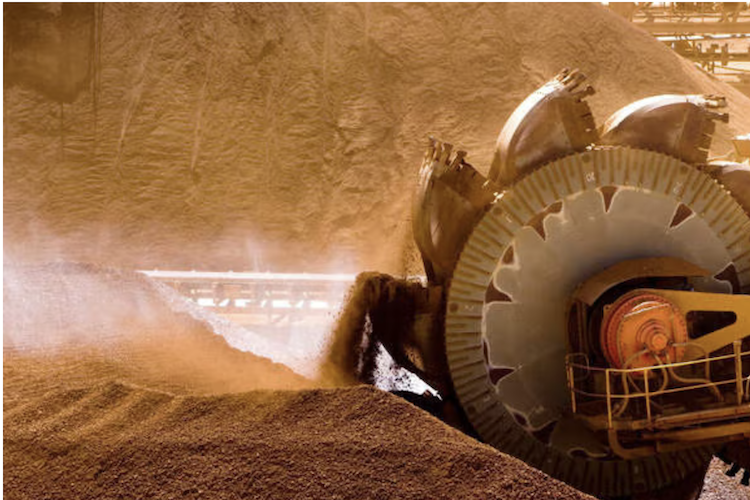
Iron ore crushing in Western Australia
But the resulting impurities prevent the ore from being used in the newer electric arc furnaces. These facilitate green steelmaking because they can run on solar or wind electricity.
Hockaday was recruited by Professor Jacques Eksteen to help develop a new process that could solve that problem. (She previously designed a solar pretreatment of manganese ores for Mintek in South Africa.)
Sodium hydroxide pretreatment is a potential pathway to green steel – removing impurities difficult to target by other beneficiation methods.
This new way to prepare iron ores for use in electric arc furnaces – enabling green steel – requires a treatment with caustic soda (sodium hydroxide) that dissolves impurities into solution, improving the purity of the iron ores which are not dissolved.
Australia exports around 900 million tons of iron ore annually. It would require huge amounts of sodium hydroxide to prepare even 10 million tons per year of Australia’s Pilbara region iron ore for electric arc furnace steelmaking through a leaching treatment – 3.6 million tons annually.
The current global production of sodium hydroxide is around 80 million tons per year. The sheer scale required to sell upgraded iron ore at a profit would rule out buying sodium hydroxide.
“If you bought that much sodium hydroxide and transported it to Australia, you would upset the world market for sodium hydroxide, and it would become even more expensive,” said Hockaday.
“So we want to do it not by importing a whole lot of expensive reagents, but by making it. Which we can do using the waste brines from desalination. And we don’t want to generate heaps of mine waste either. We want to create byproducts that have market value.”
The idea is very much at the concept stage, and they are conducting a feasibility study to see if it might be viable for industry to pursue.
How changing waste brine treatment could generate the sodium hydroxide
Perth already gets about half of its drinking water from traditional desalination, which leaves behind a large amount of salty waste brine.
This is where the innovation comes in. Rather than buying the sodium hydroxide they need, the Curtin team is exploring a way to produce it from the waste brines generated by seawater desalination.
The Curtin team is studying whether a new way to treat this brine could produce the sodium hydroxide needed to clean and upgrade the iron ore, so it could be processed in electric arc furnaces to make green steel.
They would produce sodium hydroxide from waste brine in a process they called BALIO (Brine-derived Alkaline Leaching of Iron Ore).
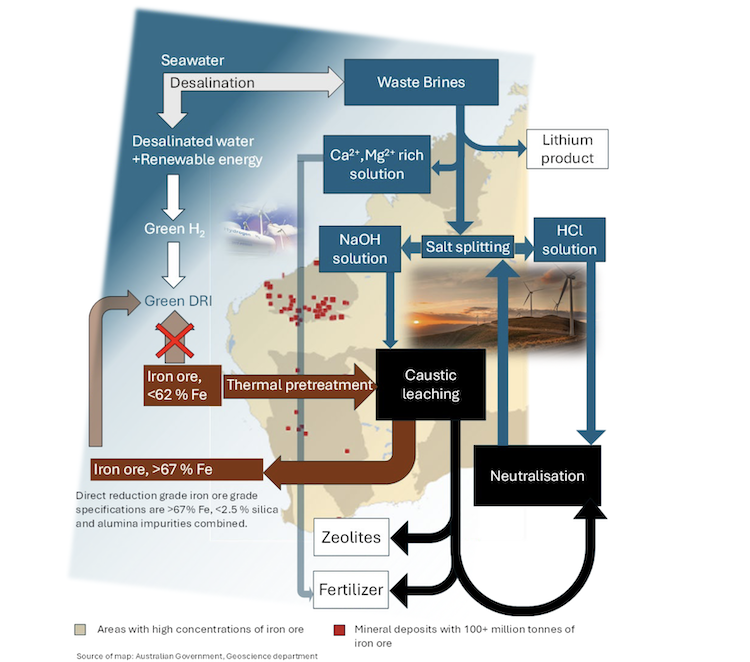
BALIO desalination
How their BALIO process works
In this process, the waste brine is split into two useful chemicals – hydrochloric acid (HCl) and sodium hydroxide (NaOH) – using electricity in an electrolytic cell. The sodium hydroxide solution is heated and concentrated by evaporating water before treating the ore.
The process could use solar PV for the electricity, and concentrated solar thermal (CST) for the heat, making it a clean energy process.
“About 2000 cubic meters per hour of sodium hydroxide solution needs to be concentrated by producing around 500 t/h of steam, and electricity has a higher cost than direct solar thermal heat,” she said.
The leftover materials wouldn’t go to waste either. The team hopes to extract valuable byproducts like phosphates and zeolites from the waste streams. Selling these materials could help make the system profitable and reduce waste going into the ocean or to solid tailings dumps.
If successful, this idea could lower pollution from both mining and desalination in Western Australia. Less salty water would be returned to the sea, fewer mine tailings would be left on land, and the processed iron ore could now be used to make green steel in electric furnaces.
The research is still at a very early stage. If it could be scaled up economically, it would transform both the region’s desalination brine reclamation and support the development of a green steel industry in Western Australia.
For now, the Curtin researchers are still testing the concept in the lab and running a feasibility study. But their small-scale experiments already show that BALIO treatment of Western Australia’s desalination brine can generate sodium hydroxide and that significant amounts of impurities can be removed from iron ore samples.
Acknowledgements:
The BALIO project has received funding from the Heavy Industry Low-carbon Transition Cooperative Research Centre (HILT_CRC), the Australian Renewable Energy Agency (ARENA), the Minerals Research Institute of Western Australia, and Curtin University.
You can read more about the project at HILT CRC – upgrading iron ore for DRI production using seawater – Australian Renewable Energy Agency (ARENA)
