











A young Belgian engineer gazes thoughtfully over the bridge. Below, the water is flowing downstream as usual, but you notice a strange phenomenon. Water hits the bridge pillars and forms small vortices as a way to dissipate kinetic energy. His head also starts spinning. Using the movement produce electricityThe young man thinking about this issue is Geert Slachmuylders, who will soon share his thoughts with fellow entrepreneur Jasper Verreydt, who will embrace it with enthusiasm.? Both began working on the project, first developing a theoretical model to prove the feasibility of a microturbine based on this principle. can. Back in the present, in 2018, after subsequent capital rounds from investors and the Belgian government, they launched his one of the first operational plants in Chile. The project leverages the old water turbine infrastructure to provide renewable energy to the Mapuche indigenous community of the Donihue region.
The system consists of a concrete structure that collects water from the river. The water spirals and flows through the lilliputian’s only moving part, the turbine. Power plant. Simple but efficient.smallest hydro turbine With an output of 15-20 KW, it can power 4-5 households. However, the theoretical output can reach up to 10MW, making it a highly scalable technology that can power even small cities.
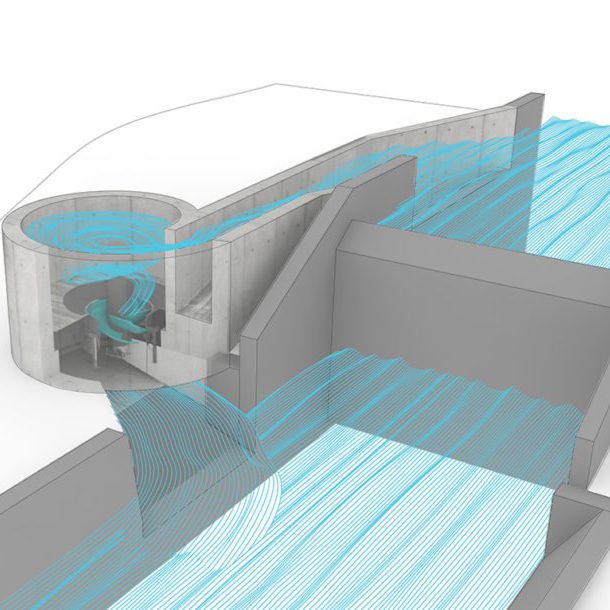
hydro power It is one of the longest established power generation technologies. Nevertheless, it has its own drawbacks. First, building a dam is a complex and expensive process. Second, storing large amounts of water affects the surrounding terrain, preventing some fish species from swimming upstream. The founders claim that the investment can be recouped within 4-6 years, yet the fish can swim unharmed. As a bonus, a self-cleaning screen can also be used to filter debris from the electric current, and finally, the life of the concrete basin he exceeds 20 years.
this innovative technology It has great potential in mountainous regions, developing countries and isolated communities, as it can work in rivers with low water flow and a drop of just one meter. Structures can be placed on riverbanks or in the stream itself.
In the future, just like wind turbines, solar panels and fuel cells, micro turbine It can help provide distributed energy, also known as distributed generation.
sauce: turbulent hydro
