











When designing robots for ocean exploration of other planets, we need robots that are robust, versatile, and easily housed in spacecraft. A soft-bodied robot inspired by marine life turned out to be the best option.
Salps are small animals that live in the world’s oceans, and they move through the ocean by pumping water from their jelly-like, barrel-shaped bodies. They spend part of their life cycle alone, and part of it is connected to other salps by long chains.
Scientists at the University of Bristol, led by researcher Valentina Lo Gatto, have developed an experimental underwater robot. To Salps known as robosarps.
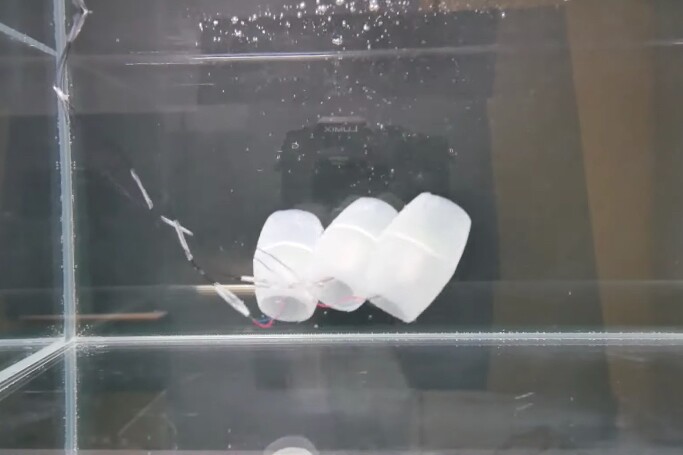
Each has a tubular soft silicone body with drone-style electric motors and propellers inside. This bi-directional propeller draws water into the body, propelling the robot up and down or back and forth. However, such a simple propulsion mechanism allows only fairly basic movements.
Valentina Lo Gatto
With that limitation in mind, RoboSalps can be linked together to form multi-robot structures that can be maneuvered like true submersibles. Some of them can be used for horizontal thrust and some for vertical thrust.
As an added bonus, if one of the RoboSalps in the group fails, the others can fill in, providing a redundant system. It is also possible for multiple robots to move autonomously as a group to an underwater destination, then split up to perform separate tasks independently, and then linked back together.
“It’s light weight and robustness make it ideal for extraterrestrial underwater exploration missions, such as the subsurface ocean of Jupiter’s moon Europa,” said Lo Gatto.
Other proposed applications include inspection of sewage tunnels and industrial cooling systems.
You can see RoboSalps in action in the video below.
Robosarps
Source: University of Bristol
