











Within Europe, how do you view the opportunities in the clean energy market?
Europe has been at the forefront of the global energy transition, supported by ambitious decarbonisation goals and continued investment in renewable energy infrastructure. As solar power, battery energy storage, and EV adoption continue to grow, the demand for technologies that improve operational efficiency, infrastructure resilience, and security is also increasing.We see significant opportunities to support this transition through AIoT technologies that help customers manage energy assets more intelligently throughout their lifecycle.
Dahua has developed EV charger products. Why did you enter that market? How will you differentiate yourselves, and what benefits can you offer to CPOs and other clients?
First, electrification is reshaping the global energy landscape, and EV charging has become an essential part of modern energy infrastructure. Dahua has accumulated extensive experience in AI, IoT, cloud platforms, and intelligent edge devices. These capabilities naturally extend into EV charging, enabling us to provide not only reliable charging hardware but also intelligent management and remote operation capabilities.Second, we believe customers are looking for long-term operational value rather than products alone. One of Dahua’s key strengths is our global service network. With local teams, regional warehouses, and technical support across major markets, we can provide faster delivery, localised services, and responsive after-sales support throughout the product lifecycle. This is especially important for CPOs and commercial customers operating charging networks at scale.
You also have security products. How can they be applied to renewable energy and energy storage projects?
For new energy infrastructure, we mainly support two key application scenarios.
The first is perimeter protection. Currently, theft incidents occur frequently, many solar PV plants use our thermal cameras for intrusion detection. Any intrusion onto the solar farm will trigger an alert. Our thermal cameras can achieve accuracy of up to 99%, which is why it has been widely adopted by EPCs and asset owners.
The second is early fire detection. Our thermal imaging technology continuously monitors temperature changes and helps detect potential fire risks at an early stage.
We’ve discussed EV charging and intelligent security. What other solutions do you have for the renewable energy industry?
Beyond security and EV charging, we have solutions that can be considered predictive maintenance. Our AI-powered solutions support automated inspections of substations, PV plants, and other energy facilities, helping operators improve inspection efficiency and reduce manual workloads.
Another application is worker safety. Our AI applications can detect PPE compliance, such as helmets and safety vests, as well as unsafe behaviors, helping customers improve HSE management across energy sites.
You have an integrated solar system as well. How can that help developers deploy solar storage projects?
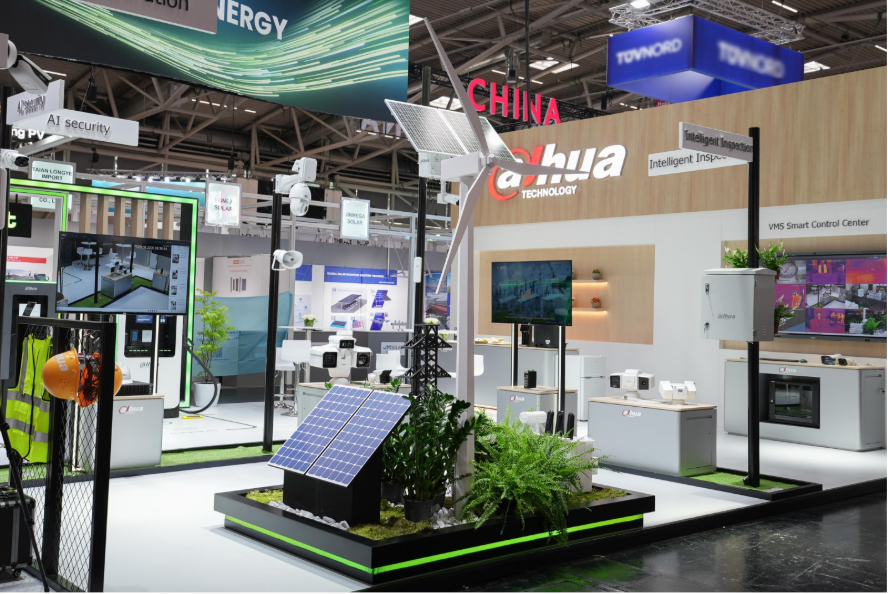
We have an integrated solar-powered wireless security solution for remote energy sites. Unlike conventional security systems that rely on grid power and wired networks, this solution integrates solar panels, batteries, and wireless AI cameras into a standalone system that can be deployed quickly with minimal infrastructure. This is especially valuable for solar developers and EPCs during project construction, when permanent power and communications infrastructure may not yet be available. It enables rapid deployment of site security while reducing installation costs and supporting more sustainable project delivery. The solution is also well suited for long-term protection of distributed PV plants, substations, and other remote energy assets.
Tell us how you’re expanding manufacturing to meet customer demand.
Manufacturing is also one of Dahua’s strengths. We operate large-scale manufacturing facilities supported by flexible production capabilities, enabling us to respond efficiently to customer demand across different markets.Another important advantage is our global supply chain and logistics network. In Europe, for example, products can be delivered through regional warehouses in the Netherlands rather than shipping directly from China. Combined with local inventory, technical support, and service teams, this enables shorter lead times, faster deployment, and more responsive after-sales support for customers across the region.

We are talking at the Smarter E Europe trade show in Germany, which is a very large market. What opportunities do you see specifically in Germany for Dahua?
Germany is one of the largest renewable energy markets in Europe and continues to invest significantly in solar energy and other renewable infrastructure. As more renewable assets are deployed, ensuring their safe and reliable operation becomes increasingly important.We are seeing growing demand for intelligent security solutions. For example, cable theft remains a common challenge for solar farms, creating operational and financial losses for asset owners. AI-powered perimeter protection and thermal technologies can help customers better protect these critical assets.We believe Germany represents an important growth market for Dahua, and we look forward to working with local partners to support the continued development of the renewable energy industry.
