











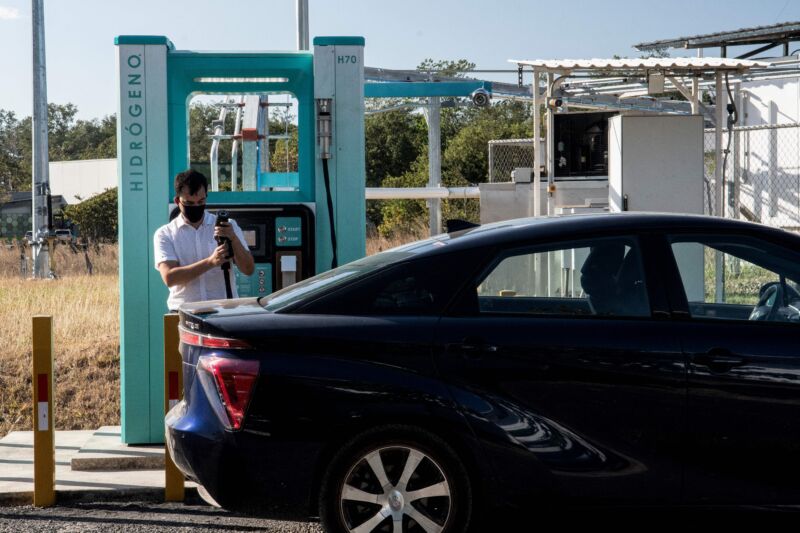
Franklin Chandias gets into his car, turns on the radio, and hears the news that gas prices have risen again. However, he set out knowing that his journey would not cost more. His tank is filled with hydrogen. His car combines that element with oxygen in a fuel cell. This fuel cell works like a small power plant, producing energy (which is sent to the battery to power the car) and water vapor. Not only will the Chang-Díaz journey cost less than yesterday, but it will also produce far less pollution than a conventional gasoline car.
Chang-Díaz wants to have a public hydrogen station nearby whenever he needs to fill up his tank, but neither his native Costa Rica nor any other Latin American country It’s still not possible. He instead ended up at a hydrogen station he built himself as part of a project aimed at demonstrating that hydrogen produced by renewable sources (green hydrogen) is the present, not the future. .
Physicist, former NASA astronaut and Ad Astra Rocket Company CEO Chang-Díaz has a clear vision. Green hydrogen is a key clean energy exporter to reduce emissions from transport and make regions such as his small Central American country, which imports fossil fuels, avert the devastating effects of global warming. He believes he is a fundamental player in the transition to
According to Inter-American Development Bank data, the most polluting sector in Latin America where clean hydrogen technology can be applied is the transport sector (which produces 40% of the region’s CO2).2 emissions) and power and energy (36% of emissions). And Zhang Diaz isn’t the only one who believes in promises. Nilay Shah, a chemical engineer at Imperial College London, says large-scale hydrogen transport will be part of the future. “By 2050, hydrogen could supply 18% of the world’s energy supply, 28% of which will be directed to the transport sector.” Chemistry and Biomolecular Engineering.
However, for green hydrogen to become a significant player in the world’s energy resources, the technology to acquire it needs to be developed on a large scale. Latin America wants to be part of this future and is already gearing up with projects across the region.
not all hydrogens are the same
Hydrogen is the lightest chemical element. The nucleus of hydrogen has only one proton and electrons orbiting it. It is also the most common one. Up to 90% of the atoms in the universe are believed to be hydrogen atoms. gas state (H2), tasteless, colorless and odorless. In the terrestrial environment, two hydrogen atoms are usually bonded to one oxygen atom to form a water molecule (H2O), or four hydrogen atoms bonded to one carbon atom to form methane (CHFour). If you only want the hydrogen atoms, you have to separate the hydrogen atoms from these compounds.
The use of hydrogen as an energy source is not new.For decades, NASA mixed H2 A gas containing oxygen to produce the energy needed to lift hundreds of tons and send the shuttle into space. The US Department of Energy lists it as a safer fuel than fossil fuels. This is because it is lighter than air, is not toxic, and dissipates quickly if leaked.
Currently, hydrogen as an energy source is mainly used in the production of petroleum derivatives, steel, ammonia and methanol. According to International Energy Agency (IEA) data, in 2020 the world’s population consumed about 90 million tons of hydrogen. This represents just 2.5% of global energy consumption. Only 5% of this hydrogen is used in Latin America, mainly in countries such as Trinidad and Tobago, Mexico, Brazil, Argentina, Venezuela, Colombia and Chile. It is primarily dirty hydrogen, which pollutes the earth because of the processes used to obtain it.
Hydrogen can be classified as gray, blue, green or even black depending on how it is derived. Gray hydrogen is produced using fossil fuels, especially natural gas in the case of Latin America. In a process called steam reforming, carbon monoxide (CO) and steam (H2O) is exposed to high temperature, moderate pressure, and a catalyst to produce carbon dioxide (CO).2) and hydrogen (H2). Hydrogen is considered the worst from an environmental point of view when coal is used instead of gas to generate the heat required for steam reforming.
Blue hydrogen uses gas or coal in the same steam reforming process, but in this case 80% to 90% of the carbon emissions end up underground through a process called industrial carbon capture and storage (CSS). . Finally, green hydrogen, also called clean hydrogen, uses electrical energy generated by renewable sources such as solar or wind power to convert water molecules into two elements, hydrogen and oxygen, by anodes and cathodes in a process. Separate. It’s called electrolysis.
Today, less than 0.4% of the hydrogen used in Latin America is green. The rest are related to fossil fuels. In fact, it took more natural gas to produce hydrogen in the region in 2019 than all the natural gas consumed by Chile’s population of 19 million. It also produced more pollutants than all cars in Colombia, a country with about 7 million cars, emit in his one year.
Globally, 4% of hydrogen production is already the result of electrolysis, while the remaining 96% still require gas, coal or petroleum derivatives.
