











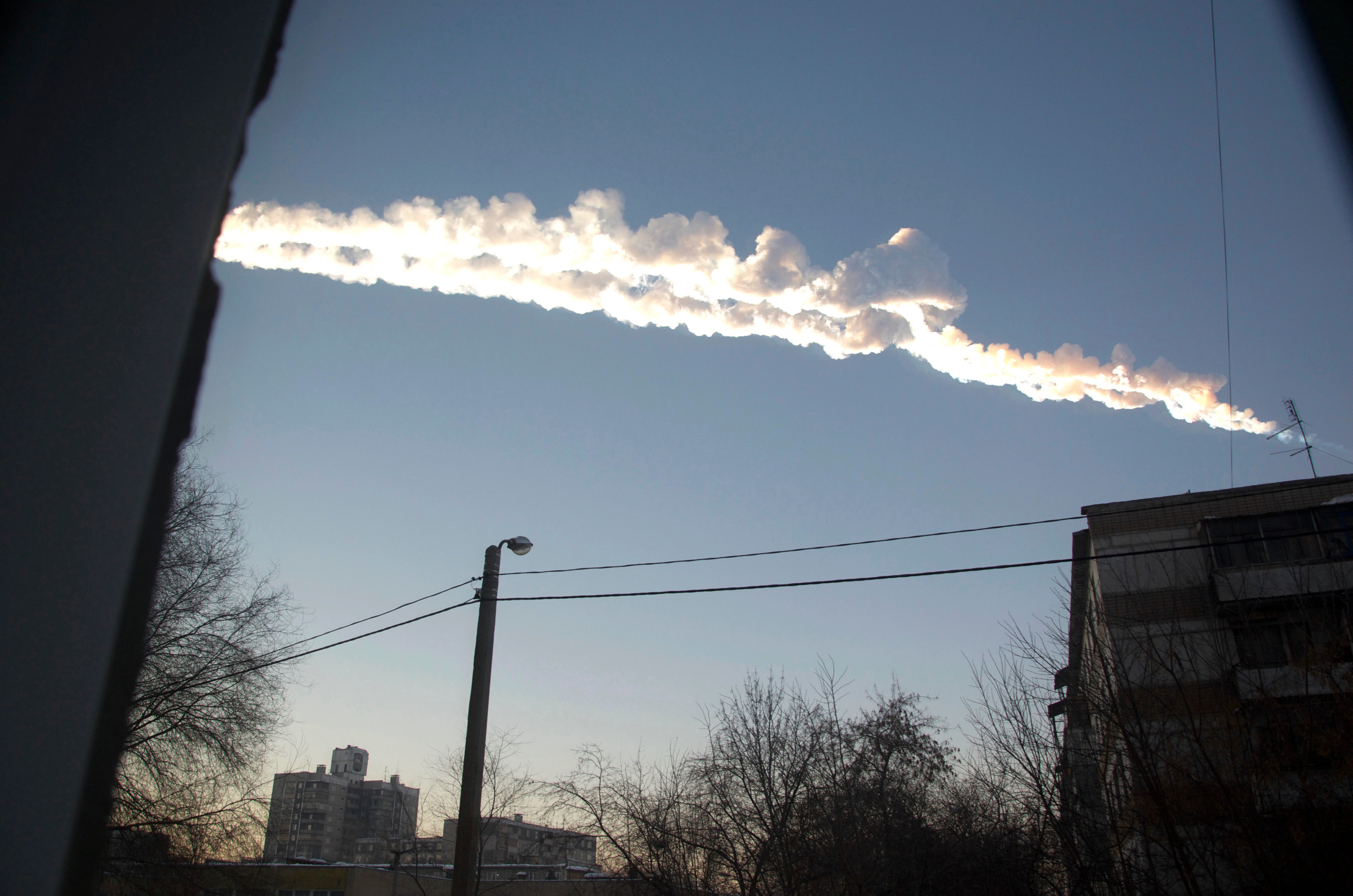
Ten years ago today, the sky exploded as the sun rose over Chelyabinsk, Russia.
On February 15, 2013, an asteroid crashed into Earth’s atmosphere at nearly 70,000 kilometers per hour. It was about the size of a tennis court and was shining brightly in the sky as if a second sun had appeared and was running from southeast to northwest.
Crashing through the air at hypersonic speed blew the asteroid’s surface off, leaving a thick trail of evaporated rock that screamed on Earth. A huge pressure began flattening the asteroid (scientists call this a “pancake”), and eventually the force overcame the asteroid about 40 kilometers above the ground. was flying more than ten times faster than a rifle bullet. These pieces themselves pancaked, producing a series of short but powerful flashes as they heated to white heat. Finally, the rest vaporized.
All this happened in just a few seconds, and the final blow came when the asteroid reached about 30 kilometers up. The remaining kinetic energy is instantly converted into heat. The resulting giant fireball briefly overpowered the Sun and released an energy equivalent to exploding 500,000 tons of TNT.
The shock wave from this explosion took nearly a minute to travel away from the blast and reach downtown Chelyabinsk, about 40 kilometers to the north. As the industrial city of a million people was beginning the day, an apparition burned across the sky. The horrific sight and long trail of steam caused people to go outside or to the windows to find out what had happened.
A terrific thunderclap shattered windows across the city, and splattered glass accounted for most of the approximately 1,500 people injured in the event. Fortunately, there were no fatalities and relatively minimal damage to infrastructure. Had the asteroid been larger, made of metal, or fallen at a steeper angle, the story might have been very different.
Chelyabinsk was the earth’s alarm clock. aloud.
It was the largest atmospheric impact since the Tunguska fireball of 1908, and a great learning experience for scientists. The asteroid smoke trail was observed by thousands of eyewitnesses and cameras, as well as satellites, and matched to each explosion event. The meteorite rained over a wide area, including one giant 0.5-ton chunk about 1 meter in diameter that landed in a lake and was later recovered. There’s even security camera footage of when its debris crashed into a frozen lake (and a dramatic plume of snow and water erupted into the air).
A meteorite recovered from the event has revealed the asteroid’s violent history. Impact veins traced them, leaving narrow cracks. These indicate that the 19-meter-wide Chelyabinsk rock was once part of a much larger asteroid that itself was impacted, breaking up debris that hit Earth and cracking it all over. rice field. Radiometric dating has shown that the first collision may have occurred 4.4 billion years ago when the solar system itself was less than 200 million years old. A crack in the Chelyabinsk rock weakened it, allowing it to collapse more easily high above the ground, creating its enormous shockwave. I touched the lives of thousands of Russians.
It is not clear which asteroid was its parent asteroid. Scientists have traced the trajectory of the Chelyabinsk impactor back into space and found it to be consistent with asteroids 2007 BD7 and 2011 EO40. One may be the mother, but this remains unknown.
Analyzing Chelyabinsk together with smaller, lower-energy events shows that such influencers hit us much more often than previously thought. Statistically speaking, Chelyabinsk-sized collisions occur about every 25 years, and thankfully most occur in marine or wilderness areas.
It’s a little alarming that astronomers didn’t see this asteroid coming long before it hit us. It’s dark. Just a few years ago, the 4-meter-wide asteroid 2008 TC3 was the first asteroid discovered before it hit Earth. Only six of her have been spotted since then before being affected, including her 2023 CX1, which just lit up the English Channel on February 13, 2023. They were small and posed no danger to us on the ground.
Well, after scaring you all about the impact, I have good news. In his ten years since Chelyabinsk, about 20,000 near-Earth asteroids have been discovered. That’s more than was found in all of history until 2013. New survey telescopes such as Pan-STARRS and the Zwicky Transient Facility are now online to improve detection and analysis. Techniques have been developed to accelerate discovery rates. Soon, the gigantic Vera Rubin Observatory and his NEO Surveyor space mission at NASA will also greatly increase the number of known asteroids that threaten Earth.
However, finding them is only the first step. Doing something about them is next. To that end, last September NASA launched the Double Asteroid Redirection Test (DART) mission. This smashed the 0.5-ton impactor into the 170-meter-wide asteroid Dimorphos, a satellite of the larger asteroid Didymos. The impact momentum changed the asteroid’s orbital period by more than 30 minutes. This far exceeded our expectations. The massive plume of material excavated by the impact and blown off the asteroid’s surface added a kick. This shows that such a spacecraft can be used to change the orbit of an asteroid.
A larger explosion might be able to deflect incoming space rock. Detonating a nuclear weapon near a small asteroid could vaporize much of its surface. This hot steam expands rapidly and acts like rocket exhaust, pushing the asteroid into a new and hopefully safer orbit. This method has some rather difficult problems to overcome. For example, detonating nuclear weapons in space is currently illegal under the Outer Space Treaty.
Since the Chelyabinsk impact, two probes have not only approached small asteroids, but also collected samples from them (one with Hyabusa-2, which has already dropped samples on Earth, and the other with OSIRIS-2). Rex plans to do so later this year). Both the asteroids Ryugu (about 1 kilometer in diameter) and Bennu (500 meters in diameter) are piles of rubble, essentially loose clusters of small rocks held together by their own little gravity. increase. All small asteroids are likely piles of debris, and this can affect how we dodge them. Their weaker structure means they can absorb spacecraft impacts more easily. Imagine trying to punch a box of peanuts. However, the DART mission also showed that impacts release large amounts of material, and that momentum transfer can actually increase impact effects.
Chelyabinsk surprised us. Small impacts like this can still slip through our guards, but spotting potential threats from space, and learning what we can do if we find Earth in our crosshairs, is an improvement. Big and dangerous asteroids are rare, but just look to Meteor Crater, Arizona, and you’ll see why they should be taken seriously. About 50,000 years ago, it may have pierced the desert more than a kilometer wide, wiping out the plants and animals that lived there at the time. This may be one of the most recent direct impacts on Earth, but it will not be the last.
Unless, of course, you do something to stop them.
This is an opinion and analysis article and the views expressed by the author or authors are not necessarily Scientific American.
