











Aerial seeding with a drone might seem like a good idea, but the seeds can easily fly away if left on the surface of the soil. The bio-inspired seed carrier is designed to help by pushing seeds into the ground with a corkscrew.
The device, known as E-seed, was created by a team at Carnegie Mellon University led by Asst. Professor Lining Yao. She was next inspired by the Elodium genus of plants that evolved her own strategies for surviving in arid climates.
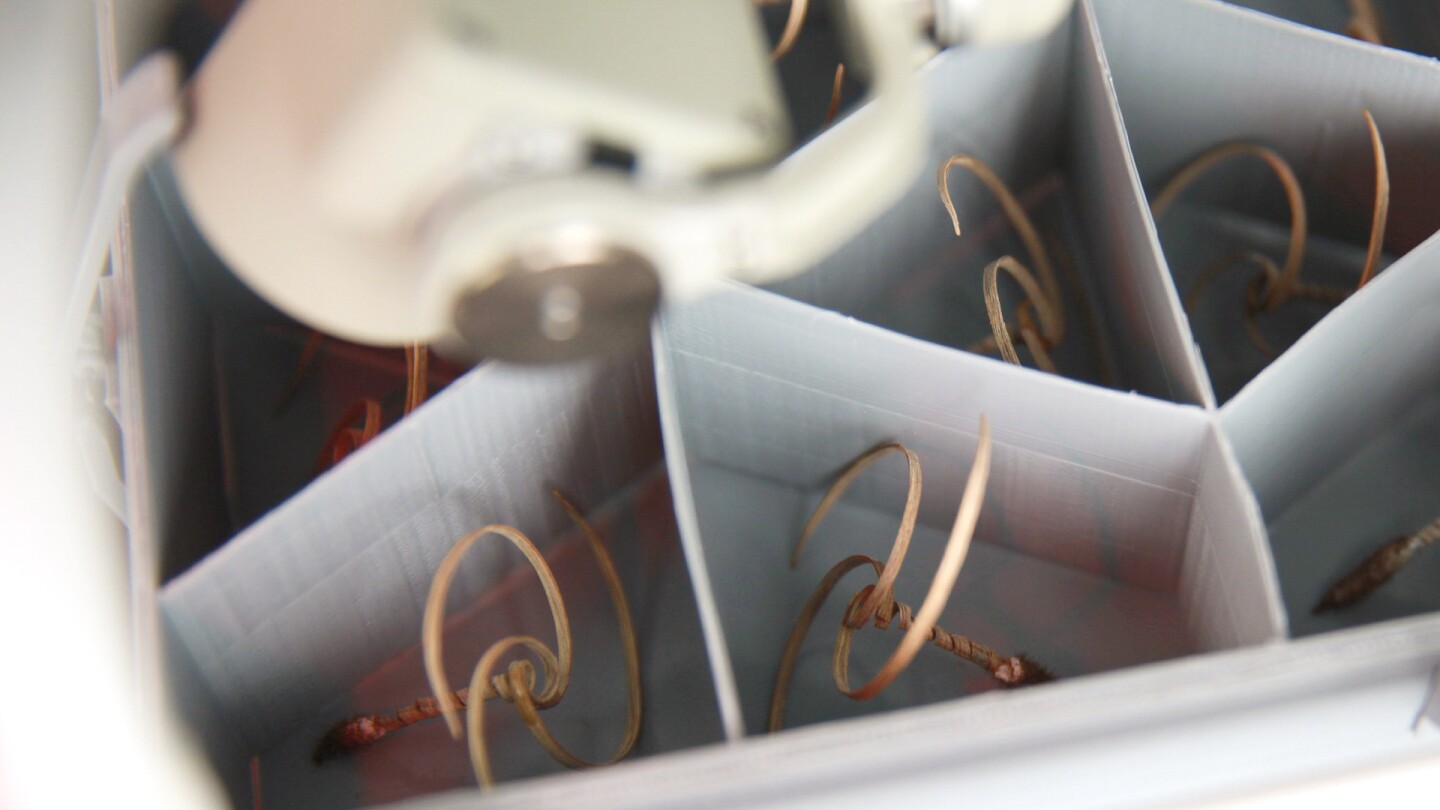
Some plants contain seeds in thin stems with a tightly coiled tail at the top. This stem separates from the main plant and falls to the ground. When wet from rain or high humidity, the stems spread their tails and stand upright, then burrow themselves and their seeds into the soil.
Carnegie Mellon University
Yao’s E-seed carrier works in a similar way, but is made from a moisture-sensitive white oak veneer. It also differs from Erodium’s seed stem in that it has three tails instead of his one. This feature helps it stand upright on relatively flat soil. Erodium doesn’t need much help in that regard, as its stems usually fall into small crevices.
Manufacture of bio-inspired seed carriers is currently a five-step process involving chemical cleaning and mechanical molding, but scientists are working to adapt it for use on an industrial scale. E-seeds can be dispersed by aerial drones in hard-to-reach areas, such as remote fields or landslide areas that need stabilization.
That said, field tests have further utilized the technology to provide non-seed payloads such as fertilizers and pest-killing nematodes.
“Seed burial has been actively studied for decades in terms of mechanics, physics and materials science, but until now no one had created an engineering equivalent.” says Yao. “Studying seed carriers is particularly rewarding because of their potential societal impact.
A paper on this study was recently published in the journal Nature.
Source: Carnegie Mellon University
