











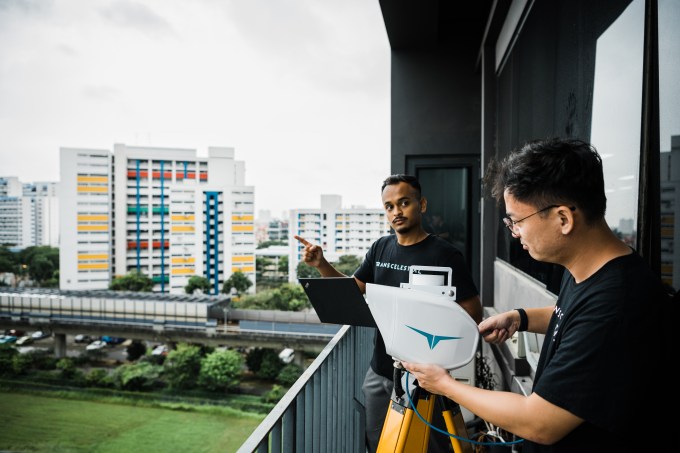
Members of the Transcelestial team installing CENTAURI devices in buildings
Transcelestial is on a mission to make the Internet more accessible by building a network of shoebox-sized devices that beam lasers at each other to create a fiber-like network. Today, the Singapore-based startup announced it has raised $10 million with the goal of expanding its wireless laser communication system in Indonesia, India, the Philippines, Malaysia, Singapore and the United States. It will eventually look to space and deploy wireless fiber optics from orbit.
The company’s A2 round was led by aerospace venture Airbus Ventures, with participation from Kickstart Ventures, Genesis Alternative Ventures, Wavemaker, Cap Vista, Seeds Capital, and investor In-Q-Tel. This brings the total amount Transcelestial has raised since its inception in 2016 to his $24 million. Previous backers include EDBI, Entrepreneur First, 500 Global, SparkLabs Global Ventures and Michael Seibel.
CEO Rohit Jha told TechCrunch that he and co-founder Mohammad Danesh believe that “connectivity is a human right” and that improving internet connectivity for at least 1 billion people will bring commercial and technological benefits. He said all decisions would be made.
They say the current Internet infrastructure is the main reason many people lack reliable Internet access. For example, submarine cables are expensive to build and link only two points. Terrestrial long-haul networks provide good coverage for Tier 1 cities, but leave small cities and towns behind. Middle and last mile distributions are often costly and face priority issues.
Transcelestial’s laser communication system eliminates underground cables, which are expensive to install and maintain, and radio frequency-based devices with complex spectrum licensing regulations. As a result, Transcelestial can significantly reduce the cost per bit, he said. Transcelestial’s shoebox-sized device called CENTAURI is already rolling out to South and Southeast Asian markets.
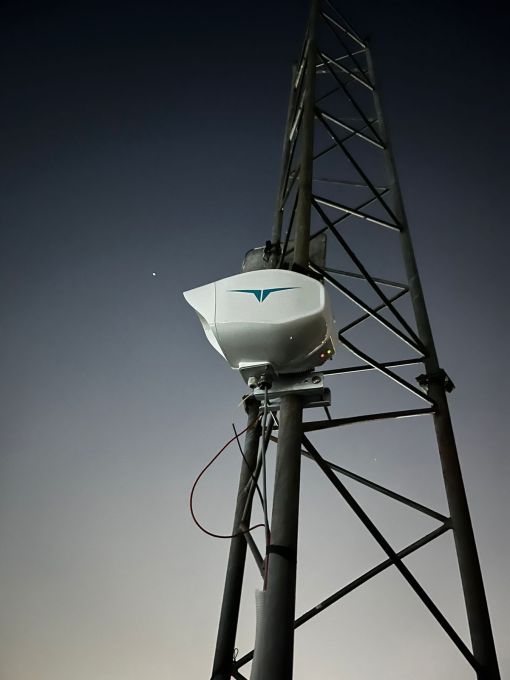
Centauri installation
The startup recently demonstrated at the University of Technology Sydney that its laser technology can provide 5G connectivity. The next destination is space. Transcelestial is committed to bringing its technology to the Low Earth Orbit (LEO) constellation, with the goal of deploying wireless fiber optics directly into cities and down from orbit.
In the meantime, the company plans to move beyond the Asian market and begin expanding early market access in the U.S., where 27% of rural people and 2% of urban people, according to a Pew Trust study. % lacked readily available Internet connectivity. Transcelestial plans to enter the US over the next 12 months by seeking cooperation with governments, businesses and telecom companies. Jha said the company is already secretly working with several of his ISPs and major West Coast enterprise his cloud and data center companies.
A portion of Transcelestial’s new funding will be used to prepare its production facility, the Terabit Factory, for supply chain uncertainty. The facility has the capacity to manufacture up to 2,4000 of his CENTAURI devices per year, according to Tracelestial, the largest deployment of any laser communications manufacturer in the world.
In a statement regarding the funding, In-Q-Tel Managing Director Clayton Williams said: We are pleased to expand this capability to enable space-based data backhaul for secure point-to-point communications from anywhere in the United States and the globe. ”
