











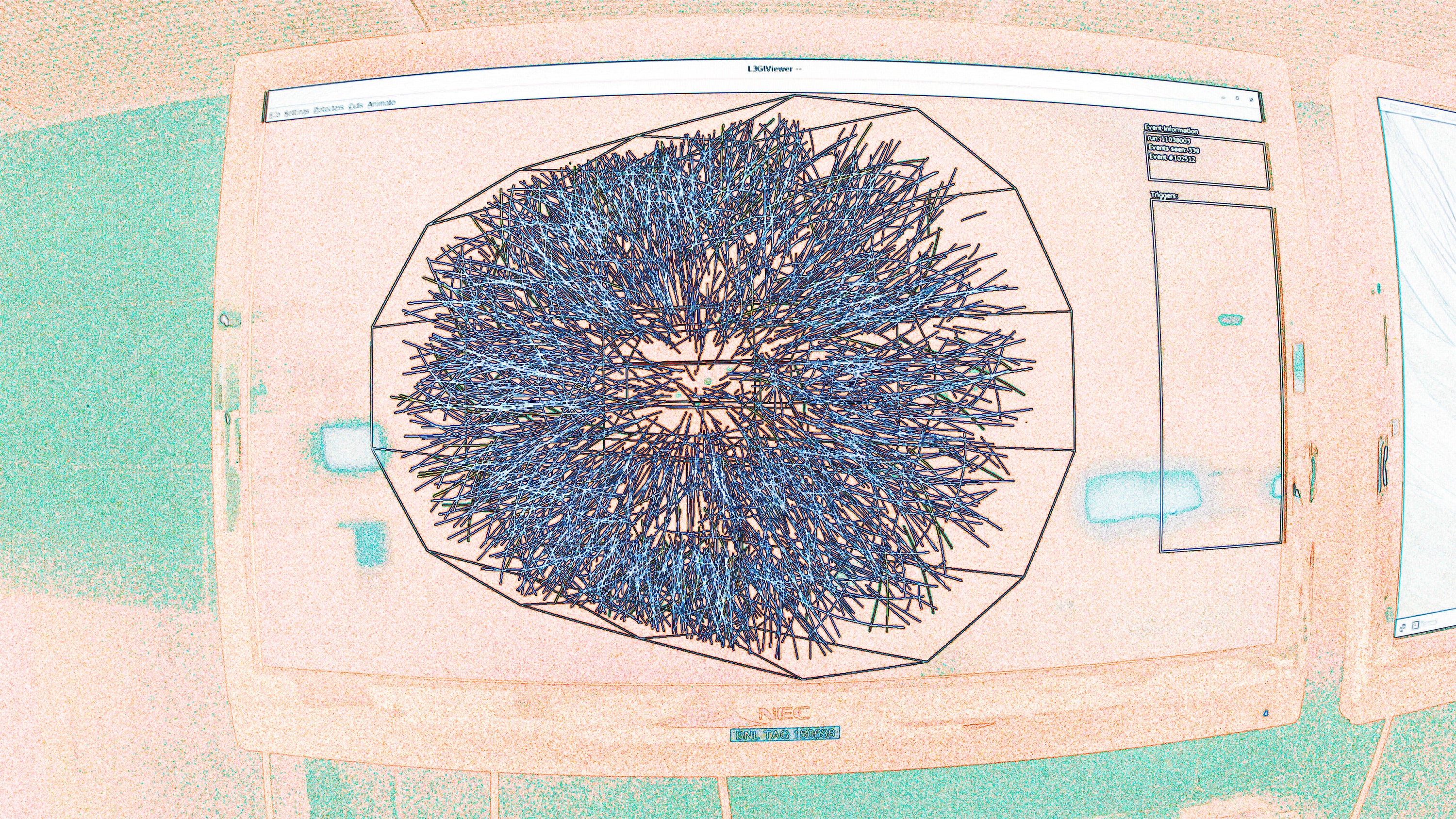
Scientists have found a way to glimpse the very beginning of time using one of the most complex and powerful machines on earth. This time machine is a particle accelerator, a glimpse into the nascent cosmic soup. Right after the Big Bang, our universe was a completely different place.
It started out so small, dense, and hot that the building blocks of our real atom couldn’t even form. Disassembled. quark. These quarks floated in a perfect fluid, with particles carrying the forces that held them together inside proton and neutron houses.
These particles are called gluons. Scientists have named this universe as producing fluid quark-gluon plasma. As we know it has not been found in nature since the beginning of time. But scientists can reproduce it in a particle accelerator. It was first officially observed at Brookhaven National Laboratory on Long Island, where researchers used the Relativistic Heavy Ion Collider, or RHIC for short, to shatter atoms.
RHIC’s 2.4-mile-long ring accelerates nuclei around its massive circle at 99.995% the speed of light 80,000 times per second. They are steered within this ring by giant superconducting magnets, cooled to near absolute zero at several points along the path, where her two opposing beams of atomic nuclei cross and collide. Collisions cause particle explosions and tiny droplets of quark-gluon plasma.
Here in Brookhaven, there are two collision points where detectors can monitor the action. sPHENIX and STAR. sPHENIX is brand new. STAR has been upgraded to be more sensitive than ever. Each detector is like an onion with layers of nested detectors, wires, cooling tubes, and electronics that extract massive amounts of data tracking to detect particles, energy, and motion. At the core of each device is a powerful superconducting magnet capable of bending charged particles. Identify particles of different masses.
These measurements reveal secrets about quark-gluon plasmas and provide an ever-greater understanding of how the tiniest pieces of matter behave. By studying this quark soup, scientists are learning about the origins of our primordial universe and the matter around us.
