











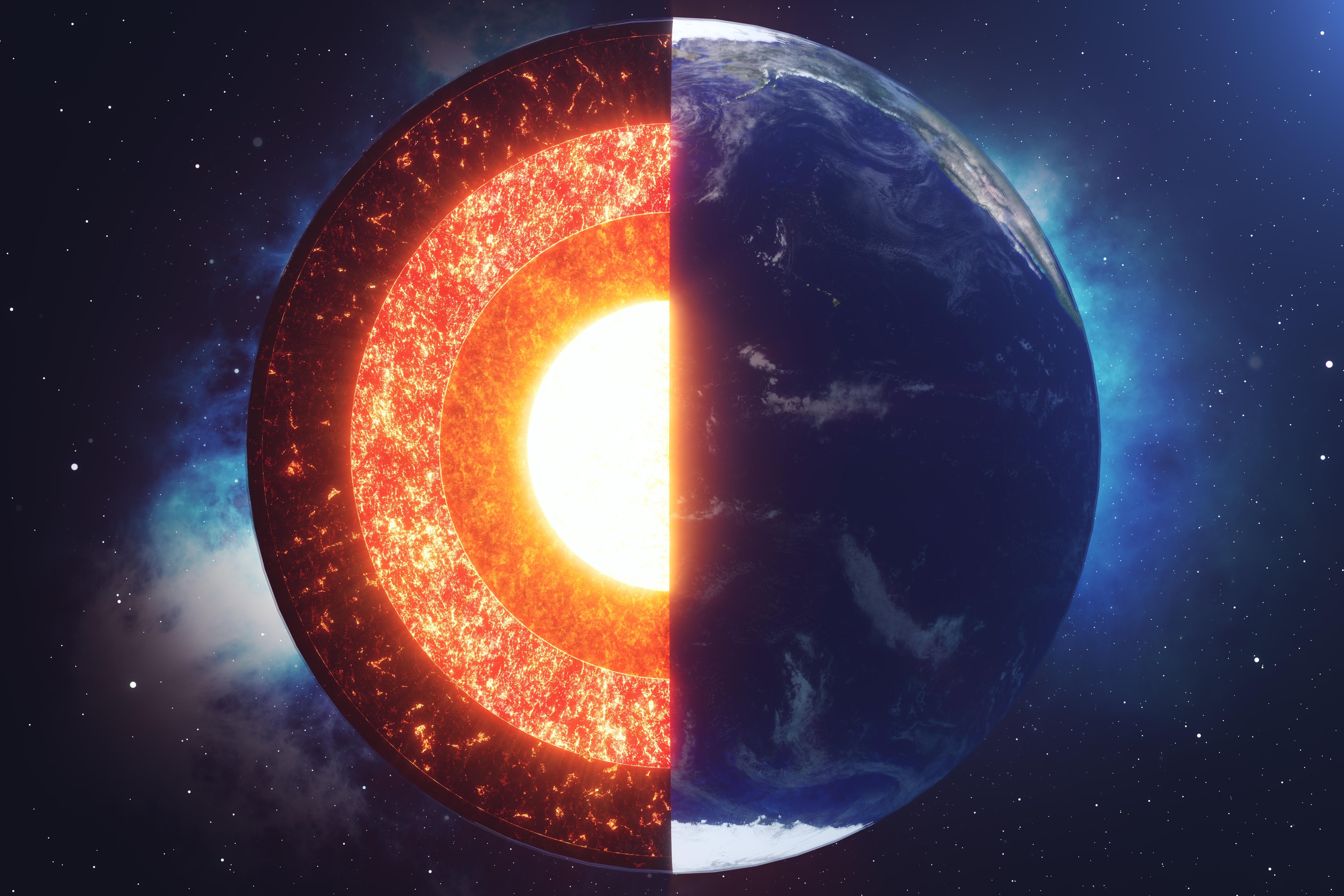
The Earth’s core consists of solid iron-nickel balls that rotate within layers of liquid metal. But that ball may not be as simple as it seems. New research suggests that the inner core contains its own inner core.
If so, this so-called innermost inner core could mark an early stage in Earth’s evolution.
Earth scientists have long observed that seismic waves from earthquakes behave differently when they pass through the core of the inner core than when they pass through the upper layers. This indicates some sort of organizational change. However, only a few usable seismic waves have been detected to pass through the innermost portion of this inner core, so scientists have few data points to study the composition of that region.
In a study published February 21 in the journal Nature Communicationsseismologists peered into the inner core using a new method of tracking echoes from earthquakes and found changes in the way waves travel in the innermost core, about 1,300 kilometers (808 miles) in diameter.
“This is a new way to sample the innermost core,” says Thành Sơn Phạm, a postdoctoral researcher in seismology at the Australian National University (ANU) and study co-author. “We strengthen the existing evidence for the existence of an innermost inner core, which should be a ball about half the size of the inner core.” The latter, he said, is just over 2,400 kilometers in diameter.
However, not all seismologists agree that the observations are clear evidence for the innermost core. The changes in wave behavior are likely accurate and consistent with previous research, says seismologist Dan Frost of the University of South Carolina. He was not involved in this research. But the results, he says, could be related to gradual changes within the core rather than a sharp, sharp transition: “I think it’s an unnecessary split into multiple layers.” ’” he says Mr. Frost.
The only way to look deep into the Earth’s interior is to use seismic waves like scanners. By analyzing how waves change as they pass through planets, researchers can learn the properties of the material through which they pass. To do this in the innermost core would require a strong earthquake on one side of the planet and a seismometer to pick up the wave exactly on the opposite side. Otherwise the wave signal will not pass directly through the heart of the core.
Phạm and his co-author, ANU seismologist Hrvoje Tkalčić, used a different strategy. As the number of seismic sensors deployed around the world continues to grow, it is becoming increasingly possible to detect very weak seismic signals, says Phạm. He and his Tkalčić collected signals from large earthquakes over magnitude 6.0. This earthquake produces waves that bounce around the Earth repeatedly. These echoing waves are small because they lose energy each time they pass the planet. But they pass through the inner core multiple times as they ripple through the interior. Researchers added up these repeated faint signals. “We can record signals that used to be very weak, but now we can strengthen them,” says Phạm.
The results reveal that there is a large difference in how wave angle affects velocity, a phenomenon called anisotropy, in the central part of the inner core compared to the outermost region. .
New research is unlikely to settle the debate about what this wave shift, which dates back to 2002, means. suggesting that a catastrophic event may have changed the latter’s ways. If so, the separate layers could act like planetary time capsules, says Phạm.
However, other geoscientists argue that the iron-nickel alloy that makes up the inner core has a gradual organization of crystallization patterns with increasing depth. This tissue change affects the way seismic waves travel through the innermost core. According to this hypothesis, the inner core has solidified basically consistently throughout Earth’s history, and the distinction between the innermost inner core is not very meaningful. There is no clear boundary between the inner cores.
Frost disputes the interpretation of Phạm and Tkalčić’s findings, but praises the use of multiple faint echoes of earthquakes to see the core of the Earth. It’s very valuable because it changes what you need to see inside the Earth,” says Frost. “This gives us access to more earthquakes.”
